
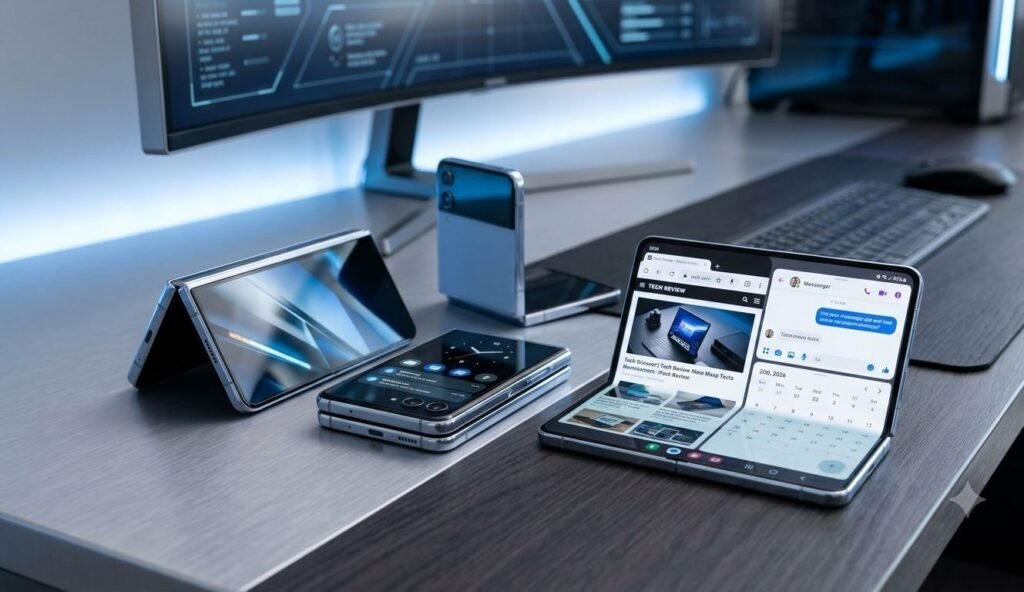
Foldable phones have been commercially available since 2019. That is long enough for the technology to mature from fragile curiosity to genuinely viable daily driver — and long enough to assess honestly who benefits from the form factor and who is paying a significant premium for something that doesn’t solve a real problem in their life.
The category has consolidated considerably. Early foldables from Samsung, Huawei, and Motorola were plagued by hinge reliability issues, software that didn’t adapt well to the changing screen geometry, and price points that put them firmly in the enthusiast-only bracket. Seven years on, the picture is different. Hinge mechanisms have improved to the point where manufacturers are offering multi-year durability ratings. Android has developed meaningful foldable-specific features. The price gap between flagship foldables and flagship slab phones has narrowed — though it hasn’t closed. And a clear taxonomy of form factors has emerged: book-style foldables that open to tablet size, and flip-style foldables that fold in half for pocketability.
What hasn’t changed is that foldables remain a considered purchase rather than a default one. They are heavier, thicker when folded, more expensive, and in some cases more fragile than comparable slab phones. The question this article answers is not whether foldables are impressive — they are — but whether one should be your next phone given your actual usage, budget, and tolerance for trade-offs.
The Two Form Factors: Books and Flips
The foldable phone category splits into two fundamentally different designs, and choosing between them is the first decision to make — they solve different problems.
Book-style foldables — exemplified by the Samsung Galaxy Z Fold series, Google Pixel Fold, and OnePlus Open — are phones that unfold to reveal a tablet-sized inner display, typically in the 7.5 to 8-inch range. When folded, they’re a relatively normal-width phone with a cover display. When open, they offer a significantly larger canvas for reading, watching video, multitasking with split-screen apps, and productivity tasks. The value proposition is consolidating phone and tablet into a single device — one thing you carry instead of two.
Flip-style foldables — exemplified by the Samsung Galaxy Z Flip series, Motorola Razr series, and Google Pixel 9 Pro Fold — fold in half horizontally, making a phone that fits into smaller pockets and bags when closed, at the cost of a crease and a hinge in the middle of the display when open. The outer cover screen has become a significant differentiator in recent generations — some flip foldables now have cover screens large enough to run apps independently, reducing how often you need to open the phone at all. The value proposition is pocketability and a distinctive form factor rather than additional screen real estate.
These two categories appeal to different people for different reasons, and conflating them in a single purchase decision leads to dissatisfaction. Someone who wants more screen space for productivity should be looking at book foldables. Someone who wants a phone that fits in a small bag or a jeans pocket should be looking at flip foldables. Both categories have moved significantly forward in 2026 — but they’re solving different problems.
What Has Actually Improved Since 2019
Hinge durability
The hinge is the most mechanically complex and failure-prone component of a foldable phone. Early foldables from 2019 and 2020 had hinges that allowed dust and debris ingress, crease visibility that worsened over time, and failure modes that weren’t well understood because the form factor was new.
Current-generation hinges are substantially more robust. Samsung rates the Z Fold 6 and Z Flip 6 hinges at 200,000 fold cycles — approximately 100 folds per day for five years. Independent testing by consumer durability labs has generally validated that current hinges hold up well through normal use. The crease in the inner display has not been eliminated but has become less pronounced on premium models, and the hinge mechanisms on leading devices now include effective dust and particle ingress protection. IPX8 water resistance — full submersion protection — is now standard on flagship foldables, removing a vulnerability that existed in earlier generations.
Software maturity
Android’s adaptation to foldable form factors has improved meaningfully. Google’s large screen guidelines for app developers have been in place long enough for most major apps to implement proper foldable layouts — split-screen use, adaptive layouts that respond to hinge angle, and taskbar integration are all more reliable in 2026 than they were in 2021 or 2022.
Samsung’s One UI and Google’s Pixel UI both have foldable-specific features that make the large inner display more useful: drag-and-drop between split-screen windows, app continuity when folding and unfolding, flex mode panels that use the hinge angle as a tripod (splitting the screen into camera viewfinder and controls), and multitasking workflows that would be genuinely useful on a slab phone but impractical.
The remaining software weakness is third-party app optimisation. Not all apps take advantage of the larger inner display — some simply letterbox or stretch a phone-format layout to fill the tablet-sized screen, which looks poor and wastes the available space. The situation has improved since 2019 but has not been fully resolved.
Cover screen utility
The cover screen on flip foldables has evolved from a small notification strip to a functional mini-display. The Samsung Galaxy Z Flip 6 and Motorola Razr 2024 both have cover screens large enough to run apps, respond to messages, check navigation, and interact with notifications without opening the phone. This has changed the flip foldable from a form-factor novelty into a device with a genuine interaction model: use the cover screen for quick tasks, open the phone for extended use.
On book foldables, the cover display has similarly matured — sized and specified close to a regular phone display rather than a secondary afterthought, enabling full phone functionality when the device is folded.
Price progression
The first Samsung Galaxy Fold launched at $1,980 in 2019. Flagship book foldables in 2026 start at around $1,799 for the Samsung Galaxy Z Fold 6 and similar devices, while entry-level flip foldables can be found for under $700 in some markets. The price premium over flagship slab phones has narrowed from roughly double to roughly 30 to 50 percent for book foldables, and flip foldables in particular have become competitive with upper-mid-range slab phones. This doesn’t make them cheap, but it changes the nature of the value calculation.
The Genuine Benefits of a Foldable Phone
A larger display for content consumption and reading
The inner display of a book foldable — typically in the 7.5 to 8-inch range — is genuinely better for reading long-form content, watching video, browsing image-heavy content, and using apps designed for larger screens. If you regularly read articles, ebooks, or documents on your phone and find yourself squinting or scrolling more than you’d like, the larger display is a meaningful quality-of-life improvement that translates to daily use, not just occasional use.
Multitasking that actually works
Split-screen multitasking on a slab phone is technically possible but practically cramped — two apps sharing a 6.1 to 6.7 inch display leaves each with less space than is comfortable for sustained use. On the inner display of a book foldable, split-screen becomes genuinely usable — two apps each receiving roughly the equivalent of a medium tablet’s worth of screen. Having a document open alongside a note-taking app, a video call alongside reference material, or a map alongside a messaging thread is a qualitatively different experience on a 7.8-inch display than on a 6.5-inch one.
Replacing a phone and tablet with one device
For users who currently carry both a phone and a tablet, or who regularly wish they had their tablet with them when they only have their phone, a book foldable makes a compelling consolidation argument. One device, one charger, one cellular data plan, one set of apps — with both phone and tablet functionality available on demand. Whether this consolidation is worth the foldable premium depends entirely on how much you currently use a tablet and how much you value having that functionality in your pocket.
Pocketability for flip foldables
A flip foldable folded in half is genuinely smaller than a slab phone — closer to the dimensions of a compact camera or a thick card wallet than a modern large-screen phone. For users who find current smartphones awkwardly large in small pockets, small bags, or formal clothing without generous pockets, the flip form factor solves a real problem. The trade-off is the hinge, crease, and thickness when unfolded — but for pocketability as a priority, flip foldables deliver.
The cover screen as a low-distraction interface
An underappreciated benefit of flip foldables with large cover screens is the ability to complete most quick phone interactions without fully opening the device. Checking a notification, replying to a message, skipping a song, checking the time, or glancing at navigation are all achievable on the cover screen without triggering the full phone experience. For users who find their phone a source of distraction or who want to limit full-screen engagement, the cover screen provides a lower-friction, lower-distraction interface mode — phone-like functionality without the full phone.
The Honest Trade-Offs That Still Exist
Weight and thickness
Current flagship book foldables weigh between 250 and 300 grams — roughly 70 to 100 grams heavier than comparable slab phones. This is noticeable in a pocket, noticeable in the hand during extended use, and particularly noticeable if you’re accustomed to a lighter device. Flip foldables are closer to slab phone weight when unfolded, but are thicker — the folded hinge mechanism adds bulk that doesn’t compress away.
The crease
Every foldable phone with an inner display has a crease — a visible, tactilely perceptible indentation where the display folds. Manufacturers have reduced the visibility and depth of the crease significantly compared to early generations. On the best current displays, it is barely visible when the screen is lit and the device is held at a normal viewing angle. Under certain lighting conditions, held at certain angles, or when the screen is at rest, it becomes more apparent. The crease is a real feature of the product and anyone who says otherwise is selling you something. In practice, most users stop noticing it within days of regular use — but it is worth handling a display unit before purchasing to assess your personal tolerance.
Camera system compromises
The internal space constraints of a folding mechanism mean that book foldables cannot accommodate the same camera hardware as slab flagships at equivalent price points. The Samsung Galaxy Z Fold 6’s camera system is good — competitive with upper-mid-range flagships — but does not match the Samsung Galaxy S24 Ultra’s periscope telephoto and sensor package. If you take photography seriously and camera performance is your primary smartphone priority, a slab flagship at the same or lower price will outperform a book foldable. Flip foldables have the opposite problem — the folded form factor actually benefits from having a cover screen that can double as a viewfinder for selfies using the main cameras, which are higher quality than front-facing cameras on slab phones.
Durability and repairability
Foldable phones have more failure points than slab phones — the hinge mechanism, the inner display with its polymer screen protector, and the folding connectors that run through the hinge are all components without equivalents in slab phone design. Repair costs for foldable inner displays are significantly higher than for slab phone screens. Insurance and extended warranty coverage is more important to evaluate before purchasing a foldable than it is for a conventional smartphone.
The polymer screen coating on inner displays — required to allow the screen to flex — is softer than the glass on slab phone displays and more susceptible to scratching and indentation from fingernails or sharp objects. Most foldables ship with a pre-applied screen protector on the inner display that should not be removed — a detail that catches some buyers by surprise.
Price premium
At the book foldable tier, you are paying a meaningful premium over a comparable slab flagship. The Samsung Galaxy Z Fold 6 at $1,799 competes for the same budget as the Samsung Galaxy S24 Ultra at $1,299, which outperforms it in camera and raw processing speed while being lighter and more pocketable in a conventional sense. The foldable premium buys you the larger inner display and the tablet consolidation — if those aren’t features you’ll use daily, the value equation doesn’t work.
Who Should Actually Buy a Foldable
Power users who genuinely multitask on their phone
If you regularly find yourself wishing you had more screen space for simultaneous apps — working in multiple documents, referencing one app while typing in another, video calling while looking at shared content — a book foldable’s split-screen capability on a large inner display is a genuine productivity upgrade. The key word is genuinely: if you occasionally think “more screen would be nice” but don’t actually run two apps simultaneously in practice, the premium isn’t justified.
People who carry both a phone and a tablet
If your current setup involves a phone and a small tablet, and you regularly wish you had your tablet when you only have your phone, a book foldable is the device this situation is designed for. One device, always in your pocket, that can function as both. The consolidation argument is strongest for people who travel frequently, commute on public transport with long journeys, or have workflows that genuinely use a tablet regularly.
Anyone who reads extensively on their phone
For heavy readers of long-form content — articles, ebooks, digital comics, academic papers, PDFs — the larger inner display of a book foldable is a meaningful ergonomic improvement over a slab phone. More words per page means less scrolling and a more book-like reading experience. If reading is a significant portion of your phone use, the display upgrade has clear daily value.
Small-pocket users who prioritise pocketability
For users of smaller bags, formal clothing, or anyone who finds modern large-screen phones awkward to pocket, a flip foldable folded to half size genuinely solves a real problem. This is especially relevant for users who have been making do with a smaller slab phone because they found larger ones impractical — a flip foldable offers a large screen when needed and a compact footprint when not.
Tech enthusiasts comfortable with trade-offs
Some users simply enjoy using well-engineered interesting technology, value being an early adopter of mature-but-not-ubiquitous form factors, and are comfortable managing the trade-offs of weight, crease, and camera compromise in exchange for the novel experience. This is a legitimate purchasing motivation — not every purchase needs a productivity justification. If you fall into this category, you know it, and the foldable market in 2026 offers genuinely excellent engineering worth experiencing.
Who Should Not Buy a Foldable
Anyone who prioritises camera performance above all else
At any given price point, a slab flagship will outperform a book foldable in camera hardware. If photography is your primary smartphone use case — if you care deeply about telephoto quality, low-light performance, or video recording capabilities — the slab flagship at the same budget is the better camera. Flip foldables partially escape this rule because their folded design enables interesting camera workflows, but even they don’t match the top-tier slab flagship camera systems.
Users who drop their phones regularly
Foldable phones are more complex mechanical devices than slab phones and have more expensive failure points. If your phone history includes regular drops, cracked screens, and general rough handling, a foldable is a higher-risk purchase. The inner display polymer coating scratches more easily than glass. The hinge is a mechanical component that doesn’t exist in slab phones. Repair costs are higher. Durability-focused cases that would protect a slab phone adequately may not fully protect the more complex geometry of a foldable.
Budget-conscious buyers
There is no compelling foldable option at genuinely budget price points. The most affordable current flip foldables start at around $700, and book foldables at around $1,400. For users who want good value for money, the slab phone market at $400 to $800 offers flagship-level performance, excellent cameras, and three to four years of software support without the foldable premium. If price-to-performance is your primary evaluation metric, foldables are not the answer.
Anyone whose primary phone use is gaming
Gaming on a large inner display has intuitive appeal, but the combination of heavier weight for extended holding, the crease visible during full-screen gaming, the thermal management challenges of the folded form factor’s thicker chassis, and the generally lower screen-to-body ratio compared to gaming-optimised slab phones makes foldables a suboptimal gaming device at equivalent price points.
Users who want the thinnest, lightest device possible
Modern slab phones have reached extraordinary thinness and weight optimisation — some flagship devices are under 7mm thick and under 185 grams. No current foldable competes on these dimensions. If lightness and thinness are priorities, foldables move in the wrong direction on both axes.
The Best Foldable Phones in 2026
Samsung Galaxy Z Fold 6
Best Book Foldable: The Benchmark, Now Refined
| Specification | Detail |
|---|---|
| Inner display | 7.6-inch Dynamic AMOLED 2X, 2160 × 1856, 120Hz |
| Cover display | 6.3-inch Dynamic AMOLED 2X, 2376 × 968, 120Hz |
| Processor | Snapdragon 8 Gen 3 for Galaxy |
| RAM | 12GB |
| Storage | 256GB / 512GB / 1TB |
| Camera | 50MP main / 10MP 3× telephoto / 12MP ultrawide |
| Battery | 4,400mAh |
| Charging | 25W wired / 15W wireless |
| Hinge rating | 200,000 folds |
| Water resistance | IPX8 |
| Weight | 239g |
| OS updates | 7 years Android updates |
Samsung has been iterating on the Z Fold formula longer than anyone, and the Z Fold 6 represents the most refined version of the book foldable to date. The changes from the Z Fold 5 are evolutionary rather than revolutionary — a slightly flattened chassis that sits more evenly on a flat surface, a marginally lighter weight, and further software refinement in One UI 6.1.1’s foldable-specific features. The cover display has grown slightly and is now genuinely usable as a primary phone screen when the device is folded.
The inner display remains the category benchmark — 7.6 inches at 120Hz with Samsung’s best AMOLED panel technology. The crease is present but has become less pronounced through successive iterations. The hinge is tight and confident, opening to a flat position and holding any angle reliably — better than most competitors at flex mode tasks like propping the phone for video calls.
The Galaxy AI features — generative editing in the camera app, live translation, note assist in Samsung Notes, and cross-app AI functions — are the most integrated AI package in a foldable and take particular advantage of the large inner display for tasks like side-by-side document and AI chat.
The camera system is the most frequently cited limitation: the 10MP 3× telephoto compares unfavourably with the periscope telephoto on the Galaxy S24 Ultra at the same price range. For users who don’t require extreme telephoto reach, the camera system is good — but it’s the clearest specification where the foldable form factor exacts a cost.
Pros:
- Most refined book foldable on the market — seven years of hinge and software iteration
- 7.6-inch inner display is the largest in this roundup at the highest quality
- Seven years of Android and security updates — the best software commitment in this category
- Comprehensive Galaxy AI integration takes advantage of the large display
- IPX8 water resistance and 200,000-fold hinge rating
Cons:
- 10MP 3× telephoto is the weakest camera specification relative to price in this roundup
- 239g is the heaviest device in this roundup
- 25W wired charging is slower than some competitors at this price tier
- Price premium over slab flagships remains significant
- Thicker than slab phones when folded — noticeable in a pocket
Who Should Buy This: Samsung ecosystem users who want the most proven, best-supported book foldable available. Anyone who values long-term software support and wants confidence in a seven-year update commitment. Users who want the most polished One UI foldable experience.
Who Should Skip This: Users who prioritise camera telephoto performance — the Galaxy S24 Ultra is the better choice at a similar budget. Those who want the lightest possible foldable.
Google Pixel 9 Pro Fold
Best for Camera and Pure Android: Google’s Maturing Foldable
| Specification | Detail |
|---|---|
| Inner display | 8.0-inch LTPO OLED, 2076 × 2152, 120Hz |
| Cover display | 6.3-inch Actua OLED, 2424 × 1080, 120Hz |
| Processor | Google Tensor G4 |
| RAM | 16GB |
| Storage | 256GB / 512GB |
| Camera | 50MP main / 10.5MP 5× periscope telephoto / 10.5MP ultrawide |
| Battery | 4,650mAh |
| Charging | 21W wired / 21W wireless |
| Hinge rating | Not published (tested to industry standard) |
| Water resistance | IPX8 |
| Weight | 257g |
| OS updates | 7 years Android updates |
Google’s Pixel Fold lineup took a generation longer than Samsung’s to reach full confidence, and the Pixel 9 Pro Fold is the device where Google’s book foldable argument becomes compelling on its own terms rather than as an alternative-to-Samsung choice. The 8.0-inch inner display is the largest in this roundup. The 5× periscope telephoto — a first for a Google foldable — closes the camera gap that was the original Pixel Fold’s most significant weakness. And the Tensor G4’s on-device AI processing powers Pixel-exclusive AI camera features that leverage the large inner display for editing and organisation tasks.
The Pixel’s camera system is the strongest in this book foldable roundup. The combination of Google’s computational photography processing, a 50MP main sensor, and a proper periscope telephoto at 5× optical zoom produces results that compete meaningfully with non-foldable flagships — a departure from the pattern of camera compromise that typically characterises book foldables.
Gemini integration is deeper on Pixel than on any other Android device — the AI assistant’s multimodal capabilities are enhanced by the large inner display, and features like Circle to Search, Live Translate, and Pixel Screenshots (which catalogues and makes searchable everything you’ve seen on your screen) are more useful on the larger canvas.
The Tensor G4 is competitive but not class-leading in raw processing performance against Snapdragon 8 Gen 3 — thermal management under sustained workloads is occasionally a limitation. Wired charging at 21W is slower than ideal at this price tier.
Pros:
- Largest inner display in this roundup at 8.0 inches
- 5× periscope telephoto — closes the camera gap that defined earlier Google foldables
- Google’s computational photography produces the best camera results of any book foldable in this roundup
- Deepest Gemini and Pixel AI integration on any foldable
- Seven years of Android updates directly from Google
- 16GB RAM — most in this roundup, future-proofing for multitasking demands
Cons:
- Tensor G4 trails Snapdragon 8 Gen 3 in sustained performance benchmarks
- 21W wired charging is the slowest in this roundup at this price point
- Heavy at 257g
- Less established foldable software ecosystem than Samsung’s One UI
- Higher price than Z Fold 6 in most markets
Who Should Buy This: Users who prioritise camera performance and want the best imaging in a book foldable. Pure Android enthusiasts who want Google’s software directly. Users who heavily use Google’s AI features and want the deepest Gemini integration available.
Who Should Skip This: Users who want the fastest charging available. Those who prefer Samsung’s established One UI foldable software ecosystem. Budget-conscious foldable buyers — this is the most expensive book foldable in the roundup.
OnePlus Open 2
Best Value Book Foldable: Premium Specs, Lower Price
| Specification | Detail |
|---|---|
| Inner display | 7.82-inch LTPO AMOLED, 2268 × 1984, 120Hz |
| Cover display | 6.31-inch AMOLED, 2484 × 1116, 120Hz |
| Processor | Snapdragon 8 Gen 3 |
| RAM | 16GB |
| Storage | 512GB |
| Camera | 50MP main / 64MP 3× periscope telephoto / 48MP ultrawide |
| Battery | 5,000mAh |
| Charging | 67W wired / 50W wireless |
| Hinge rating | 200,000 folds |
| Water resistance | IPX4 |
| Weight | 245g |
| OS updates | 4 years Android updates |
The OnePlus Open 2 makes the most aggressive value argument in the book foldable category. Against the Galaxy Z Fold 6 and Pixel 9 Pro Fold, it offers a larger battery, significantly faster wired and wireless charging, a higher-resolution telephoto camera, and 16GB of RAM — at a noticeably lower price. The specifications sheet is the best in this roundup by a significant margin.
The 67W wired charging and 50W wireless charging are the fastest in the category and represent a genuine practical advantage — a full charge in under an hour, wireless charging that competes with the wired charging speed of some competitors. The 5,000mAh battery is the largest in this roundup and, combined with the efficient Snapdragon 8 Gen 3, delivers all-day battery life with margin to spare.
The camera system led by a 64MP 3× periscope telephoto is impressive on paper and good in practice — competitive with book foldable alternatives and better than the Z Fold 6’s telephoto in particular. The ultrawide at 48MP is the highest resolution ultrawide in this roundup.
The honest trade-offs are software update commitment — four years of Android updates versus seven years on Samsung and Google — and water resistance rated at IPX4 (splash resistant) rather than IPX8 (submersion rated). OxygenOS, OnePlus’s Android skin, is clean and fast but has a smaller support community and fewer foldable-specific optimisations than Samsung’s One UI after years of iteration.
Pros:
- Most competitive price in the book foldable category with premium specifications
- Fastest charging in this roundup — 67W wired, 50W wireless
- Largest battery at 5,000mAh
- 64MP periscope telephoto outperforms the Z Fold 6’s camera on paper and in many shooting scenarios
- 16GB RAM standard across all configurations
Cons:
- IPX4 water resistance — splash resistant only, not submersion rated
- Four years of Android updates versus seven years for Samsung and Google
- OxygenOS foldable software ecosystem less mature than One UI
- Less established brand trust for long-term device support than Samsung or Google
- Cover display slightly narrower than competitors — less comfortable for one-handed use when folded
Who Should Buy This: Value-conscious buyers who want book foldable performance at the lowest price in this roundup. Users who prioritise fast charging and battery life. Anyone who wants the best camera specifications in a book foldable at this price point.
Who Should Skip This: Users who prioritise long-term software support — four years is the shortest update commitment in this roundup. Those in environments where full water resistance is important. Users who want the most mature foldable software experience.
Samsung Galaxy Z Flip 6
Best Flip Foldable: Cover Screen Utility, Proven Reliability
| Specification | Detail |
|---|---|
| Outer display | 3.4-inch Super AMOLED, 748 × 720, 60Hz |
| Inner display | 6.7-inch Dynamic AMOLED 2X, 2640 × 1080, 120Hz |
| Processor | Snapdragon 8 Gen 3 for Galaxy |
| RAM | 12GB |
| Storage | 256GB / 512GB |
| Camera | 50MP main / 12MP ultrawide |
| Battery | 4,000mAh |
| Charging | 25W wired / 15W wireless |
| Hinge rating | 200,000 folds |
| Water resistance | IPX8 |
| Weight | 187g |
| OS updates | 7 years Android updates |
The Galaxy Z Flip 6 is the flip foldable market leader and the device against which all flip competitors are measured. The 3.4-inch cover screen — the largest Samsung has shipped on a Flip — runs a modified version of One UI that allows full app use, including Samsung’s Galaxy AI features, without opening the phone. The combination of flex mode (using the hinge as a stand for hands-free photography or video calls), the cover screen as a viewfinder for taking selfies with the main cameras, and the compact folded footprint makes the Z Flip 6 the most versatile pocketable flagship available.
The seven-year Android update commitment matches the Z Fold 6 and is the best software longevity promise in the flip foldable category. At 187g, it is meaningfully lighter than any book foldable and comparable in weight to many slab phones — the pocketability and weight advantages of the flip form factor are real and daily.
The camera system is a genuine two-camera setup with a 50MP main sensor — a significant improvement from earlier Flip generations that used lower-resolution main sensors. Image quality is competitive with upper-mid-range slab phones, though it lacks the telephoto that differentiates premium slab flagships. The flex mode camera workflow — phone propped at hinge angle, large shutter button on the lower half of the display — is one of the most practically useful unique features of the flip form factor.
The battery at 4,000mAh is the largest ever shipped in a Galaxy Flip but is still the smallest in this roundup — the compact folded form factor constrains battery size, and heavy users may find themselves reaching for a charger by evening.
Pros:
- Most proven flip foldable on the market with seven-year update commitment
- 3.4-inch cover screen enables full app use without opening the phone
- Flex mode camera workflow is genuinely useful for hands-free and group photography
- IPX8 water resistance — full submersion protection
- Lightest device in this roundup at 187g
- Competitive price for a flagship-level flip foldable
Cons:
- No telephoto camera — a significant gap versus slab flagships at equivalent price
- 4,000mAh battery is the smallest in this roundup
- 25W wired charging is the slowest in this roundup
- Cover screen at 60Hz refresh rate feels dated compared to 120Hz inner display
- Inner display crease is more visible than on book foldable competitors due to the more aggressive fold angle
Who Should Buy This: Users who want a compact, pocketable flagship with proven software support. Small-pocket users who find current slab phones too large to carry comfortably. Anyone who wants to use the cover screen as a primary low-distraction interface. Users who want the established Samsung ecosystem with the best flip form factor available.
Who Should Skip This: Users who require telephoto camera capability — the lack of a telephoto is the most significant camera limitation in this roundup. Heavy users who need all-day battery with margin — the 4,000mAh battery may fall short. Those who want the fastest charging available.
Motorola Razr 2024 (Razr 50 Ultra)
Best Flip Alternative: Largest Cover Screen, Premium Design
| Specification | Detail |
|---|---|
| Outer display | 4.0-inch pOLED, 1272 × 1080, 165Hz |
| Inner display | 6.9-inch pOLED, 2640 × 1080, 165Hz |
| Processor | Snapdragon 8s Gen 3 |
| RAM | 12GB |
| Storage | 256GB / 512GB |
| Camera | 50MP main / 50MP 2× telephoto |
| Battery | 4,000mAh |
| Charging | 45W wired / 15W wireless |
| Hinge rating | Not published |
| Water resistance | IP48 |
| Weight | 189g |
| OS updates | 3 years Android updates |
The Motorola Razr 2024 Ultra makes its case against the Galaxy Z Flip 6 primarily through two differentiators: a larger 4.0-inch cover screen — the biggest on any flip foldable — and a 165Hz refresh rate on both displays that makes scrolling and animation noticeably smoother than the Z Flip 6’s 120Hz inner and 60Hz outer displays.
The 4.0-inch cover screen is a genuinely usable display — running a full Android interface including Moto AI features, app access, and Google Assistant. At this size, the cover screen transitions from a convenience to a primary interaction surface for many use cases — checking emails, replying to messages, browsing at a glance. The case for opening the phone becomes primarily about extended reading or content creation rather than most quick interactions.
The 45W wired charging outperforms the Z Flip 6’s 25W — a full charge in under an hour, compared to nearly ninety minutes on Samsung’s flip. The addition of a 50MP 2× telephoto camera — absent on the Z Flip 6 entirely — addresses one of the flip foldable format’s typical camera limitations.
The honest limitations are the software update commitment — three years of Android updates versus Samsung’s seven — and the Snapdragon 8s Gen 3 processor, which is the mid-tier version of Qualcomm’s flagship chip and trails the full Snapdragon 8 Gen 3 in sustained performance. IP48 water resistance protects against dust and directed water jets but is not the full IPX8 submersion rating of the Z Flip 6.
Pros:
- 4.0-inch cover screen — the largest on any flip foldable, genuinely app-capable
- 165Hz refresh rate on both displays — the smoothest display in this roundup
- 45W wired charging significantly faster than Galaxy Z Flip 6
- 50MP 2× telephoto — the only flip foldable in this roundup with a dedicated telephoto
- Premium design with leather or vegan leather back options — distinctive aesthetics
Cons:
- Three years of Android updates — shortest software commitment in this roundup
- Snapdragon 8s Gen 3 is the mid-tier chip — trails full 8 Gen 3 in benchmarks
- IP48 rather than IPX8 — not submersion rated
- Motorola’s long-term software support track record is less established than Samsung’s
- 4,000mAh battery same as Z Flip 6 despite larger cover screen drawing more power
Who Should Buy This: Users who want the largest, most capable cover screen available on a flip foldable. Anyone for whom display smoothness at 165Hz is a priority. Users who want a telephoto camera on a flip foldable. Those drawn to distinctive design options beyond the standard glass-and-aluminium finish.
Who Should Skip This: Users who prioritise long-term software support — three years is the shortest commitment in this roundup. Those in environments where submersion water resistance is important. Users who want the most proven, established flip foldable ecosystem.
Side-by-Side Comparison Table
| Product | Type | Inner Display | Weight | Cameras | Battery | Charging | Updates | Best For |
|---|---|---|---|---|---|---|---|---|
| Samsung Galaxy Z Fold 6 | Book | 7.6″ 120Hz | 239g | 50MP + 10MP 3× tele | 4,400mAh | 25W | 7 years | Best all-round book foldable |
| Google Pixel 9 Pro Fold | Book | 8.0″ 120Hz | 257g | 50MP + 10.5MP 5× tele | 4,650mAh | 21W | 7 years | Best camera, pure Android |
| OnePlus Open 2 | Book | 7.82″ 120Hz | 245g | 50MP + 64MP 3× tele | 5,000mAh | 67W | 4 years | Best value, fastest charging |
| Samsung Galaxy Z Flip 6 | Flip | 6.7″ 120Hz | 187g | 50MP + 12MP UW | 4,000mAh | 25W | 7 years | Best proven flip |
| Motorola Razr 2024 Ultra | Flip | 6.9″ 165Hz | 189g | 50MP + 50MP 2× tele | 4,000mAh | 45W | 3 years | Biggest cover screen, telephoto |
What to Look For When Buying
Decide on the form factor before the brand
Book or flip is a more consequential decision than which brand within each category. Book foldables are about more screen; flip foldables are about smaller package. Be honest about which problem you’re actually trying to solve — extra screen real estate or pocketability — and choose the form factor accordingly. Buying a book foldable because you like the idea of a larger screen but not having a specific workflow that uses it will lead to regret. Buying a flip foldable when your actual need is more screen space will leave you disappointed.
Software update commitment matters more on foldables
Foldables are expensive devices and most buyers reasonably expect to keep them for three or more years. The software update commitment — how many years of Android and security updates the manufacturer promises — directly affects how long the device remains secure and feature-current. Samsung and Google’s seven-year commitment is the category benchmark. OnePlus’s four years and Motorola’s three years are meaningful limitations for long-term buyers at premium prices.
Assess the cover display for flip foldables
The cover screen on a flip foldable is increasingly a differentiator rather than an afterthought. Before purchasing, spend time with the cover screen on a display unit: is the display large enough for your likely quick-interaction use cases? Does it run the apps you’d want on it? Is the UI well adapted for the smaller, taller form factor? A large, capable cover screen meaningfully changes how you interact with the device daily.
Water resistance rating
IPX8 (submersion rated to 1.5 metres for 30 minutes) versus IPX4 or IP48 (splash/jet resistant) is a meaningful practical difference for a device you carry everywhere. If you’re in environments where phone contact with water is likely — rain, poolside, beach, kitchen, bathroom — prioritise IPX8 rated devices. The Galaxy Z Fold 6, Pixel 9 Pro Fold, and Galaxy Z Flip 6 are all IPX8. The OnePlus Open 2 (IPX4) and Motorola Razr 2024 (IP48) offer less protection.
Handle a display unit before purchasing
The crease, the hinge feel, the weight, and the cover screen usability are all things that you will either accommodate quickly or find persistently irritating — and individual sensitivity varies significantly. Every major foldable in this roundup has retail display units available in most markets. Handling the device before purchasing is more important for a foldable than for any other smartphone category.
Frequently Asked Questions
How long do foldable phone hinges actually last? Samsung and OnePlus rate their hinges at 200,000 fold cycles — approximately 100 folds per day for five years of continuous use. Independent stress testing by technology publications has generally confirmed that current hinges hold up through normal use without the degradation seen in early generation foldables. Real-world hinge failures do occur, primarily from extreme impacts or ingress of grit and debris in environments without adequate sealing. For normal daily use, hinge failure before the device is otherwise obsolete is not a common occurrence on current generation devices.
Can foldable phones replace a tablet entirely? For some use cases, yes. If your tablet use is primarily media consumption, reading, light document editing, and browsing, a book foldable covers those needs adequately. If you use a tablet for creative work — illustration, detailed photo editing, split-screen professional workflows — a dedicated iPad or Android tablet with its larger display and full-sized accessory support is still meaningfully superior. The consolidation argument works best for users whose tablet use is consumption-oriented rather than creation-oriented.
Is the inner screen crease really noticeable in daily use? It depends on the person and the lighting. In direct bright light or at certain angles when the screen is displaying light content, the crease is visible on all current foldable inner displays. During normal phone use — video, dark UI, moderate lighting — most users habituate to it within days and stop registering it consciously. People who are particularly sensitive to display imperfections will find it more persistently noticeable. Handling a display unit in the store under various lighting conditions is the only reliable way to assess your personal tolerance.
Are foldable phones worth buying for photography? It depends on which foldable and what type of photography. Flip foldables offer a genuinely useful flex mode workflow for self-portraits and group shots — propping the phone at hinge angle and using the main cameras rather than the lower-quality front camera is a meaningful quality improvement. Book foldables’ larger inner display is useful for reviewing and editing photos. However, in outright camera hardware quality, slab flagships at equivalent price points typically outperform foldables — the Google Pixel 9 Pro Fold is the exception that comes closest to matching its slab siblings. If photography is your primary use case, a slab flagship is likely the better investment.
How do foldable phones handle in cases? Foldable-compatible cases are available from both manufacturers and third-party accessory makers. The geometry of a folding device limits the protection a case can provide — full wraparound rigid cases that would protect a slab phone don’t translate directly to a hinge-based design. Most foldable cases protect the outer surfaces when folded and the cover display, but provide limited protection for the inner display when open. Samsung’s own cases for the Z Fold and Z Flip include inner display protection flaps and hinge coverage that third-party cases may not. Assess case options before purchasing if device protection is a significant concern.
What happens if the inner display breaks? Inner display replacement on a foldable is significantly more expensive than on a slab phone — the displays are custom-sized, use flexible OLED panels, and require disassembly of the hinge mechanism. Samsung offers repair programmes and device protection plans that include inner display coverage at reduced cost. For a device costing $1,800, purchasing manufacturer extended warranty or third-party device insurance that specifically covers inner display damage is a reasonable additional investment. Review what your carrier or insurer covers specifically for foldable inner displays before purchase.
Our Verdict
Foldable phones in 2026 are genuinely good products that solve specific problems for specific users. The technology has matured sufficiently that reliability concerns that were legitimate in 2019 and 2020 are substantially less relevant today. But they remain niche devices — not because of quality, but because the people who benefit most from the form factor are a specific subset of smartphone users rather than the general market.
The clearest buyer for a book foldable is someone who multitasks meaningfully on their phone, reads extensively on their phone, or currently carries both a phone and a tablet. For those users, the large inner display is a daily-use benefit that justifies the premium. The Pixel 9 Pro Fold is the choice for camera-prioritising buyers and pure Android users. The Galaxy Z Fold 6 is the choice for Samsung ecosystem users and anyone who values the most mature foldable software experience. The OnePlus Open 2 is the choice for buyers who want premium book foldable specifications at the lowest price and can accommodate the shorter software update commitment and reduced water resistance.
The clearest buyer for a flip foldable is someone who prioritises pocketability, wants a distinctive form factor, or would genuinely benefit from a capable cover screen as a low-distraction interface. The Galaxy Z Flip 6 is the default recommendation on proven software support and reliability. The Motorola Razr 2024 Ultra is the choice for anyone who wants the most capable cover screen and a telephoto camera on a flip device.
If you don’t recognise yourself in any of these descriptions — if you’re drawn to a foldable because it’s interesting rather than because it solves a specific problem in your life — the honest advice is that a slab flagship at the same or lower price will serve you better in camera quality, weight, and simplicity. The foldable premium is best spent by people who will use what it buys.