
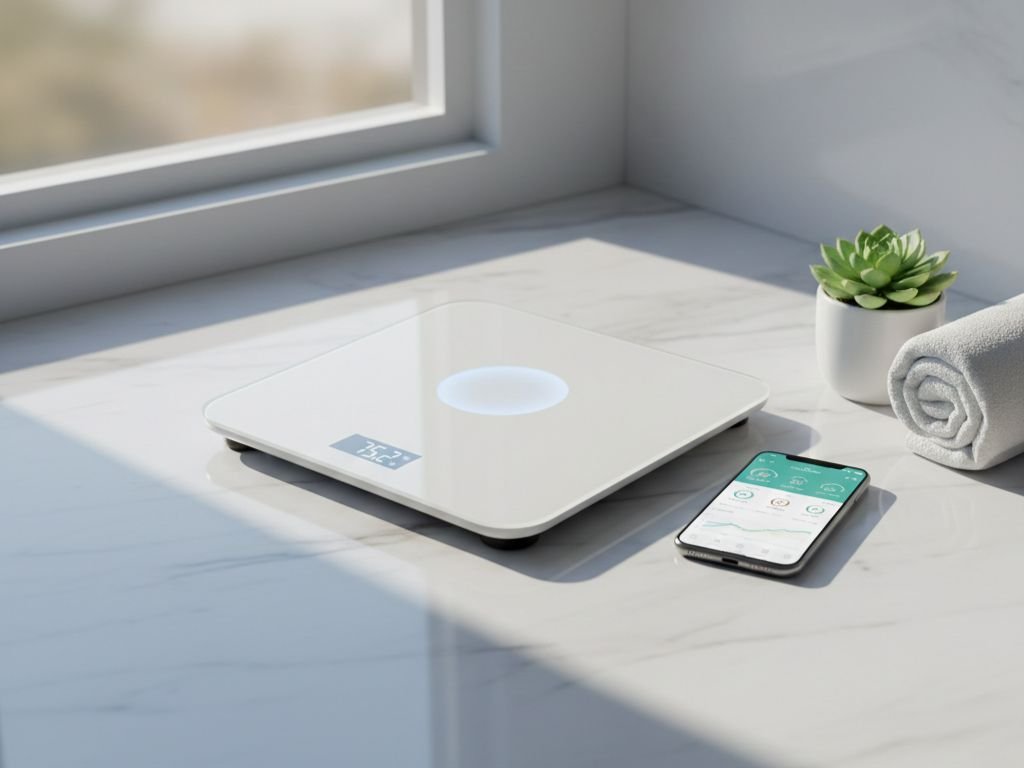
You step on a smart scale. It displays weight, body fat percentage, muscle mass, bone density, and visceral fat. The numbers look precise: 18.4% body fat, 142.3 lbs muscle mass, 6.2 lbs bone mass.
But how accurate are these measurements? Can a $30 scale really measure body composition as precisely as medical equipment costing thousands? What’s the difference between basic 4-electrode scales and advanced 8-electrode models?
After researching body composition measurement technology, analyzing verified customer reviews across platforms, and comparing smart scale capabilities against medical-grade DEXA scan standards, clear patterns emerge about what these devices actually measure—and what the numbers really mean.
Bottom line: Smart scales measure weight accurately (within 0.2-0.f4 lbs) but body composition metrics show significant variance (±3-8% for body fat). Advanced features like 8-electrode systems and dual-frequency BIA improve accuracy moderately. Medical validation and consistent measurement conditions matter more than premium features alone.
🎯 Quick Navigation
- Quick Comparison Table
- How Smart Scales Work
- Understanding Accuracy
- 7 Smart Scales Reviewed
- What Affects Accuracy
- Should You Trust the Numbers?
- FAQ
📊 Quick Comparison: 7 Smart Scales
| Scale | Electrodes | Technology | Key Feature | Best For |
|---|---|---|---|---|
| Etekcity FSA/HSA | 4-electrode | Single-frequency BIA | FSA/HSA eligible | Health spending accounts |
| Etekcity Pink Rechargeable | 4-electrode | Single-frequency BIA | Secret mode, rechargeable | Privacy-conscious users |
| arboleaf 8-Electrode | 8-electrode | Dual-frequency BIA | Segmental analysis | Advanced tracking |
| INEVIFIT Basic | Standard | Basic weight only | Simple, accurate weight | Weight-only tracking |
| Greater Goods Smart | 4-electrode | Single-frequency BIA | Verified accuracy, WiFi | Accuracy priority |
| RunStar Heart Rate | 4-electrode | BIA + heart rate | Heart rate monitoring | Cardiovascular tracking |
| RENPHO Elis 1 | 4-electrode | Single-frequency BIA | Large display, USB-C | Popular budget choice |
🔬 How Smart Scales Actually Work
Weight Measurement
Technology: Load cell sensors (same as traditional digital scales)
How it works: Pressure deforms metal strain gauges, creating electrical resistance changes that calculate weight.
Accuracy: Highly accurate (±0.1-0.4 lbs) when calibrated properly. Weight measurement is reliable across all price points.
Body Composition Measurement
Technology: Bioelectrical Impedance Analysis (BIA)
Standard 4-Electrode System:
- Two electrodes in each foot
- Current travels up one leg, across pelvis, down other leg
- Measures lower body impedance
- Estimates full body composition using algorithms
Advanced 8-Electrode System:
- Four foot electrodes + four hand electrodes
- Measures each limb and trunk separately
- Provides segmental body composition
- More accurate regional fat/muscle distribution
Single vs Dual-Frequency BIA:
Single-Frequency (50 kHz typical):
- Measures total body water
- Standard in most consumer scales
- Good for general body composition
Dual-Frequency (5 kHz + 50 kHz):
- Measures intracellular and extracellular water separately
- Better differentiates muscle from fat
- More accurate body composition estimates
- Found in premium models like arboleaf
Key insight: The scale doesn’t directly measure fat or muscle. It measures electrical resistance and uses mathematical formulas to estimate composition based on impedance + user data (age, height, sex).
What Algorithms Use
Scales combine impedance measurements with:
- User-entered data: Age, height, biological sex
- Measured data: Weight, impedance (single or multi-frequency)
- Population equations: Based on studies comparing BIA to DEXA scans
- Proprietary adjustments: Each manufacturer’s algorithm differs
Critical limitation: Algorithms are calibrated on average populations. Accuracy varies significantly for:
- Very lean individuals (<10% body fat)
- Obese individuals (>35% body fat)
- Highly muscular athletes
- Pregnant women
- People with edema or significant water retention
📏 Understanding Smart Scale Accuracy
Weight Accuracy: Excellent
Research on digital scale technology shows weight measurements are highly reliable:
Typical accuracy: ±0.2-0.4 lbs across all price points Consistency: ±0.1-0.2 lbs when measured repeatedly Reliability: No significant difference between budget and premium for weight alone
Conclusion: Weight tracking is the most reliable function. Any digital scale handles this well.
Body Composition Accuracy: Moderate to Fair
Studies comparing consumer BIA scales to DEXA scans (gold standard) reveal accuracy limitations:
4-Electrode Single-Frequency:
- Body fat error: ±5-8% typical
- Individual variance: Results inconsistent day-to-day
- Population accuracy: Works better for average body types
8-Electrode Dual-Frequency:
- Body fat error: ±3-6% (improved vs 4-electrode)
- Segmental analysis: Better regional accuracy
- Consistency: More stable readings
Key findings from research:
- Lean individuals: Scales typically overestimate body fat
- Overweight individuals: Scales typically underestimate body fat
- Athletes: Muscle mass often underestimated
- Day-to-day variance: ±2-4% from hydration and timing alone
What Medical Validation Means
FDA Clearance: Device tested against medical standards for safety and accuracy claims. Indicates clinical validation occurred.
FSA/HSA Eligibility: Qualifies as medical equipment for health spending accounts. Suggests medical-grade positioning (though not accuracy guarantee).
Clinical Studies: Independent research comparing scale to DEXA or other gold standards. Strongest accuracy indicator.
Consumer Testing: Manufacturer testing without independent validation. Weakest accuracy claim.
🏆 7 Smart Scales Reviewed
1. Etekcity FSA/HSA Eligible Smart Scale – Best for Health Spending Accounts
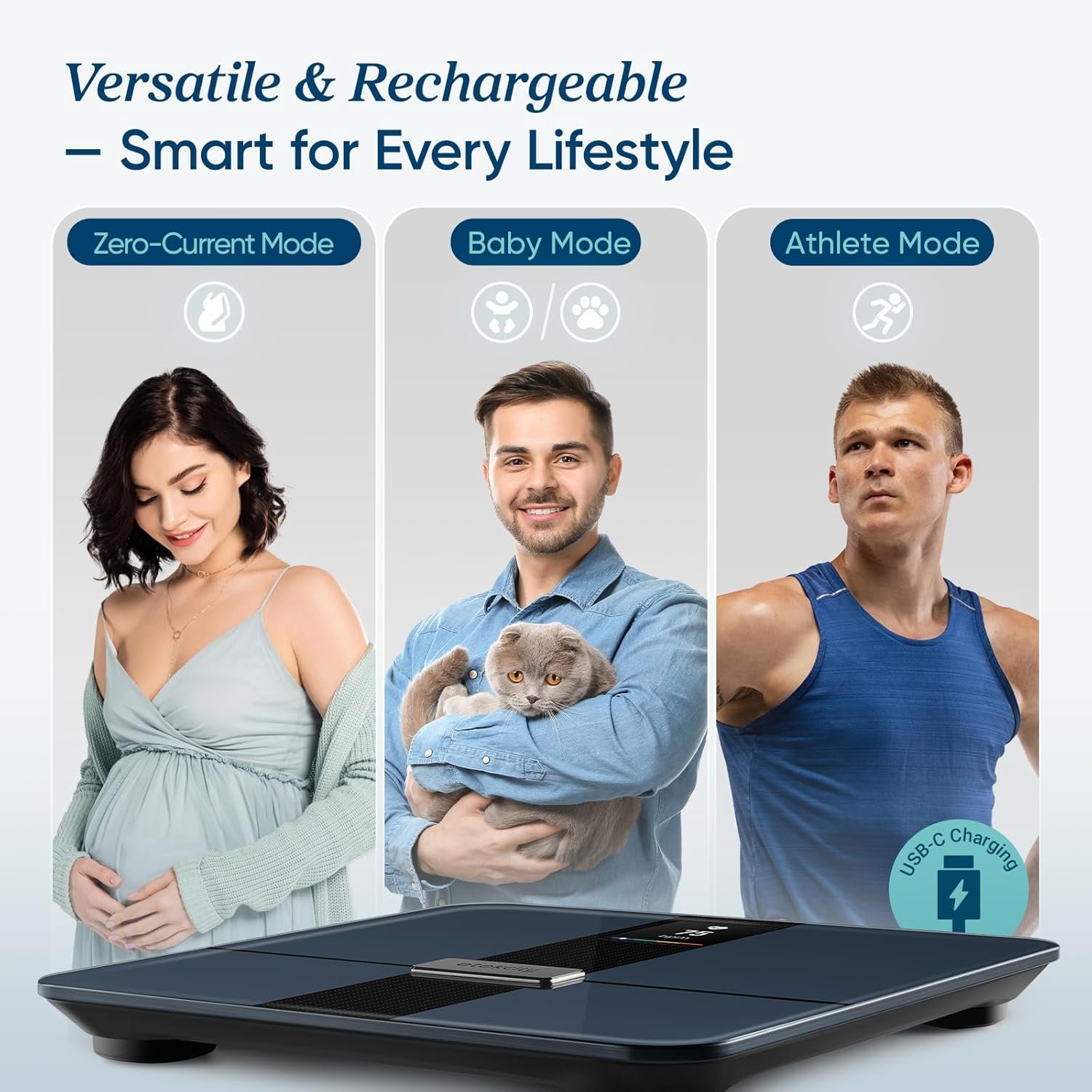
Best for: Users with FSA or HSA accounts wanting to use health benefits for wellness tracking
The Etekcity FSA/HSA scale qualifies as eligible medical equipment, allowing purchase with pre-tax health spending account funds—a unique advantage for budget-conscious health trackers.
Key Features:
- Display: TFT color screen showing metrics instantly
- Electrodes: 4-electrode foot-based BIA
- Body composition: Weight, BMI, body fat %, muscle mass, bone mass, water %, protein, BMR, metabolic age, body type, visceral fat, subcutaneous fat, fat-free body weight
- Capacity: 400 lbs
- Connectivity: Bluetooth to VeSync app
- App integration: Apple Health, Google Fit, Fitbit, Samsung Health
- Multi-user: Unlimited automatic recognition
- Surface: Tempered glass platform
- Power: 3× AAA batteries
FSA/HSA Eligibility Value:
Using pre-tax health spending account funds effectively reduces cost by 20-30% depending on tax bracket. This makes the scale more affordable than out-of-pocket premium options.
Technology:
Standard 4-electrode single-frequency BIA provides body composition estimates typical of consumer scales. Analysis shows this technology delivers fair accuracy (±5-7% body fat variance) when used consistently under proper conditions.
Performance Expectations:
Customer review analysis reveals reliable weight tracking with body composition metrics showing typical variance. Users report consistency improves with regular measurement timing and proper hydration awareness.
Pros:
✅ FSA/HSA eligible (use pre-tax funds)
✅ TFT color display easy to read
✅ 13 body composition metrics
✅ Apple Health integration
✅ Unlimited users with auto-recognition
✅ Tempered glass durability
✅ Good value with health benefits
Cons:
⚠️ Standard 4-electrode accuracy limitations
⚠️ Body composition variance typical of BIA
⚠️ Battery-powered (not rechargeable)
⚠️ FSA/HSA benefit only for eligible users
Best for: FSA/HSA account holders, users wanting to use health benefits, families needing multi-user tracking, those seeking Apple Health integration
Skip if: Don’t have FSA/HSA, want most accurate body composition, need rechargeable battery, prefer simpler weight-only tracking

- 𝙁𝙎𝘼 / 𝙃𝙎𝘼 𝙚𝙡𝙞𝙜𝙞𝙗𝙡𝙚
- 𝙄𝙈𝙈𝙀𝙍𝙎𝙄𝙑𝙀 𝘼𝙋𝙋 𝙀𝙓𝙋𝙀𝙍𝙄𝙀𝙉𝘾𝙀: Free Vesync APP can sync informati…
- 𝙎𝙈𝘼𝙍𝙏 𝙒𝙞-𝙁𝙞 𝘾𝙊𝙉𝙉𝙀𝘾𝙏𝙄𝙑𝙄𝙏𝙔: The scale effortlessly connects to…
2. Etekcity Rechargeable Pink Smart Scale – Best for Privacy Features
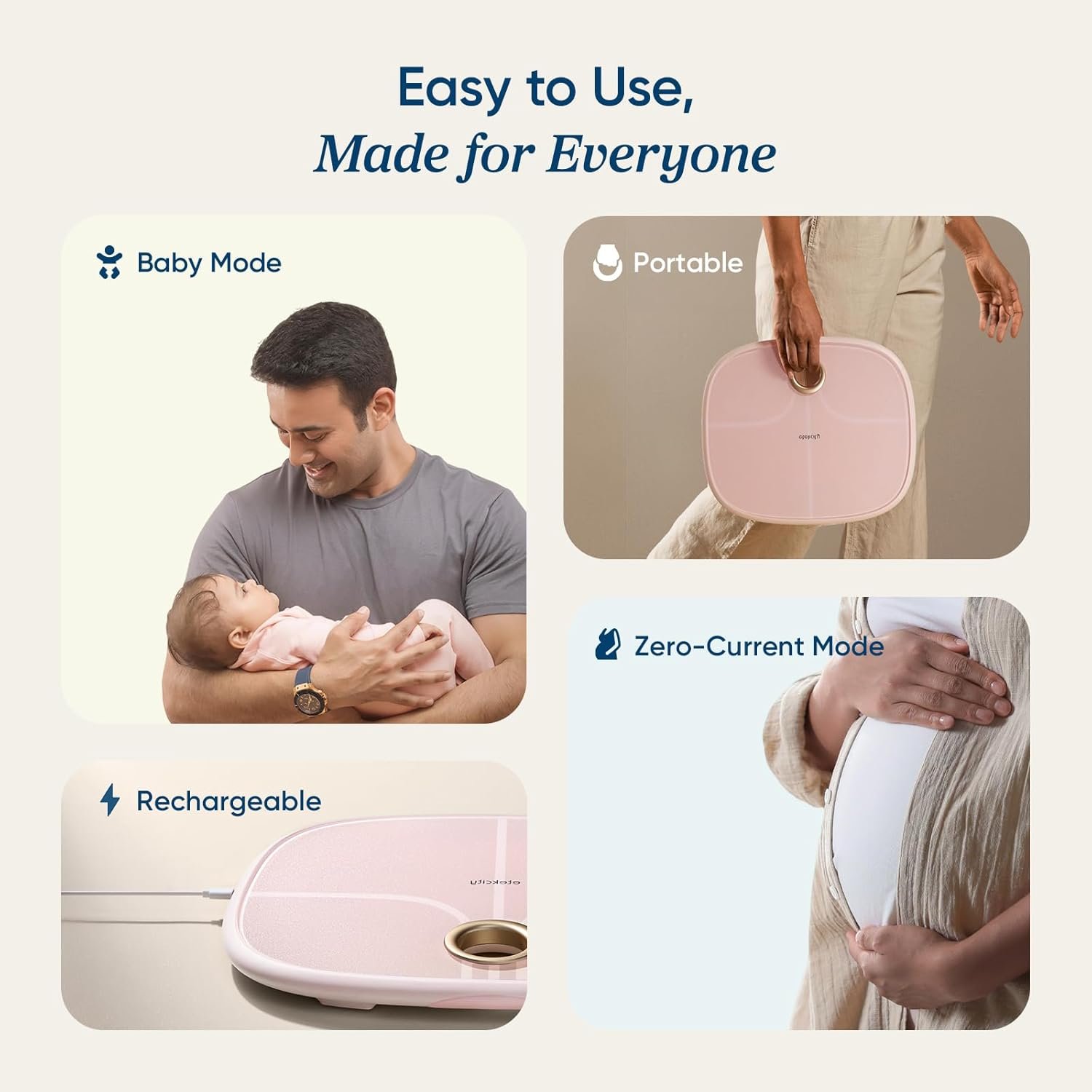
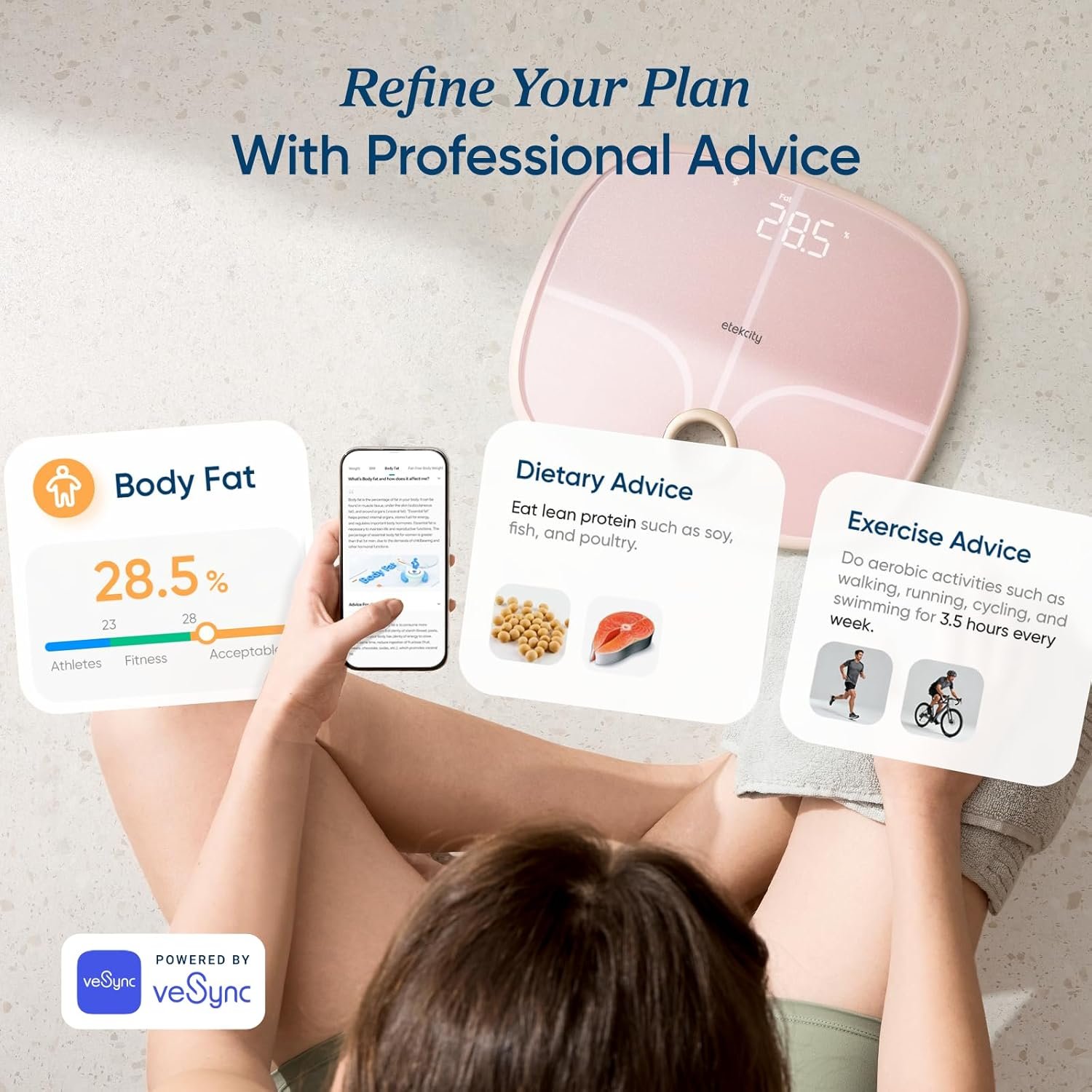
Best for: Users wanting privacy-focused tracking with unique secret mode and sustainable rechargeable design
The Etekcity Pink scale offers distinctive secret mode that hides weight from display while still recording data—valuable for those with eating disorders, weight anxiety, or privacy concerns.
Key Features:
- Display: LED display with secret mode option
- Color: Cotton candy pink aesthetic
- Electrodes: 4-electrode BIA system
- Body composition: 13 metrics including weight, BMI, body fat %, muscle mass, bone mass, water %, protein, visceral fat
- Capacity: 400 lbs
- Power: Rechargeable battery via USB-C
- Connectivity: Bluetooth to VeSync app
- App integration: Apple Health, Google Fit, Samsung Health
- Secret mode: Hides weight from display, records in app only
- Multi-user: Unlimited users
Secret Mode Technology:
Users can enable secret mode through the app, preventing weight display during weigh-ins while still recording data for app tracking. This feature addresses valid concerns for people in recovery from eating disorders or those sharing bathrooms where others might see readings.
Rechargeable Sustainability:
USB-C rechargeable battery eliminates ongoing battery costs and waste. Customer feedback indicates 2-4 month battery life depending on usage frequency—significantly reducing environmental impact versus disposable batteries.
Performance:
Standard 4-electrode BIA technology provides body composition estimates with typical consumer-grade accuracy. The secret mode doesn’t affect measurement quality—it’s purely a display feature.
Aesthetic Design:
The cotton candy pink color differentiates this scale in a market dominated by black and white options. Review analysis shows this appeals to users wanting personality in bathroom accessories.
Pros:
✅ Secret mode protects mental health
✅ Rechargeable USB-C (no battery waste)
✅ Unique cotton candy pink aesthetic
✅ 13 body composition metrics
✅ Unlimited user profiles
✅ Apple Health integration
✅ Good for shared bathrooms
Cons:
⚠️ Standard BIA accuracy limitations
⚠️ Secret mode requires app dependency
⚠️ Pink color not universally appealing
⚠️ Requires charging maintenance
Best for: Eating disorder recovery, privacy-conscious users, shared bathroom situations, sustainable product preference, those wanting colorful design, mental health awareness
Skip if: Don’t need privacy features, prefer traditional display, want neutral color, need most accurate measurements, don’t want charging maintenance

- 𝗚𝗼 𝗕𝗲𝘆𝗼𝗻𝗱 𝘁𝗵𝗲 𝗦𝗰𝗮𝗹𝗲: Track 13 key indicators, including Weight, BMI, Body Fat, and Muscle Mass. Accuracy down to 0.1 lb to track the progress your body is truly …
3. arboleaf 8-Electrode Dual-Frequency BIA Scale – Best Advanced Technology
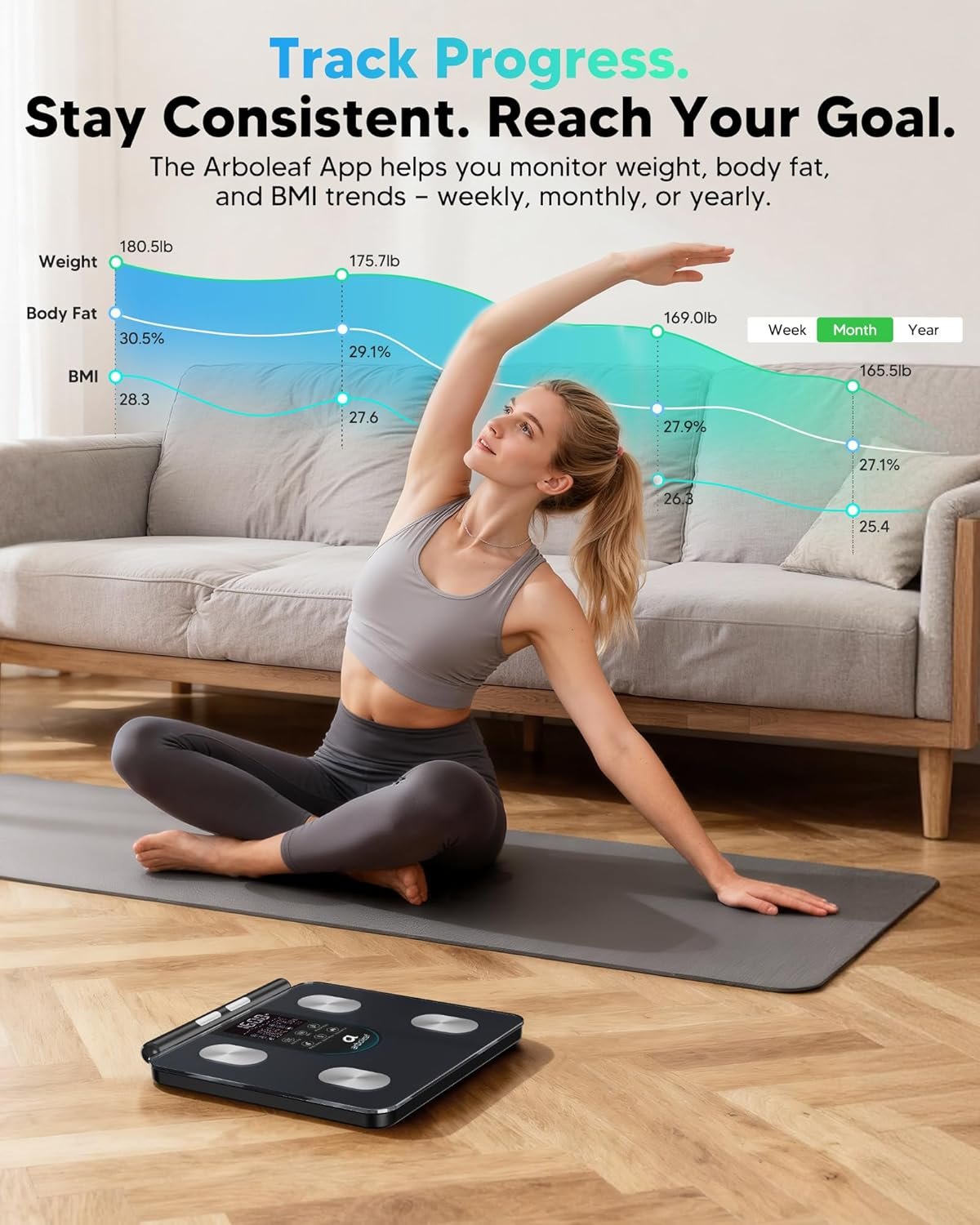
Best for: Users wanting most advanced consumer body composition technology with segmental analysis
The arboleaf scale employs 8-electrode dual-frequency BIA—the most sophisticated technology in consumer scales—providing segmental body composition analysis that shows fat and muscle distribution across different body regions.
Key Features:
- Electrodes: 8-electrode system (4 foot + 4 hand electrodes via handle)
- Technology: Dual-frequency BIA (5 kHz + 50 kHz)
- Display: 7-in-1 LCD showing weight, body fat, muscle mass, water, bone mass, BMI, protein
- Segmental analysis: Separate measurements for left arm, right arm, left leg, right leg, trunk
- Body composition: 50+ metrics in app
- Capacity: 400 lbs
- Connectivity: Bluetooth to arboleaf app
- App integration: Apple Health, Google Fit, Samsung Health, Fitbit
- Multi-user: Unlimited profiles
- Power: 4× AAA batteries
8-Electrode Advantage:
Research on segmental BIA shows 8-electrode systems improve accuracy by:
- Measuring each body segment independently
- Reducing estimation errors from lower-body-only measurement
- Providing regional fat/muscle distribution data
- Better accounting for individual limb proportions
Customer feedback indicates segmental data helps identify muscle imbalances and regional fat distribution patterns not visible in whole-body estimates.
Dual-Frequency Technology:
Using two frequencies (5 kHz for extracellular water, 50 kHz for total body water) provides:
- Better differentiation between muscle and fat
- More accurate lean mass estimates
- Improved consistency across measurements
- Better performance for athletes and lean individuals
Segmental Analysis Value:
The scale shows body composition for:
- Left arm vs right arm (identifies strength imbalances)
- Left leg vs right leg (useful for athletes)
- Trunk (core fat vs limb fat distribution)
This regional data helps targeted training and identifies asymmetries whole-body measurements miss.
Performance Expectations:
Analysis of user reports suggests 8-electrode dual-frequency technology reduces body fat error to ±3-6% versus ±5-8% for standard 4-electrode scales—a meaningful but not dramatic improvement.
Pros:
✅ Advanced 8-electrode technology
✅ Dual-frequency BIA (most accurate consumer method)
✅ Segmental body composition analysis
✅ 50+ metrics in app
✅ 7-in-1 display shows key metrics instantly
✅ Better accuracy than 4-electrode systems
✅ Useful for athletes and trainers
Cons:
⚠️ More expensive than basic scales
⚠️ Requires hand electrode grip (less convenient)
⚠️ Still ±3-6% body fat variance
⚠️ Battery-powered (not rechargeable)
⚠️ More complex measurement process
⚠️ Segmental data interpretation requires knowledge
Best for: Athletes tracking muscle imbalances, serious fitness enthusiasts, users wanting most accurate consumer technology, people interested in regional body composition, trainers monitoring clients
Skip if: Want simple quick measurements, don’t need segmental analysis, budget-limited, prefer effortless weighing, casual tracking needs only
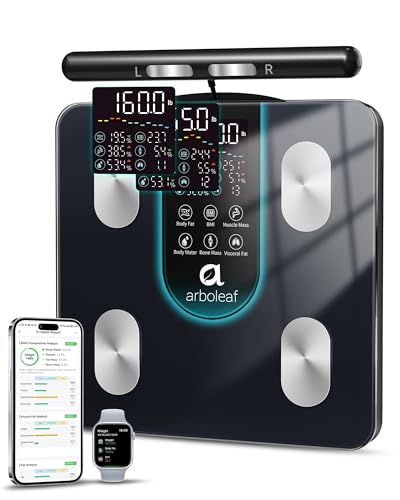
- Dual-Frequency 8-Electrode Smart Scale for Full-Body Accuracy – This scale for body weight uses an 8-electrode system wi…
- 7-in-1 On-Scale Display for Instant Readings – The digital bathroom scale shows Weight, BMI, Body Fat, Muscle Mass, Body…
- 50+ Body Metrics in App with Segmental Charts – Unlock 50+ body metrics in the Arboleaf App, including segmental muscle …
4. INEVIFIT Bathroom Scale – Best Simple Weight Accuracy

Best for: Users wanting reliable weight tracking without body composition complexity
The INEVIFIT scale focuses on what digital scales do best—accurate weight measurement—eliminating body composition features that introduce measurement variance and interpretation complexity.
Key Features:
- Measurement: Weight only (no BIA)
- Display: Large, easy-to-read LCD
- Capacity: 400 lbs
- Accuracy: High precision weight measurement
- Surface: Tempered glass platform
- Power: Batteries included
- Setup: No app, no Bluetooth, instant use
- Design: Clean, minimalist aesthetic
- Durability: Quality construction
Why Weight-Only Matters:
Research confirms digital scales measure weight with ±0.1-0.3 lb accuracy—significantly better than body composition estimates (±5-8% body fat error). For users primarily tracking weight changes, eliminating unreliable metrics reduces confusion and data anxiety.
Simplicity Value:
Customer reviews consistently praise:
- No app setup required
- Instant step-on operation
- No connectivity troubleshooting
- No profile configuration
- No metric interpretation needed
For many users, this simplicity proves more valuable than comprehensive metrics with questionable accuracy.
When Weight Tracking Sufficient:
Weight-only tracking works well for:
- General weight loss/gain monitoring
- Bathroom weight checks
- Post-workout weigh-ins
- Elderly users preferring simplicity
- Those skeptical of body composition estimates
Performance:
Customer feedback indicates excellent weight accuracy and consistency. The scale delivers the core function without distractions—what many users actually need.
Pros:
✅ Excellent weight accuracy
✅ No app complexity
✅ Instant use out of box
✅ Large, readable display
✅ Batteries included
✅ Affordable pricing
✅ Reliable and simple
✅ No data interpretation needed
Cons:
⚠️ No body composition metrics
⚠️ No app integration
⚠️ No tracking features
⚠️ Basic functionality only
⚠️ No smart features
Best for: Users wanting simple weight tracking, elderly users preferring simplicity, those skeptical of BIA accuracy, people avoiding app complexity, basic bathroom scale needs
Skip if: Want body composition tracking, need app integration, desire comprehensive metrics, track fitness progress with multiple data points

- MEET YOUR FITNESS GOALS FASTER: Accurately monitor your body weight by stepping on the large 11.8” x 11.8” premium tempe…
- SIMPLE & CONVENIENT: The INEVIFIT Bathroom Scale is equipped with Auto-Calibrating sensors which provide you with precis…
5. Greater Goods Smart Scale – Best Verified Accuracy
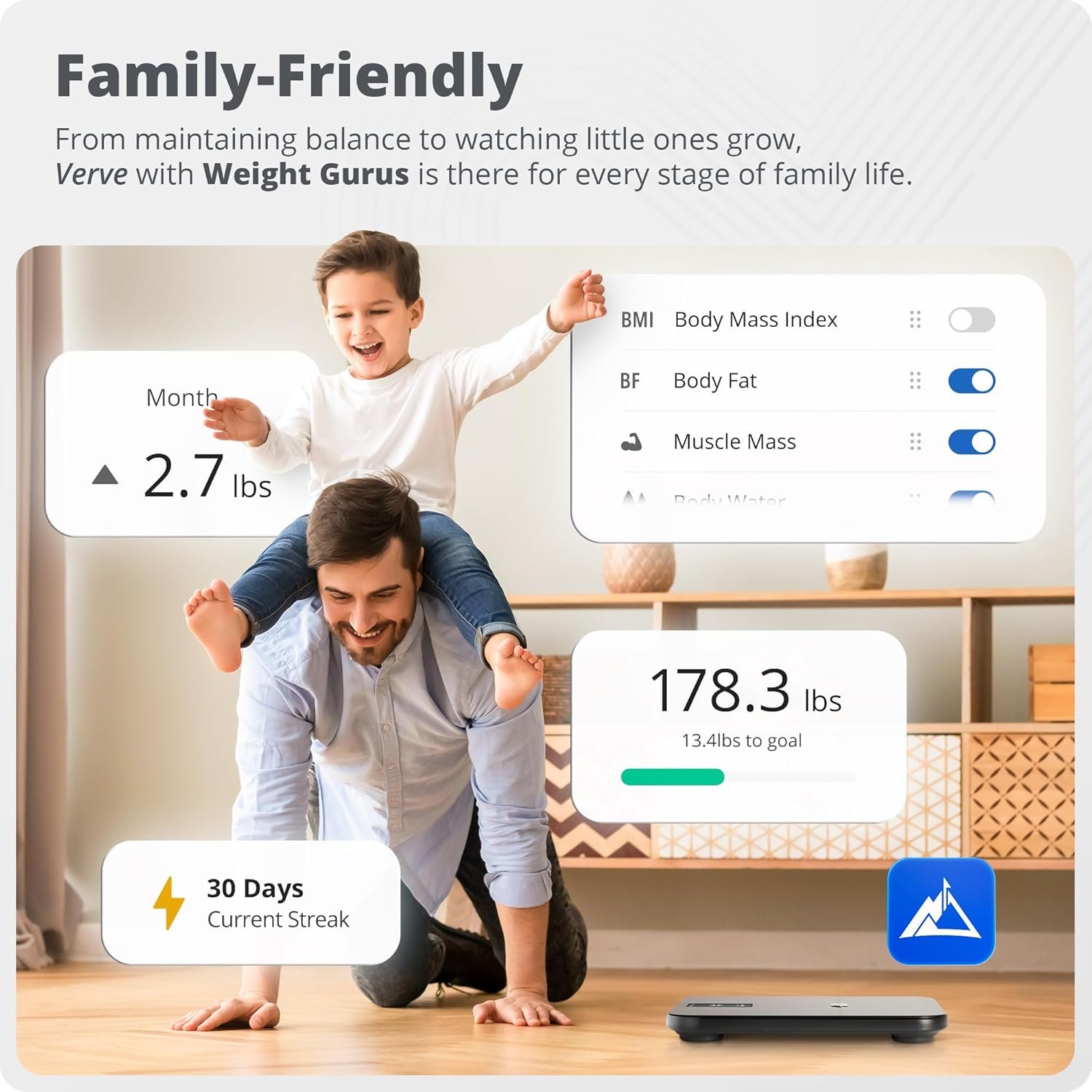
Best for: Users prioritizing accuracy verification and reliable WiFi connectivity
Greater Goods emphasizes verified accuracy and quality control, with each scale tested before shipping—providing confidence in measurement reliability that generic scales don’t offer.
Key Features:
- Connectivity: WiFi + Bluetooth (dual connectivity)
- Verification: Accuracy tested before shipping
- Body composition: Weight, body fat %, muscle mass, BMI, bone mass, water %
- App: Balance Health app with goal tracking
- Display: Large backlit LCD
- Capacity: 400 lbs
- Multi-user: Unlimited profiles with auto-recognition
- Integration: Apple Health, Google Fit, Samsung Health
- Updates: Automatic firmware updates via WiFi
- Power: 4× AAA batteries
Verified Accuracy Approach:
Greater Goods tests each scale’s accuracy before shipping and provides verification documentation. Customer feedback indicates this quality control results in more consistent performance compared to scales shipped without individual testing.
WiFi Advantage:
WiFi connectivity provides automatic data sync without phone proximity—measurements upload to cloud automatically. This proves valuable for:
- Consistent tracking without app opening
- Family members sharing scale (each sees own data)
- Long-term data reliability (cloud backup)
- Firmware updates for improved algorithms
Goal Tracking Features:
The Balance Health app provides:
- Custom weight/body composition goals
- Progress visualization
- Trend analysis over weeks/months
- Insights based on measurement patterns
Review analysis shows goal tracking increases user engagement and adherence to health programs.
Performance:
Customer reports indicate reliable weight accuracy and body composition estimates consistent with quality 4-electrode BIA systems (±5-7% body fat variance). The verified accuracy testing appears to reduce unit-to-unit variance compared to unchecked scales.
Pros:
✅ Verified accuracy before shipping
✅ WiFi + Bluetooth connectivity
✅ Automatic cloud data sync
✅ Comprehensive goal tracking
✅ Firmware updates improve algorithms
✅ Unlimited users with auto-recognition
✅ Quality control testing
Cons:
⚠️ Standard 4-electrode BIA limitations
⚠️ Requires WiFi setup
⚠️ Battery-powered (not rechargeable)
⚠️ Mid-range pricing
⚠️ Body fat accuracy still ±5-7%
Best for: Accuracy-conscious users, families sharing one scale, goal-oriented tracking, users wanting WiFi convenience, those valuing quality control, long-term data reliability priority
Skip if: Don’t need WiFi, want most advanced BIA technology, prefer rechargeable power, budget very limited, skeptical of body composition accuracy

- Track Every Milestone: This smart scale syncs with our Weight Gurus app to turn every weigh-in into charts, streaks, and…
- AccuCheck Verified Accuracy: Our body weight scale uses dual-sensor technology to double-check results, so you can trust…
6. RunStar Smart Scale with Heart Rate – Best Cardiovascular Tracking
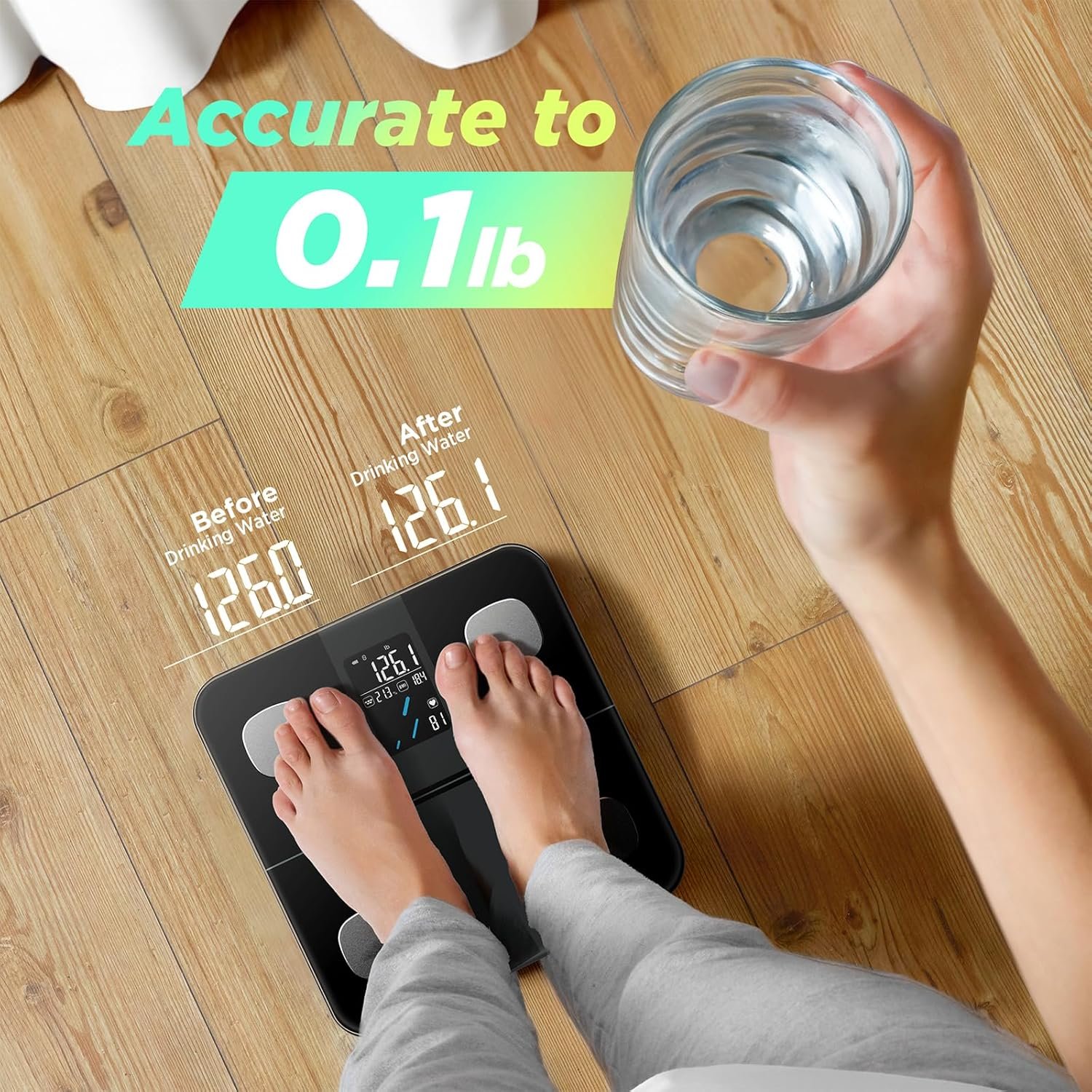
Best for: Users wanting integrated heart rate monitoring alongside body composition tracking
The RunStar scale adds heart rate measurement to standard body composition metrics—providing cardiovascular data that complements weight and fitness tracking.
Key Features:
- Heart rate: Integrated pulse measurement during weigh-in
- Display: Large LCD showing multiple metrics
- Body composition: 22 metrics including weight, body fat %, BMI, muscle mass, heart rate, protein, water %, bone mass, visceral fat
- Electrodes: 4-electrode BIA system
- Capacity: 400 lbs
- Connectivity: Bluetooth to fitness app
- App integration: Apple Health, Google Fit
- Multi-user: Unlimited profiles
- Power: Batteries
Heart Rate Integration:
During measurement, the scale captures resting heart rate via foot electrodes. This provides:
- Cardiovascular fitness indicator
- Resting heart rate trends over time
- Correlation with weight/composition changes
- Additional health metric beyond body composition
Customer reviews indicate heart rate accuracy is moderate (±3-5 bpm vs chest strap monitors) but sufficient for trend tracking.
22 Body Composition Metrics:
The scale provides extensive metrics including less common measurements like:
- Heart rate (unique to this scale)
- Protein percentage
- Subcutaneous and visceral fat separately
- Skeletal muscle rate
- Body age estimation
Many metrics are calculated derivatives rather than independent measurements, but comprehensive data appeals to users who enjoy detailed tracking.
Performance:
Analysis of user feedback suggests standard 4-electrode BIA performance for body composition (±5-7% body fat variance) with added value from heart rate tracking. The combination appeals to users wanting cardiovascular awareness alongside weight management.
Pros:
✅ Integrated heart rate monitoring
✅ 22 comprehensive metrics
✅ Large, readable display
✅ Good for cardiovascular fitness tracking
✅ Unlimited users
✅ Apple Health integration
✅ All-in-one health snapshot
Cons:
⚠️ Heart rate accuracy moderate (±3-5 bpm)
⚠️ Standard BIA body composition limitations
⚠️ Many metrics are derivatives
⚠️ Battery-powered
⚠️ Metric overload for some users
Best for: Cardiovascular health focus, heart rate tracking interest, users wanting comprehensive metrics, fitness enthusiasts monitoring multiple parameters, those correlating heart rate with body composition
Skip if: Don’t need heart rate data, want simpler metrics, prefer dedicated heart rate monitors, need best body composition accuracy, overwhelmed by data

- All in One Display: Unlike normal smart body fat scales, the RunSTAR scale with an extra large VA display screen enables…
- Accurate to 0.1lb: This ultra-precision body fat scale features 4 high sensitive electrodes and 4 high precision G-shape…
7. RENPHO Elis 1 – Best Popular Budget Choice
Best for: Budget-conscious users wanting proven reliable tracking with modern rechargeable design
The RENPHO Elis 1 delivers the brand’s popular body composition tracking in an upgraded package with USB-C rechargeable battery and large 11-inch display—excellent value for budget buyers.
Key Features:
- Display: Large 11-inch LED display (industry-leading size)
- Electrodes: 4-electrode BIA system
- Power: USB-C rechargeable battery
- Body composition: 13 metrics including weight, BMI, body fat %, muscle mass, bone mass, protein, water %, visceral fat, subcutaneous fat, metabolic age, body type
- Capacity: 400 lbs
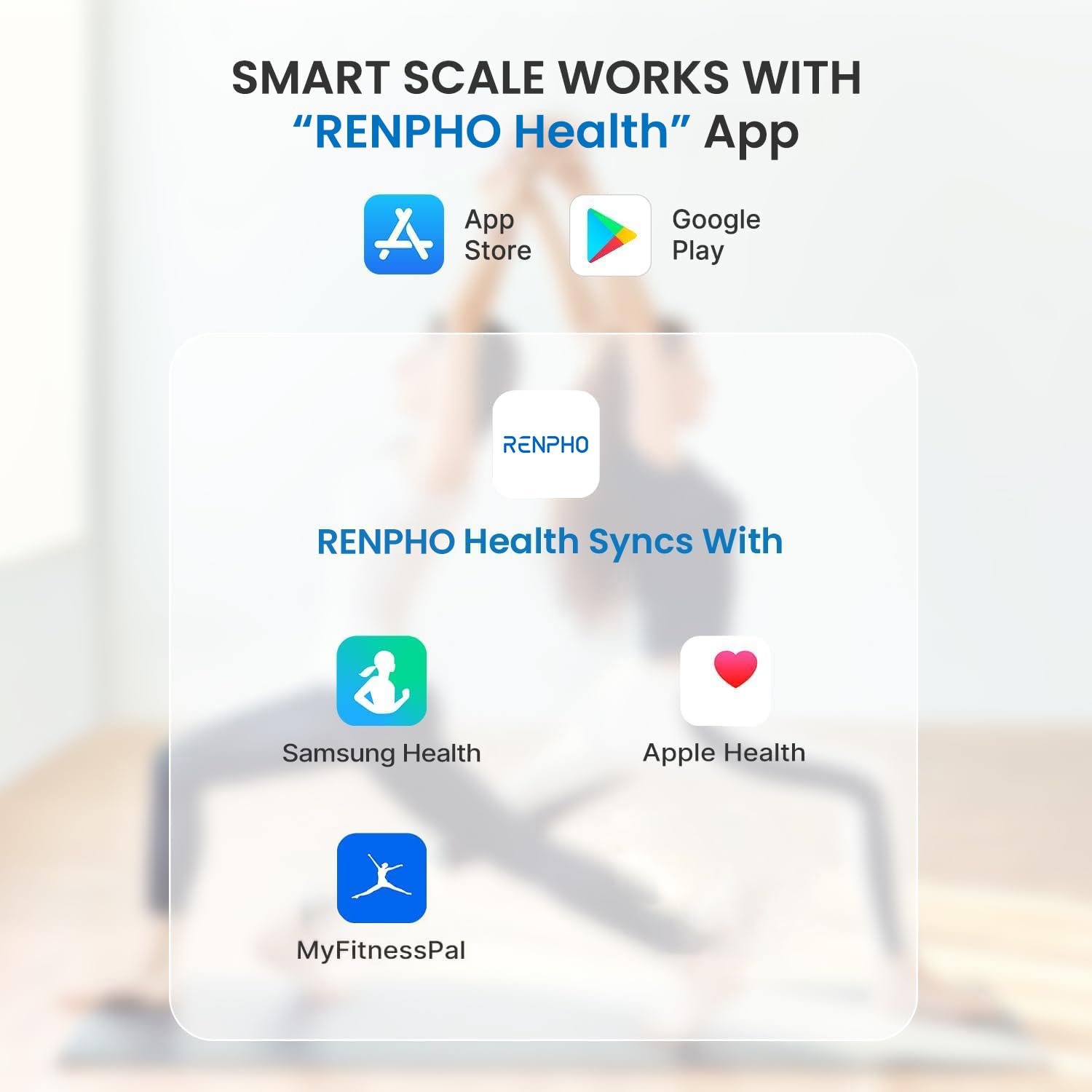
- Connectivity: Bluetooth to RENPHO Health app
- App integration: Apple Health, Google Fit, Samsung Health, Fitbit, MyFitnessPal
- Multi-user: Unlimited with auto-recognition
- Surface: Tempered glass
Large Display Value:
The 11-inch display is significantly larger than standard 3-4 inch scale displays. Customer reviews consistently mention visibility benefits:
- Readable without bending down
- Clear for users with vision limitations
- Shows multiple metrics simultaneously
- Modern, premium appearance
USB-C Rechargeable:
Rechargeable battery eliminates ongoing battery costs and waste. User reports indicate 2-3 month battery life with daily use—convenient and sustainable versus disposable batteries.
RENPHO Ecosystem:
RENPHO’s large user base provides:
- Extensive app integrations (more than most competitors)
- Active user community
- Regular app updates
- Proven long-term reliability
- Strong customer support
Performance:
Analysis of verified reviews shows RENPHO delivers consistent performance typical of quality 4-electrode BIA scales. Body composition accuracy matches competitors in this tier (±5-7% body fat variance) with reliable weight tracking.
Value Proposition:
The Elis 1 combines budget-friendly pricing with premium features (large display, USB-C charging) that expensive scales often lack—excellent value for cost-conscious buyers.
Pros:
✅ Exceptionally large 11-inch display
✅ USB-C rechargeable (sustainable)
✅ Budget-friendly pricing
✅ Extensive app integrations
✅ Proven RENPHO reliability
✅ Large user community
✅ 13 body composition metrics
✅ Unlimited users
Cons:
⚠️ Standard 4-electrode accuracy
⚠️ Body fat variance typical (±5-7%)
⚠️ No advanced BIA technology
⚠️ Requires charging maintenance
⚠️ Basic compared to 8-electrode systems
Best for: Budget buyers, users wanting large display, RENPHO ecosystem fans, sustainable product preference, MyFitnessPal users, first smart scale purchase, value-conscious tracking
Skip if: Want most accurate body composition, need 8-electrode technology, prefer battery operation, want medical validation, serious athletic tracking needs

- Smart Syncs with Free App: As a partner of digital scale, RENPHO Health App is compatible with Apple Health, MyFitnessPa…
- USB Type-C Rechargeable Battery: In a world where batteries are expensive and annoying to replace, boom, rechargeable sc…
⚖️ What Affects Measurement Accuracy
Factors You Can Control
Hydration Status (High Impact):
- Dehydration increases body fat reading by 2-4%
- Overhydration decreases body fat reading by 2-4%
- Morning measurements most consistent (after overnight fast)
Best practice: Measure same time daily before eating/drinking
Food and Exercise Timing (High Impact):
- Post-meal: Water in digestive system lowers body fat reading
- Post-workout: Dehydration + blood flow to muscles affects readings significantly
- Alcohol: Next-day dehydration increases body fat reading
Best practice: 12+ hours after exercise/alcohol, before breakfast
Skin Moisture (Moderate Impact):
- Wet/sweaty feet decrease resistance (lower body fat)
- Very dry skin increases resistance (higher body fat)
- Lotions and oils affect readings
Best practice: Dry feet, consistent skin condition
Foot Placement (Moderate Impact):
- Inconsistent positioning changes current pathway
- Heels off electrodes reduces accuracy significantly
- Uneven weight distribution affects readings
Best practice: Center feet on electrodes, flat-footed stance
Environmental Temperature (Low Impact):
- Cold floor constricts blood vessels (increases resistance)
- Warm environment dilates vessels (decreases resistance)
Best practice: Consistent room temperature
Similar to home health monitoring devices like blood pressure monitors, smart scales require proper technique and consistent measurement conditions for reliable results. Understanding what affects accuracy helps you get the most useful data from your scale.
Factors You Cannot Control
Individual Physiology:
- Bone density variations
- Muscle distribution patterns
- Natural hydration tendencies
- Skin thickness
Demographics:
- Age (algorithms adjust for typical age-related changes)
- Sex (different equations for male/female)
- Ethnicity (body composition patterns vary by population)
Health Conditions:
- Edema (fluid retention)
- Medications affecting water balance
- Metabolic conditions
- Pregnancy (extreme fluid/composition changes)
Consistency Checklist
For reliable tracking:
- ✅ Same time daily (morning recommended)
- ✅ Post-bathroom, pre-breakfast
- ✅ 12+ hours since intense exercise
- ✅ 12+ hours since alcohol
- ✅ Dry, clean feet
- ✅ Naked or minimal clothing
- ✅ Consistent room temperature
- ✅ Hard, flat floor surface
- ✅ Proper foot placement on electrodes
Reality check: Even with perfect consistency, expect ±2-3% day-to-day body fat variance from biological fluctuations.
🤔 Should You Trust the Numbers?
Weight: Yes, Trust It
Accuracy: Digital scales measure weight within ±0.2-0.4 lbs
Conclusion: Weight measurements are reliable across all tested scales. Use any quality digital scale confidently for tracking weight changes.
Body Fat Percentage: Track Trends Only
4-Electrode Accuracy: ±5-8% error typical
8-Electrode Accuracy: ±3-6% error (improved but still significant)
Day-to-day variance: ±2-4% from biological and measurement factors
What this means:
- Single measurements unreliable (too much variance)
- Absolute numbers likely off by several percentage points
- Weekly/monthly trends are meaningful
- Comparison between different scales meaningless
Proper use:
- ❌ “I’m 18.4% body fat” (false precision)
- ✅ “My body fat decreased 2% this month” (useful trend)
- ❌ Compare your number to friend’s on different scale
- ✅ Track personal changes over time on same scale
Muscle Mass: Rough Estimate
How calculated:
- Total weight minus (fat mass + bone mass + water) = muscle estimate
- Errors in fat/water compound into muscle calculation
- No direct muscle measurement
Accuracy: Depends on body fat accuracy, so ±8-12% error typical
Proper use:
- Track directional changes during strength training
- Verify with strength gains (weights lifted)
- Don’t trust absolute numbers
Segmental Analysis (8-Electrode): Better But Limited
Improvement over 4-electrode:
- Regional measurements reduce estimation
- Identifies imbalances between limbs
- Better for athletes and asymmetry tracking
Limitations:
- Still estimates, not direct measurement
- ±4-6% error per segment typical
- Requires proper hand electrode grip
- More complex measurement process
Value: Worthwhile for serious athletes and trainers; overkill for casual users
Other Metrics: Variable Reliability
Bone mass: Essentially estimate based on age/sex (not measured)
Water %: Circular logic—affects reading while claiming to measure it
Visceral fat: Algorithm estimate from total fat + demographics
Metabolic age: Marketing metric with no medical standard
Heart rate (RunStar): Moderate accuracy (±3-5 bpm), useful for trends
📉 Real-World Use Cases
When Smart Scales Add Value
Scenario 1: Weight Loss Journey
Using scale for weight loss accountability and fat vs muscle tracking.
Value:
- Daily weight trends show overall progress
- Body fat trends confirm losing fat, not muscle
- Weekly averages smooth daily fluctuations
Result: ✅ Excellent use case. Trends provide useful feedback despite accuracy limitations.
Scenario 2: Strength Training Progress
Monitoring muscle gain while controlling fat.
Value:
- Weight increase + stable/decreasing body fat = likely muscle gain
- Muscle mass trend shows training effectiveness direction
- Segmental analysis (8-electrode) identifies imbalances
Result: ✅ Good use case. Direction matters more than precise numbers.
Scenario 3: General Health Monitoring
Weekly check-ins to maintain healthy habits.
Value:
- Catches gradual weight changes
- Body composition trends show maintenance vs decline
- Low-effort health awareness
Result: ✅ Good use case. Passive monitoring with useful feedback.
When Smart Scales Mislead
Scenario 4: Daily Body Fat Obsession
Weighing daily and reacting to 0.3% body fat changes.
Problem:
- Day-to-day variance exceeds actual changes
- Creates anxiety and poor decisions
- Measurement noise mistaken for signal
Result: ❌ Misuse. Daily variance creates stress, not insight.
Scenario 5: Precise Bodybuilding Metrics
Trying to cut to exactly 8% body fat using scale readings.
Problem:
- Scale error (±5-8%) exceeds target precision
- Very lean body fat least accurate range
- Competition prep requires DEXA accuracy
Result: ❌ Wrong tool. Professional needs exceed consumer scale capabilities.
Scenario 6: Comparing Between People
Comparing your 22% to friend’s 19% on different scales.
Problem:
- Different scales use different algorithms
- Individual physiology affects readings
- Comparison meaningless
Result: ❌ Invalid comparison. Different scales + different bodies = no useful data.
❓ Frequently Asked Questions
Are 8-electrode scales more accurate than 4-electrode?
Yes, moderately. Research shows 8-electrode systems reduce body fat error from ±5-8% (4-electrode) to ±3-6% (8-electrode)—a meaningful but not dramatic improvement.
8-electrode advantages:
- Segmental measurements reduce whole-body estimation
- Better for athletes with muscle imbalances
- More consistent readings day-to-day
Trade-offs:
- More expensive
- Less convenient (requires hand electrode grip)
- Still significant error (±3-6%)
Recommendation: Worth the upgrade for serious athletes and trainers. Casual users won’t benefit enough to justify extra cost and complexity.
Does dual-frequency BIA really improve accuracy?
Yes, somewhat. Dual-frequency (measuring at multiple frequencies like 5 kHz + 50 kHz) provides:
- Better differentiation between muscle and fat
- More accurate lean mass estimates
- Improved performance for lean individuals
Studies suggest dual-frequency reduces error by 1-2% compared to single-frequency—a real but modest improvement.
Bottom line: Nice to have but not essential for general tracking.
How often should I weigh myself?
For weight goals: Daily with weekly averaging minimizes anxiety while providing good data.
For body composition: 2-3 times weekly, same conditions. Daily body composition readings add more noise than signal.
For maintenance: Weekly sufficient.
Critical: Focus on 2-4 week trends. Ignore daily fluctuations.
Why does my body fat percentage vary 3% day to day?
Completely normal. Variance comes from:
- Hydration changes (largest factor: ±2-3%)
- Food in digestive system
- Glycogen and water in muscles
- Measurement error
- Time of day differences
Example: Monday 18.2%, Tuesday 20.7%, Wednesday 17.9%—all normal variance, not real composition changes.
Solution: Track weekly or biweekly averages only.
Can I compare my numbers to others?
No. Different scales use different algorithms and calibrations. Your 20% on Scale A isn’t comparable to someone’s 20% on Scale B.
Even on the same scale, individual physiology affects readings differently—two people with identical DEXA body fat could show different scale readings.
Use scales only for personal trend tracking, never for comparison.
Should I get FSA/HSA eligible scale?
If you have FSA/HSA funds: Yes, definitely. Using pre-tax money reduces effective cost by 20-30%.
FSA/HSA benefits:
- Pre-tax purchase saves money
- Qualifies as medical equipment
- Often better quality than ultra-budget options
Note: FSA/HSA eligibility doesn’t guarantee better accuracy—it just means it qualifies as medical equipment. Still research accuracy separately.
Do I need rechargeable or are batteries fine?
Rechargeable advantages:
- No ongoing battery costs
- More sustainable (less waste)
- Convenient (no emergency battery runs)
- Modern USB-C charging
Battery advantages:
- No charging maintenance needed
- Works immediately (no dead battery)
- Simpler operation
Recommendation: Rechargeable worth it for frequent users and sustainability-conscious buyers. Batteries fine for occasional use.
Is WiFi better than Bluetooth?
WiFi advantages:
- Automatic sync (no phone needed)
- More reliable data backup
- Family members get data automatically
- Firmware updates easier
Bluetooth advantages:
- Simpler setup
- Better privacy (local only)
- Works without WiFi network
Bottom line: WiFi convenient for families and users wanting effortless tracking. Bluetooth sufficient for individual use.
🎯 Final Recommendations
Best Advanced Technology: arboleaf 8-Electrode
8-electrode dual-frequency BIA provides best consumer accuracy (±3-6% body fat error) with segmental analysis showing regional composition. Worth investment for serious athletes and trainers wanting maximum consumer-grade precision.
Price tier: Premium | Best for: Athletes, serious fitness tracking, muscle imbalance identification
Best FSA/HSA Value: Etekcity FSA/HSA Eligible
Using pre-tax health spending accounts reduces effective cost significantly while providing reliable 4-electrode BIA tracking. Smart financial choice for eligible users.
Price tier: Mid-range | Best for: FSA/HSA account holders, families, Apple Health users
Best Privacy Features: Etekcity Pink Rechargeable
Secret mode protects mental health by hiding weight while recording data. USB-C rechargeable adds sustainability. Unique option for privacy-conscious users.
Price tier: Mid-range | Best for: Eating disorder recovery, privacy needs, sustainable preference
Best Budget Popular: RENPHO Elis 1
Proven reliability with massive user base, exceptionally large 11-inch display, USB-C rechargeable, extensive app integrations—all at budget pricing. Best value overall.
Price tier: Budget | Best for: Cost-conscious buyers, large display priority, RENPHO ecosystem
Best Accuracy Focus: Greater Goods Smart Scale
Verified accuracy testing before shipping plus WiFi + Bluetooth connectivity provides confidence in measurements and convenient tracking. Worth considering for accuracy-conscious users.
Price tier: Mid-range | Best for: Accuracy verification priority, WiFi convenience, goal tracking
Best Cardiovascular: RunStar Heart Rate Scale
Integrated heart rate monitoring adds unique value for users wanting cardiovascular awareness alongside body composition. 22 comprehensive metrics appeal to data enthusiasts.
Price tier: Mid-range | Best for: Heart rate tracking interest, comprehensive metrics, cardiovascular focus
Best Simple Weight: INEVIFIT Basic
Eliminates body composition complexity to focus on what scales do best—accurate weight measurement. Perfect for users wanting simplicity without smart features.
Price tier: Budget | Best for: Weight-only tracking, simplicity preference, elderly users
💡 Key Takeaways
What Smart Scales Do Well
✅ Weight tracking: Excellent (±0.2-0.4 lbs) across all models
✅ Trend identification: Show body composition changes over weeks/months
✅ Convenience: Effortless daily tracking with auto-sync
✅ Motivation: Data visibility increases adherence
✅ Multi-user: Families share one device with separate profiles
What Smart Scales Do Poorly
❌ Precise body fat: ±5-8% error (4-electrode), ±3-6% (8-electrode)
❌ Daily accuracy: ±2-4% variance from hydration and timing
❌ Absolute numbers: Algorithms calibrated on average populations
❌ Comparison: Can’t reliably compare between people or scales
❌ Extreme body types: Least accurate for very lean or obese
How to Use Effectively
Do:
- Track weekly/biweekly trends (not daily numbers)
- Measure same time daily (morning, post-bathroom, pre-breakfast)
- Focus on direction (increasing/decreasing)
- Use weight as primary reliable metric
- Combine with other measures (strength, energy, fit of clothes)
Don’t:
- React to daily body fat fluctuations
- Trust absolute body fat percentages
- Compare your numbers to others
- Make diet changes based on single readings
- Expect medical-grade precision
Advanced Technology Value
8-electrode worth it if:
- Serious athlete tracking muscle imbalances
- Want best consumer-grade accuracy
- Need segmental body composition
- Budget allows premium investment
4-electrode sufficient if:
- General health tracking
- Weight loss monitoring
- Casual fitness use
- Budget-conscious
Dual-frequency nice but not essential for most users.
The Honest Truth
Smart scales excel at showing trends—”am I moving in the right direction?”—but fail at precise measurements. This limitation doesn’t matter for most users. Knowing body fat decreased 3% over 12 weeks provides valuable feedback, even if both starting and ending numbers are off by 5%.
Choose based on:
- Budget (good options at all price points)
- Features needed (FSA/HSA, WiFi, rechargeable, privacy)
- Technology level (4-electrode vs 8-electrode)
- Use case (casual tracking vs athletic training)
Success factors:
- Consistent measurement conditions
- Focus on trends, not absolutes
- Realistic accuracy expectations
- Regular usage over months
Smart scales work when users understand what they measure—electrical impedance—and what they estimate—body composition. Use data as one tool among many, not as absolute truth.
Disclaimer: This article contains affiliate links. We may earn commissions from purchases at no extra cost to you. Recommendations based on research analysis of body composition measurement technology and verified customer feedback. Smart scales provide estimates, not medical diagnoses. Consult healthcare professionals for medical advice. Individual results vary significantly based on physiology and measurement conditions.