
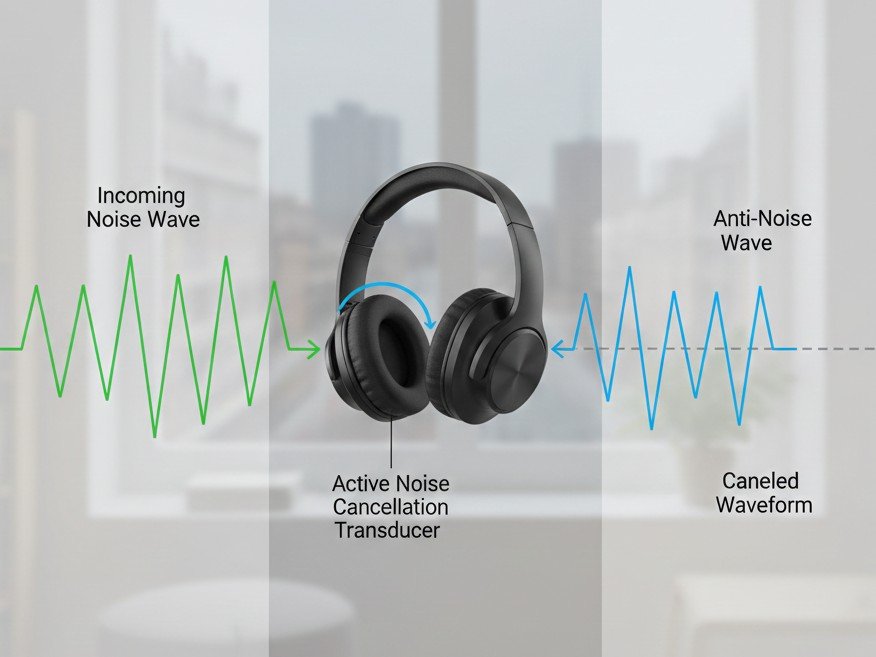
Noise cancellation is marketed as a premium feature across headphones, earbuds, microphones, and conference devices — yet most buyers don’t understand what the technology actually does or why it works in some situations and fails in others.
This guide explains the physics and engineering behind both active and passive noise cancellation, when each type works effectively, their fundamental limitations, and why “noise cancellation” means something entirely different depending on whether you’re blocking sound from entering your ears or preventing your voice from transmitting background noise.
Quick Navigation
- What Noise Cancellation Actually Is
- Passive Noise Cancellation: Physical Blocking
- Active Noise Cancellation: The Physics
- How ANC Circuits Work
- Why ANC Fails for Certain Sounds
- Microphone Noise Cancellation: Different Technology
- Hybrid Noise Cancellation Systems
- Adaptive ANC Explained
- Real-World Performance Expectations
- Common Misconceptions
- FAQ
What Noise Cancellation Actually Is
Noise cancellation refers to any technology that reduces unwanted sound — either preventing external noise from reaching your ears or preventing background noise from being transmitted through your microphone during calls.
Two completely different implementations:
Listener-side noise cancellation: Blocks environmental noise from reaching your ears so you hear music, podcasts, or calls more clearly. Found in headphones and earbuds.
Microphone-side noise cancellation: Prevents your microphone from transmitting background noise to people on the other end of a call. Found in headsets, conferencing microphones, and communication devices.
These use different technologies and solve different problems. Marketing often conflates them, creating confusion about what a product actually does.
This guide addresses both types — starting with listener-side noise cancellation (what most people mean by “noise cancelling headphones”), then covering microphone noise cancellation separately.
Passive Noise Cancellation: Physical Blocking
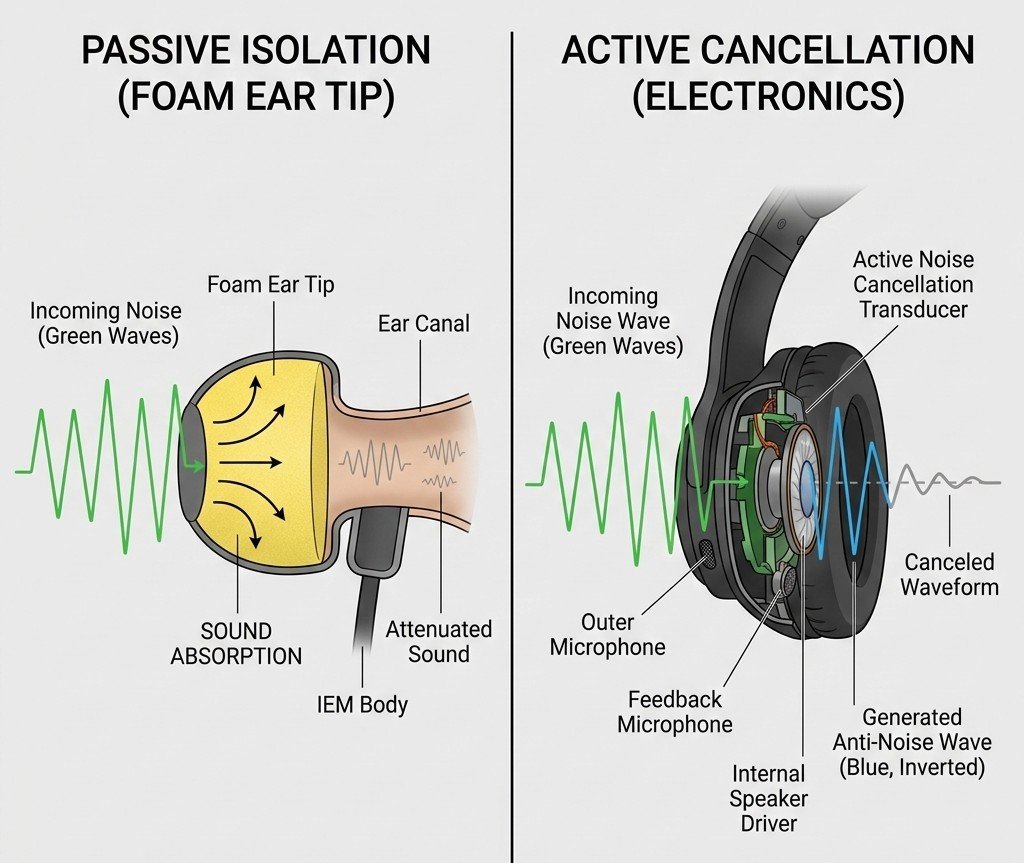
Passive noise cancellation is the simplest form — physical materials block sound waves from reaching your ear canal. No electronics, no processing, no batteries required.
How Passive Isolation Works
Sound waves are vibrations traveling through air. Dense materials absorb and reflect these vibrations rather than transmitting them. Passive noise cancellation uses foam, silicone, leather, or other materials to create a physical barrier between your ear and external noise sources.
Over-ear headphones: Padded ear cups create a seal around your entire ear. Sound waves hit the outer surface of the cup and are absorbed by padding or reflected away. The air gap between the cup and your ear creates additional isolation.
In-ear headphones/earbuds: Silicone or foam tips inserted into the ear canal block the opening. Sound waves cannot travel down the ear canal because the physical plug prevents air movement. The deeper the insertion and tighter the seal, the more effective the isolation.
Earplugs: Pure passive isolation — foam or silicone material completely fills the ear canal entrance, blocking all sound transmission.
Frequency Response of Passive Isolation
Passive noise cancellation does not block all frequencies equally. Its effectiveness depends on wavelength relative to the blocking material’s thickness and density.
High frequencies (treble): Short wavelengths (under 2 inches) are easily blocked by relatively thin materials. A 1/2 inch foam pad effectively blocks frequencies above 3-4 kHz.
Mid frequencies: Moderate wavelengths require thicker, denser materials. Effectiveness varies significantly based on material quality and seal tightness.
Low frequencies (bass): Long wavelengths (several feet for deep bass) pass through most passive materials. A 40 Hz bass tone has a wavelength of approximately 28 feet — thin padding barely affects it. This is why you hear bass from neighbors’ music through walls even when treble is completely blocked.
Passive isolation strength by frequency:
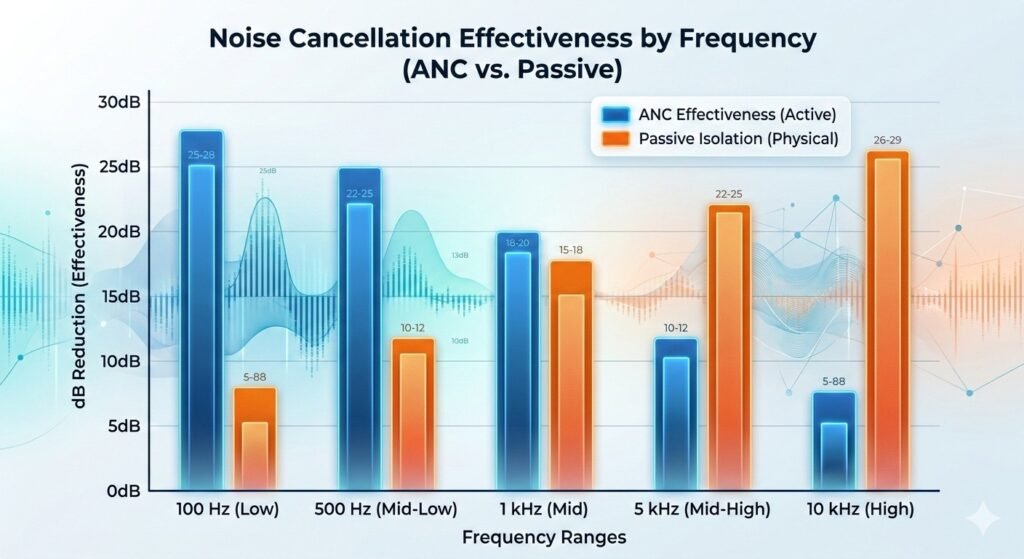
- High frequencies (4 kHz+): 20-30 dB reduction
- Mid frequencies (500 Hz – 4 kHz): 10-20 dB reduction
- Low frequencies (below 500 Hz): 5-10 dB reduction
This frequency-dependent performance is why passive isolation alone cannot eliminate deep bass sounds like airplane engines, train rumble, or HVAC systems. Active noise cancellation was developed specifically to address low-frequency noise that passive methods cannot block.
Active Noise Cancellation (ANC): The Physics
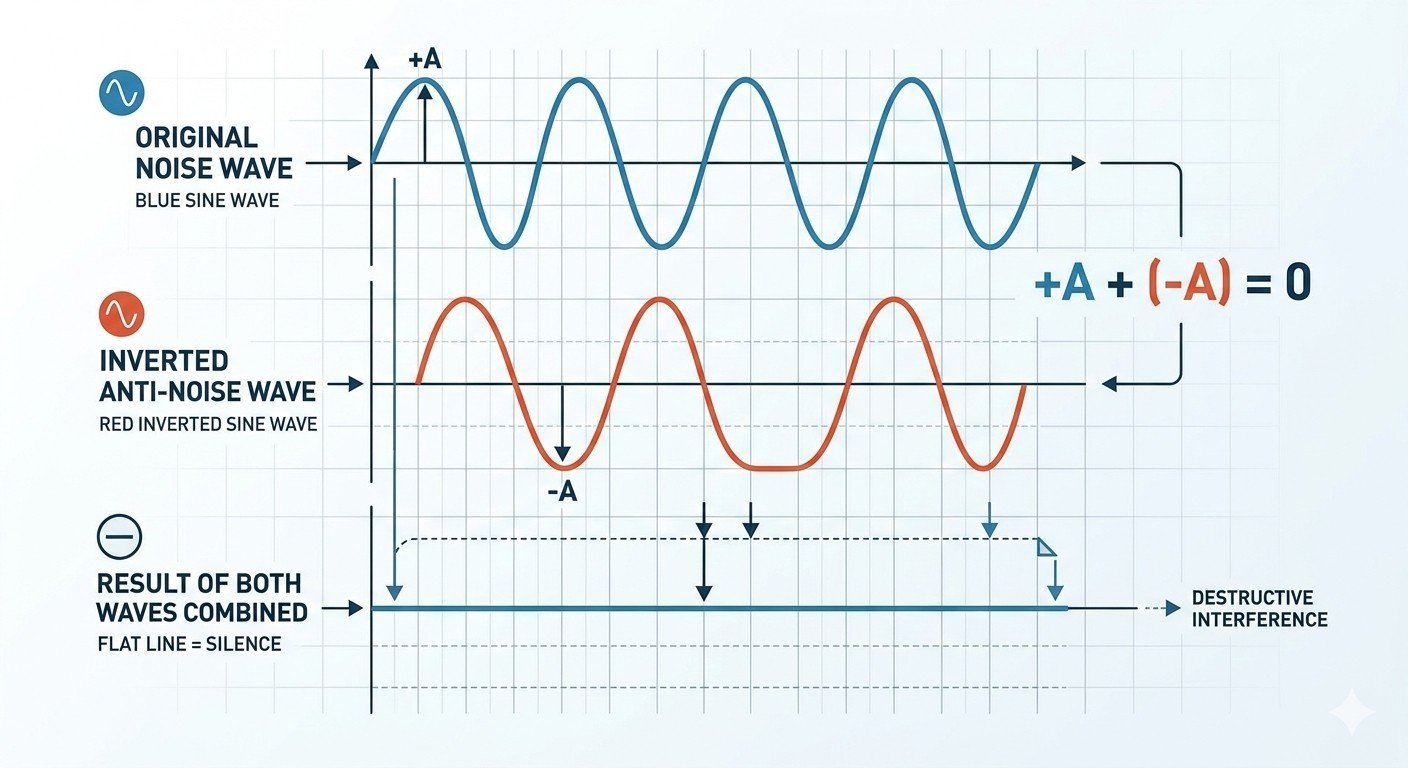
Active Noise Cancellation uses electronics to generate an “anti-noise” sound wave that cancels incoming noise through destructive interference — a physics principle where two waves of equal amplitude and opposite phase sum to zero.
Destructive Interference Explained
Sound waves are oscillating air pressure changes. When air pressure increases above ambient, the wave is in positive phase. When pressure decreases below ambient, the wave is in negative phase.
Destructive interference occurs when:
- Two sound waves meet at the same location
- Both waves have equal amplitude (loudness)
- Both waves are 180 degrees out of phase (one wave’s peak aligns with the other’s trough)
When these conditions are met, the positive pressure from one wave exactly cancels the negative pressure from the other wave. The net result is no pressure change — silence.
Mathematical representation: If incoming noise is represented as a sine wave +A, and the ANC system generates an inverted wave -A, the sum is zero: +A + (-A) = 0.
This is not just theoretical physics — it is measurable and reproducible. Two speakers playing identical tones 180 degrees out of phase create a zone between them where the sound cancels to silence. This same principle powers ANC headphones.
Why Phase Inversion Works for Noise Cancellation
The key insight: ANC doesn’t “absorb” or “block” noise. It adds an equal and opposite sound that cancels the noise through wave interference. You’re actually hearing more sound (original noise + anti-noise) but the two sounds cancel each other.
This is why ANC only works with electronic headphones that can generate sound. Passive earplugs cannot create anti-noise because they have no speakers.
How ANC Circuits Actually Work
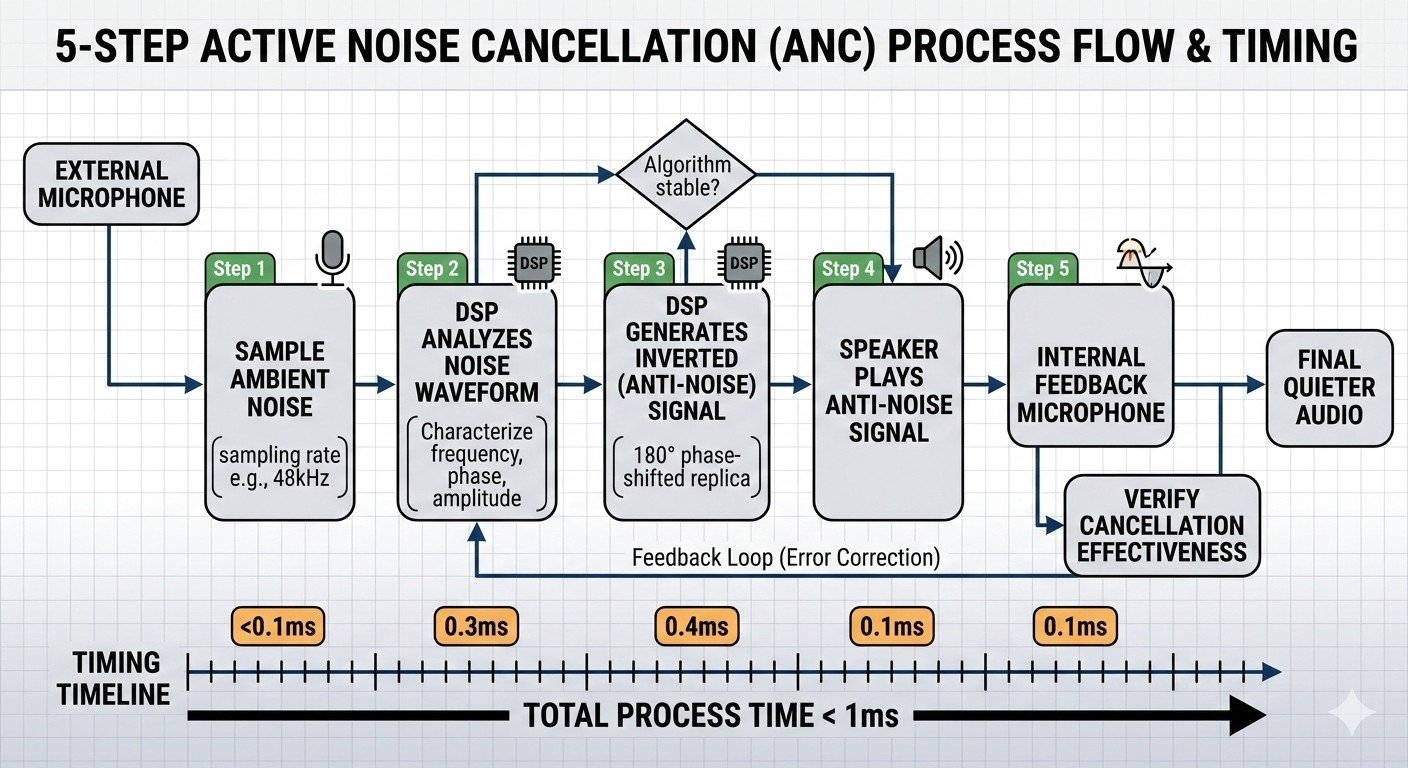
Implementing destructive interference in a wearable headphone requires real-time analysis and response measured in milliseconds.
The ANC Signal Chain
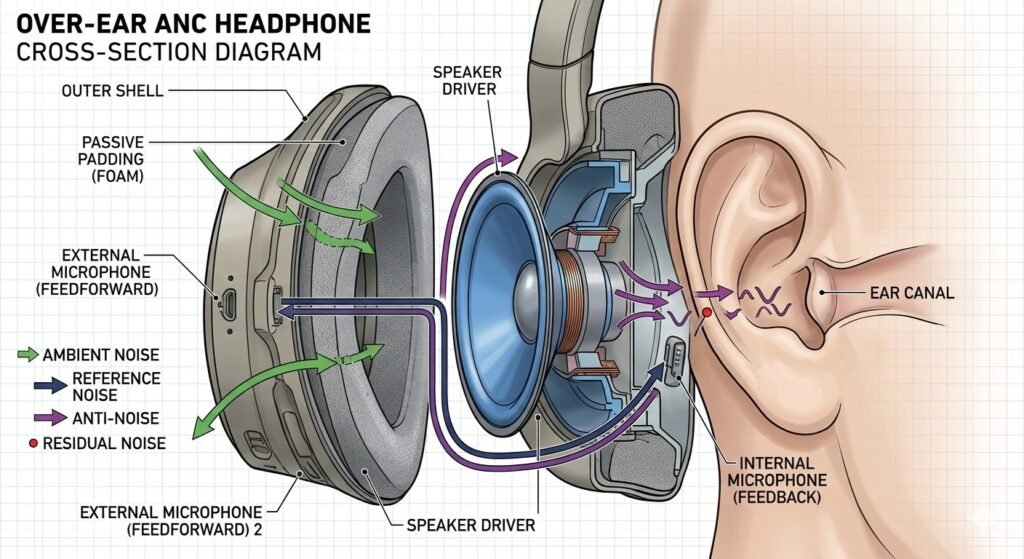
Step 1: External microphone samples incoming noise
A microphone mounted on the outside of the headphone continuously captures environmental sound. This mic faces outward, detecting noise before it reaches your ear.
Step 2: Digital signal processor (DSP) analyzes the waveform
The captured sound is digitized and analyzed to determine its frequency, amplitude, and phase characteristics. Modern ANC systems sample at 44.1 kHz or higher — over 44,000 measurements per second.
Step 3: DSP generates inverted waveform
The processor creates a mirror-image waveform — identical amplitude and frequency but inverted 180 degrees in phase. If incoming noise is a 200 Hz tone at +50 dB, the ANC system generates a 200 Hz tone at -50 dB (inverted phase).
Step 4: Inverted waveform plays through headphone speaker
The anti-noise signal is sent to the headphone driver simultaneously with your music or audio content. Both signals play together — music you want to hear plus anti-noise canceling external sounds.
Step 5: Feedback microphone verifies cancellation
A second microphone inside the ear cup (between the driver and your ear) samples the actual sound reaching your ear. If residual noise remains, the system adjusts the anti-noise signal in real-time to improve cancellation.
This entire process — capture, analyze, invert, play, verify — completes in under 1 millisecond. Any delay longer than this allows the original noise wave to pass before the anti-noise arrives, reducing cancellation effectiveness.
Feedforward vs Feedback ANC
Feedforward ANC: Uses only the external microphone to sample incoming noise before it reaches the ear. Processes and plays anti-noise based on this external signal. Works well for steady-state noise but cannot correct for imperfect cancellation.
Feedback ANC: Uses only the internal microphone to sample sound inside the ear cup. Generates anti-noise to cancel whatever residual noise is detected. Self-correcting but can only react after noise enters the ear cup.
Hybrid ANC: Combines both external and internal microphones. Feedforward handles initial cancellation, feedback corrects errors. This is the most effective implementation and now standard in premium ANC headphones.
Why ANC Fails for Certain Sounds
Active noise cancellation is exceptionally effective for specific noise types and nearly useless for others. Understanding these limitations prevents disappointment and sets realistic expectations.
What ANC Cancels Effectively
Continuous low-frequency noise: Airplane cabin hum (100-400 Hz), train rumble, HVAC systems, engine drone, refrigerator buzz. These are the sounds ANC was designed to eliminate and where it performs best — often achieving 20-30 dB reduction.
Steady-state sounds: Any noise that maintains constant frequency and amplitude. The DSP can analyze the waveform and generate a precise anti-noise signal because the sound doesn’t change.
Why low frequencies work best: Longer wavelengths (lower frequencies) have more time to be analyzed and inverted before they reach your ear. A 100 Hz wave completes a full cycle in 10 milliseconds — plenty of time for sub-1ms ANC processing. A 10,000 Hz wave completes a cycle in 0.1 milliseconds — barely enough processing time.
What ANC Cannot Cancel
Sudden transient sounds: Hand claps, door slams, sneezes, coughs. These sounds begin and end too quickly for the ANC system to analyze, generate anti-noise, and play it before the sound passes. By the time anti-noise is ready, the original sound is gone.
Human speech: Voices occupy 300 Hz – 3 kHz with constantly varying frequency and amplitude. The DSP cannot predict what the next syllable will sound like, so it cannot generate effective anti-noise. ANC reduces speech volume by maybe 5-10 dB — helpful but not elimination.
High-frequency sounds: Frequencies above 1-2 kHz have wavelengths shorter than the distance between microphone, processor, and speaker. Physical limitations prevent accurate cancellation. Passive isolation handles high frequencies better than ANC.
Random, chaotic noise: Crowds, traffic, children playing. These complex, multi-source sounds with constantly changing characteristics are too chaotic for effective ANC. Some reduction occurs but not the dramatic cancellation achieved with steady low-frequency noise.
The Processing Latency Problem
ANC systems face an impossible challenge at high frequencies: the time required to sample sound, process the waveform, and generate anti-noise exceeds the duration of the sound wave itself.
Example: A 5,000 Hz tone completes one full cycle in 0.2 milliseconds. Even a theoretical ANC system with zero processing time would struggle because the microphone-to-speaker distance (roughly 2-3 inches) introduces propagation delay approaching 0.1 milliseconds. By the time anti-noise reaches your ear, the phase relationship has shifted.
This is not a limitation of current technology — it is a fundamental physics constraint. Higher frequencies will always be handled better by passive isolation than active cancellation.
Microphone Noise Cancellation: Different Technology
When a product advertises “noise cancellation” for calls or recording, it means something completely different than headphone ANC. The goal is preventing background noise from being transmitted through the microphone, not blocking noise from reaching your ears.
Beamforming and Directional Microphones
Beamforming uses multiple microphones spaced inches apart to create a directional sensitivity pattern. Sound arriving from the target direction (your mouth) is reinforced. Sound arriving from other directions is reduced or eliminated.
How it works: If your voice reaches microphone 1 and microphone 2 with a small time delay (because mic 2 is farther from your mouth), the system can identify which direction sound came from. Sound arriving simultaneously at both mics came from the side or behind — likely background noise.
Modern conferencing microphones like the Maono PD200X use beamforming with dual microphone arrays to isolate voice from keyboard typing, air conditioning, and room echo.
AI-Powered Noise Suppression
Recent microphones use machine learning models trained to distinguish human speech from background noise in real-time.
How it works: The AI model was trained on thousands of hours of speech mixed with various background noises — keyboard typing, dog barking, traffic, music, HVAC. The model learned the spectral characteristics that distinguish speech from non-speech.
During a call, the microphone captures all sound and the AI processes it frame-by-frame (typically 10-20ms segments). For each frame, the model determines what portion is speech and what is noise. The speech portion is enhanced, the noise portion is suppressed or removed entirely.
This is fundamentally different from ANC destructive interference. The AI doesn’t generate anti-noise — it uses pattern recognition to selectively filter the audio signal.
Effectiveness: Modern AI noise suppression can eliminate steady background noise almost entirely — air conditioners, fans, keyboard typing — while preserving natural voice quality. Sudden loud transients (dog barks, door slams) are harder to suppress because they happen faster than the AI can react.
Echo Cancellation
Conference microphones and webcams for professional video calls also implement echo cancellation — preventing your microphone from transmitting sound coming from your speakers.
The problem: During a video call, sound from the other person’s voice plays through your speakers. Your microphone picks up this sound and transmits it back to them — creating an echo where they hear themselves with a delay.
The solution: The system monitors what is playing through your speakers and subtracts this signal from what your microphone captures. Only sound that isn’t coming from your speakers (i.e., your voice) is transmitted.
This uses correlation algorithms rather than destructive interference but the concept is similar — subtract known sound to isolate desired sound.
Hybrid Noise Cancellation Systems
Premium headphones and earbuds combine multiple noise reduction technologies to achieve better performance than any single method provides.
Passive + Active Hybrid
Implementation: Tight-sealing ear tips or over-ear pads (passive isolation) combined with ANC circuitry (active cancellation).
Why it works: Passive isolation handles high frequencies where ANC struggles. ANC handles low frequencies where passive isolation is weak. Together they provide effective noise reduction across the full frequency spectrum.
Example: Quality noise-cancelling earbuds under $50 use silicone tips for passive isolation of treble plus basic ANC circuitry for bass reduction. Premium models add better ANC processing and tighter passive seals.
Transparency Mode
Modern ANC headphones include a “transparency” or “ambient” mode that reverses the concept — instead of canceling external noise, external microphones pipe environmental sound into your ears so you can hear surroundings without removing headphones.
How it works: The external microphones capture environmental sound and play it through the headphone speakers alongside your music. You hear cars approaching, announcements, conversations — useful for safety and awareness.
This is the same microphone hardware as ANC but used in reverse — instead of inverting the phase to cancel sound, the system plays it normally to enhance environmental awareness.
Adaptive ANC Explained
Basic ANC applies constant noise cancellation regardless of environment. Adaptive ANC adjusts cancellation strength based on ambient noise level and type.
How Adaptive ANC Works
The external microphones continuously analyze environmental noise. The ANC system adjusts anti-noise amplitude and frequency targeting based on what it detects.
In quiet environments: ANC reduces intensity or disables entirely. Maximum cancellation isn’t needed and creates subtle pressure sensation some users find uncomfortable.
In loud environments: ANC increases to maximum cancellation for airplane cabins, train rides, or busy streets.
When speaking: Some systems detect when you’re talking (using bone conduction or internal microphone analysis) and temporarily reduce ANC or enable transparency mode so you can hear your own voice naturally.
Walking detection: Accelerometers detect footsteps and adjust ANC to reduce the “thud” sensation some users experience with maximum ANC while walking.
Why Adaptive Matters
Constant maximum-strength ANC creates a subtle pressure sensation in your ears — similar to altitude changes in an airplane. Many users find this uncomfortable during extended wear. Adaptive ANC provides strong cancellation when needed without creating pressure sensation in quiet environments.
Additionally, adaptive systems waste less battery power. Maximum ANC requires significant processing power and high speaker output. Reducing ANC in quiet environments extends battery life.
Real-World Performance Expectations
Marketing claims about noise cancellation percentage or decibel reduction are often misleading. Understanding realistic performance prevents disappointment.
Decibel Reduction by Noise Type
Airplane cabin drone (200 Hz): Premium ANC achieves 25-30 dB reduction. Budget ANC achieves 15-20 dB reduction. This is dramatic — perceived loudness reduced by roughly 75-90%.
Office HVAC (100-300 Hz): Premium ANC achieves 20-25 dB reduction. Budget ANC achieves 10-15 dB reduction.
Traffic noise (mixed frequencies): 10-15 dB reduction from ANC plus 10-15 dB from passive isolation = 20-30 dB total. Helpful but not elimination.
Human conversation (300 Hz – 3 kHz): 5-10 dB reduction from ANC plus 10-15 dB from passive isolation = 15-25 dB total. You will still hear people talking, just quieter.
Keyboard typing (high-frequency transients): Minimal ANC effect. Passive isolation provides 10-15 dB reduction for nearby typing.
Battery Life Impact
ANC requires continuous power for microphones, DSP, and anti-noise generation. Typical impact:
ANC ON: 20-30 hours playback (premium models), 15-20 hours (budget models)
ANC OFF: 30-40 hours playback (premium), 25-30 hours (budget)
Adaptive ANC reduces power consumption when less cancellation is needed, improving battery life compared to constant maximum ANC.
Common Misconceptions About Noise Cancellation
Misconception 1: ANC Blocks All Sound
Reality: ANC is highly effective for steady low-frequency noise and moderately helpful for other sounds. It does not create a cone of silence. You will still hear sudden loud noises, speech, and high-frequency sounds.
Misconception 2: More Microphones = Better ANC
Reality: Microphone count matters less than DSP quality and algorithm implementation. Two well-positioned microphones with excellent processing outperform six microphones with mediocre algorithms.
Premium earbuds typically use 4-6 microphones (2-3 per earbud) for hybrid feedforward + feedback ANC plus beamforming for calls. Budget earbuds use 2 microphones (1 per earbud) for basic feedforward ANC.
Misconception 3: ANC Is Harmful to Hearing
Reality: No peer-reviewed evidence supports hearing damage from ANC technology. The pressure sensation some users report is subjective discomfort, not harmful. ANC actually protects hearing by allowing lower listening volumes — you don’t need to raise volume to overcome background noise.
Misconception 4: Noise Cancellation and Noise Isolation Are the Same
Reality: “Noise cancellation” refers specifically to active electronic cancellation. “Noise isolation” refers to passive physical blocking. Products often use these terms interchangeably in marketing, creating confusion.
Misconception 5: ANC Works Equally Well for Music as Calls
Reality: Listener-side ANC (headphone noise cancellation) has nothing to do with microphone noise suppression for calls. These are separate technologies. A headphone can have excellent ANC for listening but terrible microphone quality for calls, or vice versa.
Frequently Asked Questions
Does noise cancellation work without music playing?
Yes, completely. ANC generates anti-noise independently of any music or audio you’re playing. You can wear ANC headphones in silence and still experience dramatic noise reduction. Some people use ANC headphones specifically for quiet focus work without playing any audio.
Can noise cancellation damage hearing?
No evidence supports this. ANC allows you to listen at lower volumes by reducing background noise — actually protecting hearing compared to raising volume to overcome noise. The pressure sensation some users report is subjective discomfort, not harmful.
Why does ANC sometimes make a hissing sound?
The hiss is the sound of the ANC circuitry itself — amplifiers, DSP, and the anti-noise signal generation all create subtle electrical noise that becomes audible in quiet environments. Higher-quality ANC systems minimize this through better component shielding and signal processing. Budget ANC often has audible hiss.
Does wind affect noise cancellation?
Yes, significantly. Wind hitting the external microphones creates turbulent air pressure changes that the ANC system interprets as noise requiring cancellation. The result is loud whooshing sounds in your ears worse than the wind itself. Most ANC systems include wind detection algorithms that disable or reduce ANC when wind is detected. For outdoor use in windy conditions, passive isolation often works better than ANC.
Why does ANC feel like pressure in my ears?
The anti-noise signal is actual sound waves playing through your headphones. Even though it cancels external noise, your ears still sense the pressure changes from both the original noise and the anti-noise signal. Some people perceive this as pressure or a “stuffed ears” sensation similar to altitude changes. Adaptive ANC reduces this by lowering cancellation strength in quiet environments.
Can I use ANC on an airplane during takeoff and landing?
Yes — contrary to outdated airline rules, the FAA allows Bluetooth and noise-cancelling headphones during all phases of flight including takeoff and landing. ANC is actually most beneficial during these phases when engine noise is loudest.
Key Takeaways
Noise cancellation encompasses two fundamentally different technologies: listener-side active noise cancellation using destructive interference to block environmental sound from your ears, and microphone-side noise suppression using beamforming and AI algorithms to prevent background noise from being transmitted during calls.
Active noise cancellation excels at eliminating continuous low-frequency sounds — airplane cabins, train rumble, HVAC hum — where it achieves 20-30 dB reduction. It provides minimal benefit for sudden transient sounds, human speech, and high-frequency noise where passive isolation performs better. The combination of passive isolation plus ANC creates effective noise reduction across the full frequency spectrum.
Microphone noise cancellation uses entirely different technology — directional microphones, beamforming, and machine learning to distinguish speech from background sounds in real-time. Modern AI noise suppression eliminates steady background noise almost entirely while preserving natural voice quality.
Understanding these distinctions prevents the most common buyer disappointment: expecting complete silence from ANC headphones. The technology delivers dramatic reduction of specific noise types but cannot eliminate all sounds. Realistic expectations — combined with quality passive isolation and well-implemented ANC — create genuinely useful noise reduction for travel, commuting, and focused work.
Related guides:
- 10 Best Budget Noise-Cancelling Earbuds Under $50 (2026 Guide)
- Maono PD200X Review: Best Solution for Noise
- Best Webcams for Professional Video Calls: What Improves Quality
- Best Microphones for YouTube & Podcast Beginners (2026 Guide)
- Best Bluetooth Speakers for Small Rooms & Dorms (2026 Edition)
- Best Desk Gadgets on Amazon (2026 Guide)