

Smart glasses have moved from science fiction to store shelves faster than most predicted. Yet mainstream adoption remains elusive — the gap between what smart glasses can do today and what consumers actually need reveals an industry at a critical inflection point.
This guide examines current smart glasses honestly: what works, what disappoints, which products are worth buying, and where the technology is realistically headed over the next decade.
What Are Smart Glasses
Smart glasses are wearable devices built into eyeglass frames that add technology features to ordinary vision. Unlike VR headsets that replace what you see, smart glasses enhance your natural view — or simply add audio and camera capabilities to familiar eyewear form.
The term covers a wide spectrum of devices. Some do nothing more than play audio through open-ear speakers. Others project navigation arrows into your field of view. The most advanced display full augmented reality overlays that blend digital information with the physical world around you.
Understanding which category a product falls into prevents the most common consumer disappointment: expecting AR visualization from a device that only offers audio and a camera.
Audio-First Smart Glasses: Built-in speakers, microphones, and cameras hidden inside normal-looking frames. No display whatsoever. Primary value is hands-free audio, phone calls, and voice assistant access throughout the day.
Camera-First Smart Glasses: Recording and photography built into wearable frames. Designed specifically for capturing first-person perspective content. May include basic audio features but no display projection.
Display Smart Glasses (True AR): Projects digital information directly into the wearer’s field of view. Ranges from simple heads-up data overlays to full augmented reality. Heavier, more expensive, and shorter battery life than non-display alternatives.
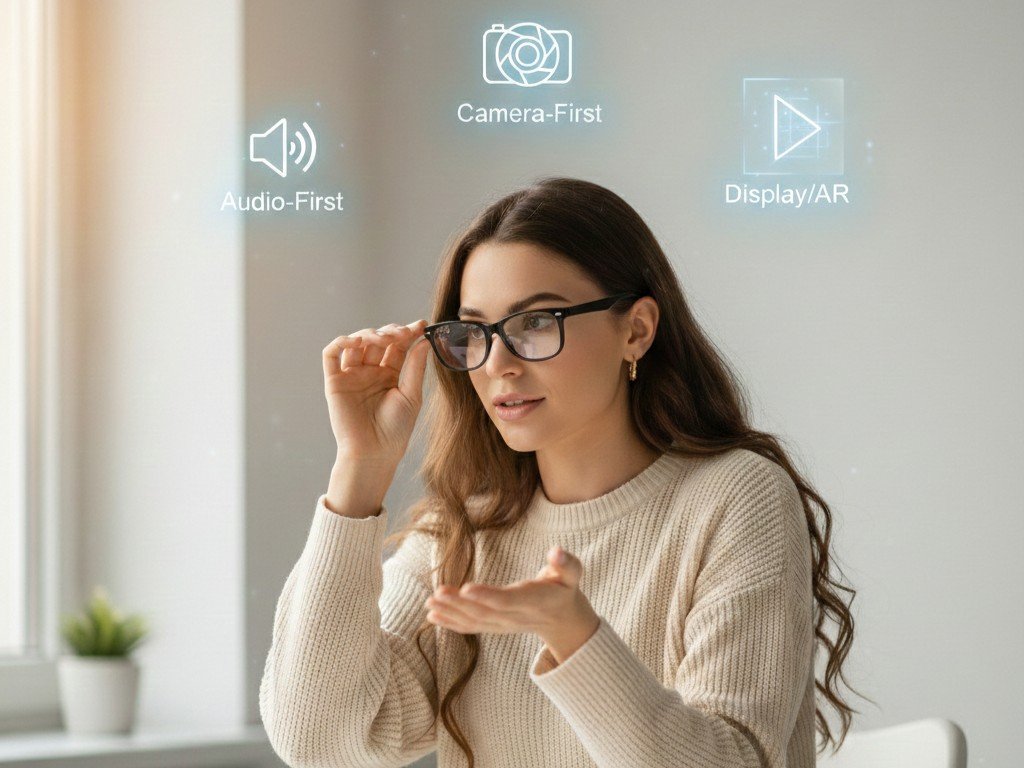
Smart Glasses Categories Explained
Audio and Camera Smart Glasses
These look nearly identical to standard eyewear. Technology lives inside the temple arms — speakers, microphones, cameras, and battery packed into slim profiles. Primary uses include hands-free music and calls, first-person video capture, voice assistant access, and navigation audio cues without looking at a phone.
Most deliver 4-6 hours of continuous audio playback, extending to 24-36 hours total with a charging case — comparable to wireless earbuds. Open-ear audio is audible to nearby people at moderate volumes, which is a genuine privacy trade-off worth considering before buying.
Camera capabilities typically capture decent photos and video but rarely match smartphone camera quality. First-person perspective footage, however, has real creative advantages unavailable from phone cameras.
Sports Smart Glasses
Performance-focused glasses designed for cyclists, runners, and skiers. A monocular heads-up display shows speed, heart rate, distance, and pace in peripheral vision without blocking primary vision. The core value is simple: checking metrics without looking down at a watch or phone maintains focus on the activity and reduces safety risk — particularly meaningful for cyclists.
Battery life typically reaches 8-12 hours, sufficient for most training sessions. Bright direct sunlight can reduce display readability in some models, and information density is limited to key metrics rather than complex interfaces.
Enterprise and Industrial Smart Glasses
Professional-grade glasses for warehouse workers, field technicians, surgeons, and inspection professionals. Binocular AR display shows guided assembly instructions, remote expert assistance feeds, and measurement overlays — all hands-free while working.
Enterprise succeeds where consumer struggles because the use case is precisely defined, productivity gains are measurable, and companies rather than individuals bear the cost. Understanding where enterprise smart glasses deliver genuine value helps predict the consumer trajectory: the same technology, refined and miniaturized, eventually reaches everyday wearers.
True Augmented Reality Smart Glasses
Projects digital content into the wearer’s field of view — navigation arrows on real streets, information panels near objects, digital elements inhabiting physical spaces. Current consumer AR glasses remain genuinely limited: field of view smaller than marketed, outdoor brightness washes out displays, and battery life under active AR use sits at just 2-3 hours.
These represent first-generation technology — impressive in demonstrations, real in limitations. Useful for specific early adopters, but not ready for mainstream all-day wear.
Top Products Available Today
| Ray-Ban Meta Gen 2 | Budget AI Smart Glasses | |
|---|---|---|
| Camera | 12MP · 3K Ultra HD | 8MP · 4K HD |
| Translation | Live | 133 languages ✅ |
| Waterproof | Splash resistant | IP67 ✅ |
| Battery | 2× extended ✅ | Standard |
| Style | Premium Wayfarer ✅ | Generic frames |
| Best For | Creators & daily use | Travelers & outdoors |
Ray-Ban Meta (Gen 2) Wayfarer — Best Premium Smart Glasses
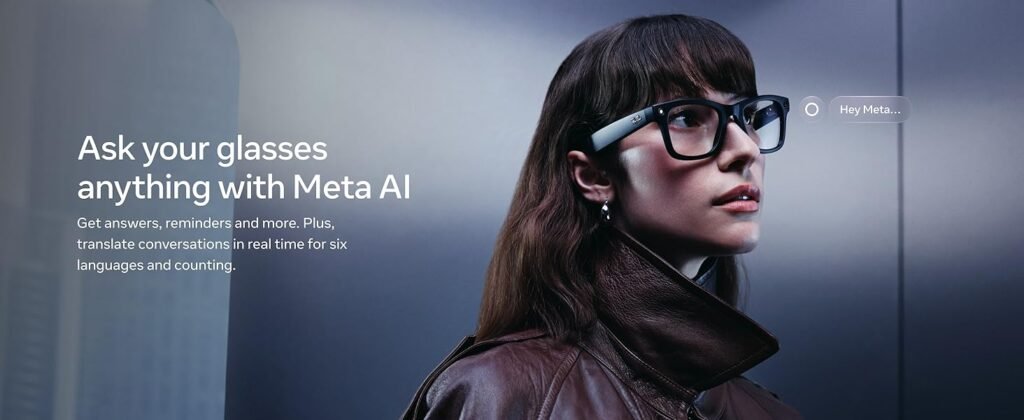
Best for: Everyday wearers wanting premium build quality, exceptional camera, and all-day battery life
The second generation Ray-Ban Meta raises the bar significantly over the original. Genuine Wayfarer design means these look indistinguishable from standard sunglasses — directly solving the most persistent smart glasses problem. The jump to 3K Ultra HD resolution and doubled battery life addresses the two most common first-generation complaints in one product update.
Key Features:
- 3K Ultra HD video recording with 12MP wide-angle camera
- 2× battery life versus previous generation
- Open-ear speaker audio (no earbuds required)
- Meta AI voice assistant with live translation
- Polarized gradient graphite lenses
- Bluetooth connectivity, compatible with iOS and Android
Real-World Strengths: Genuinely wearable all day without drawing attention. Ultra HD camera delivers footage quality noticeably sharper than the previous generation. Doubled battery life eliminates midday charging anxiety for most users. Meta AI integration handles natural voice queries — asking what you’re looking at, translating signs, answering questions — throughout the day without retrieving your phone.
Honest Limitations: No display — purely audio and camera. Open-ear speakers audible to people nearby. Camera quality still below flagship smartphones. Polarized lenses are not suitable for all screen viewing situations.
Who Should Buy: Content creators wanting best-in-class footage, users upgrading from Gen 1, professionals wanting all-day wearability, anyone wanting premium Ray-Ban aesthetic with genuine AI capability.
Who Should Skip: Anyone expecting AR overlay or any display. Budget-conscious buyers.
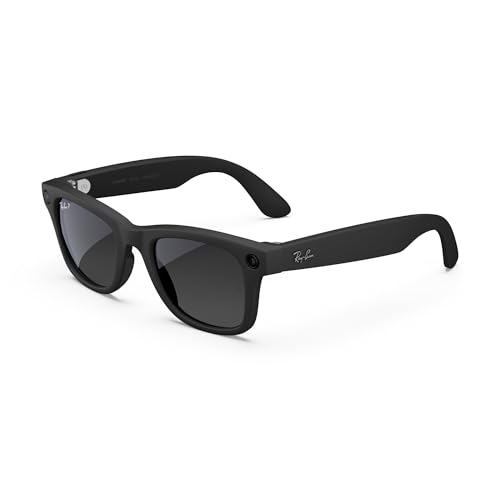
- Tap into iconic style and advanced technology with Ray-Ban Meta. Capture photos and videos, listen to music, make hands-…
- Chat with Meta AI to get suggestions, answers and reminders. Plus, with live translation, you can have a back-and-forth …
Budget AI Smart Glasses with 4K Camera — Best Value for Features

Best for: Travelers and outdoor users wanting maximum feature set at accessible cost
An impressive specification sheet — 4K video, real-time translation across 133 languages, voice assistant, object recognition, and IP67 waterproofing — at a fraction of premium brand pricing. For buyers wanting to explore smart glasses capabilities without premium investment, these represent a genuinely practical entry point.
Key Features:
- 4K HD video recording with 8MP camera
- Real-time translation in 133 languages
- AI voice control and object recognition
- IP67 waterproof rating for outdoor and rain use
- Bluetooth connectivity
- Photo, video, and audio recording
Real-World Strengths: Translation capability across 133 languages provides genuine utility for international travelers. IP67 waterproofing adds meaningful durability for outdoor and active use. Voice control and object recognition reduce phone dependency throughout the day.
Honest Limitations: Build quality and brand support below premium options. AI features functional but less refined than Meta’s implementation. Camera quality varies by usage conditions. App ecosystem less developed than established brands.
Who Should Buy: International travelers, outdoor adventurers, budget-conscious buyers exploring the smart glasses category, anyone needing wide language translation coverage.
Who Should Skip: Users prioritizing premium build quality and long-term brand support. Those wanting seamless integration with major platform ecosystems.
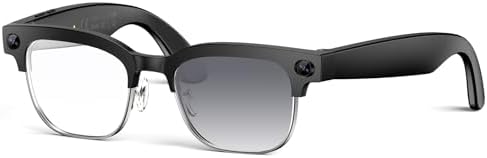
- 👓【8MP 4K HD Camera】These smart glasses feature an …
Who Actually Benefits Right Now
Content Creators: First-person footage from eye level captures authentic moments unavailable from phone cameras. Walking through a city, cooking, working in a workshop — the footage feels genuinely immersive. Increasingly valuable as authentic first-person content performs well across social platforms.
Active Commuters: Cycling or walking with audio and turn-by-turn navigation without phone in hand. Hands-free, eyes-up — a meaningfully safer way to commute.
International Travelers: Real-time translation across 133 languages removes language barriers naturally and hands-free throughout a trip. Asking for directions, reading menus, understanding signage — handled without pulling out a phone.

Athletes and Fitness Enthusiasts: Performance metric overlay during activity eliminates looking down at devices mid-training. The safety improvement for cyclists is particularly meaningful at speed.
AI Enthusiasts: Conversational AI access throughout the day — asking questions about surroundings, identifying objects, translating text in real time — without retrieving a phone from a pocket.
For households already building connected home ecosystems, smart glasses add a natural hands-free layer for device control and daily interaction.
Who Should Wait: Anyone wanting display or AR functionality should wait 2-3 years for technology that is meaningfully better and similarly priced. Style-focused buyers will find significantly more options within 1-2 years as fashion partnerships expand. Budget-sensitive buyers benefit from waiting as competition drives prices down.
Real Limitations to Know
Battery Life: Audio smart glasses deliver 4-6 hours of active use, extending to 24-36 hours total with a charging case. Display glasses sit at just 2-3 hours under active AR use. Full-day battery for display glasses is 2-3 years away. Daily charging is a real behavior change from standard glasses that never need charging at all.
Display Field of View: Current AR glasses display content in roughly 30-50 degrees of your approximately 220-degree natural field of vision. Digital content appears in a narrow window rather than naturally integrated with full sight. This is the core limitation making current consumer AR glasses feel like an early prototype.
Weight and Style: Battery, processor, camera, speakers, and optional display components require physical space. Smart glasses remain heavier than standard frames and the selection of styles is significantly narrower than the optical market. The Meta Ray-Ban collaboration proves fashion partnerships work. More collaborations are coming.
Privacy: Built-in cameras blur social norms around recording. LED indicator lights signal active recording but remain small. Use in genuinely private settings — someone else’s home, changing areas — raises real ethical concerns. Public use with an active indicator light is generally accepted.
Smartphone Dependency: Most smart glasses extend phone capabilities rather than replace them. Full features require a paired smartphone running iOS 16+ or Android 9+. You still carry your phone — smart glasses add a layer rather than eliminate a device.
Where the Technology Is Headed
1-3 Years: More capable and natural AI integration, longer battery life in audio models, improved prescription lens compatibility across more products, and more fashion brand partnerships that expand style options meaningfully.
3-5 Years: Lightweight AR display becoming viable in normal-looking frames — the most significant near-term development. Health monitoring integration using the natural all-day wear position of glasses: heart rate, stress indicators, blood oxygen. Display field of view expanding from current 30-50 degrees toward 70-90 degrees.
5-10 Years: True seamless AR with digital information naturally overlaid on the full visual field. Navigation arrows on actual streets. Information panels near real objects. Meaningful reduction in smartphone screen time as information consumption begins moving to visual overlay. This is the transformation the industry is building toward — the timeline is uncertain, but the direction is not.
Should You Buy Now or Wait?
Buy now if you want audio smart glasses for daily use — these are ready and genuinely useful. Buy now if you’re a content creator wanting authentic first-person footage, an international traveler needing hands-free translation, or an athlete who wants performance metrics without looking down.
Wait if you want display or AR functionality — 2-3 years delivers a meaningfully better experience at similar cost. Wait if style selection matters to you — more options are coming within 1-2 years. Wait if you’re price sensitive — costs are falling as the category matures.
Frequently Asked Questions
Are smart glasses worth buying in 2025? Depends entirely on use case. Audio smart glasses from established brands deliver genuine daily value for creators, commuters, travelers, and AI enthusiasts. Display and AR glasses remain early-stage for consumer use — impressive in demonstrations, limited for all-day wear. Match your expectation to the category before buying.
Do smart glasses work with all smartphones? Most require smartphone pairing with platform requirements. Meta Ray-Ban works with the Meta View app on iOS and Android. Most products require iOS 16+ or Android 9+. Some features vary between platforms. Verify specific compatibility on the manufacturer’s website before purchasing.
Can smart glasses have prescription lenses? Yes, with limitations. Ray-Ban Meta offers the most complete prescription integration through authorized optical retailers. Not all products support prescription lenses. Verify diopter range compatibility if you have a strong prescription before committing.
Are smart glasses safe for eyes? No peer-reviewed evidence of harm from current commercial products. Some users report eye fatigue with extended AR display use, similar to extended screen viewing. Audio-only smart glasses carry no eye concerns — equivalent to wearing standard glasses.
Can smart glasses replace smartphones? Not currently and not soon. They extend phone capabilities and reduce how often you physically interact with your phone. They cannot replace the screen for extended reading, video watching, navigation, or typing. Full replacement is likely 7-10+ years away.
Key Takeaways
Smart glasses span a wide spectrum — audio-first products deliver genuine value today while display and AR products are improving but genuinely limited for everyday wear. The Ray-Ban Meta Gen 2 represents the clearest mainstream success: premium camera, extended battery, and styling people actually choose voluntarily. Budget AI glasses offer compelling translation depth and IP67 waterproofing at accessible cost.
Buy for what products deliver today. The technology improvement over the next 3-5 years will be significant — but current products already justify investment for the right use cases.
This article contains affiliate links. Purchases made through links may earn a commission at no additional cost to you. All assessments reflect verified specifications and real-world user experience.