
Marketing emphasizes megapixel counts — 12MP, 48MP, 108MP — yet image quality from a 12MP full-frame camera dramatically exceeds a 48MP smartphone despite having one-quarter the pixel count. The difference is sensor size, which determines light-gathering ability, noise performance, and depth-of-field control far more than megapixel count.
This guide explains what camera sensor size actually is, how it affects image quality independently of megapixels, why larger sensors produce better low-light performance and background blur, and how to interpret sensor specifications across different device categories from smartphones to webcams to professional cameras.
Quick Navigation
- What Camera Sensor Size Means
- Sensor Size vs Megapixels
- How Sensor Size Affects Image Quality
- Common Sensor Size Standards
- Pixel Size and Pixel Density
- Low-Light Performance
- Depth of Field and Background Blur
- Crop Factor Explained
- Sensor Sizes in Different Devices
- When Megapixels Actually Matter
- FAQ
What Camera Sensor Size Means
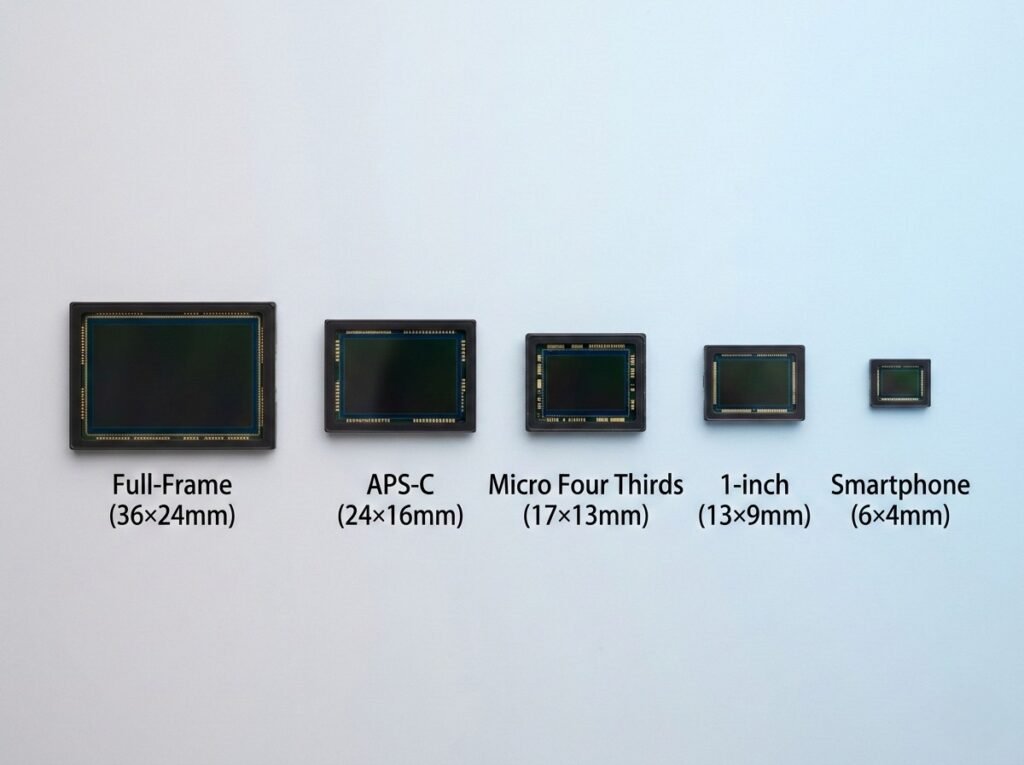
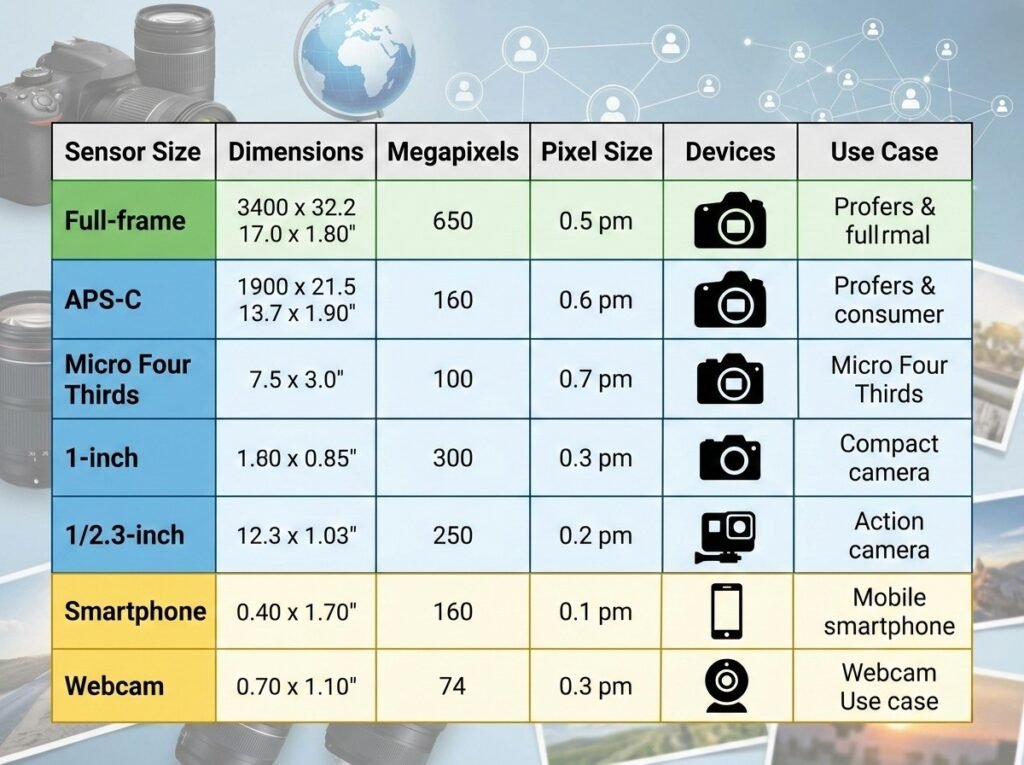
Camera sensor size refers to the physical dimensions of the imaging sensor — the chip that captures light and converts it to a digital image. Sensor size is measured diagonally (like TV screens) or by width × height in millimeters.
Physical Sensor Dimensions
Full-frame sensor: 36mm × 24mm (same as 35mm film)
APS-C sensor: ~24mm × 16mm (1.5-1.6× smaller than full-frame)
Micro Four Thirds: 17.3mm × 13mm (2× smaller than full-frame)
1-inch sensor: 13.2mm × 8.8mm (despite “1-inch” name — historical artifact)
1/2.3-inch sensor: 6.17mm × 4.55mm (most compact cameras, action cameras)
1/2.55-inch sensor: 5.6mm × 4.2mm (typical smartphone main camera)
1/3-inch sensor: 4.8mm × 3.6mm (webcams, older smartphones)
These measurements describe the actual light-collecting area. A full-frame sensor (36mm × 24mm = 864 mm²) has roughly 30× the surface area of a typical smartphone sensor (5.6mm × 4.2mm ≈ 23.5 mm²).
Why Sensor Size Is Measured Diagonally
The “1-inch,” “1/2.3-inch,” “1/3-inch” nomenclature comes from vacuum tube camera technology from the 1950s-60s. The measurement referred to the outer diameter of the imaging tube, not the actual sensor size. Modern digital sensors retained this confusing naming convention despite being much smaller than the stated measurement.
Example: A “1-inch” sensor is actually 13.2mm diagonal, not 25.4mm (1 inch = 25.4mm). The imaging area of the old 1-inch vacuum tube was roughly equivalent to today’s 13.2mm sensor.
Sensor Size vs Megapixels: The Critical Difference
Sensor size is the physical area collecting light. Megapixels is how many individual light-collecting points (pixels) are packed onto that area. These are independent variables.
The Bathtub Analogy
Sensor size = size of bathtub collecting rainwater
Megapixels = number of measuring cups you divide the water into
Large bathtub with few cups (large sensor, low MP): Each cup collects substantial water. Measurements are accurate because each cup has plenty of water.
Large bathtub with many cups (large sensor, high MP): Each cup still collects meaningful water. Measurements remain accurate with added detail.
Small bathtub with many cups (small sensor, high MP): Each cup collects minimal water. Measurements become unreliable because each cup doesn’t gather enough water. This is why 108MP smartphones don’t outperform 12MP full-frame cameras.
Real-World Example
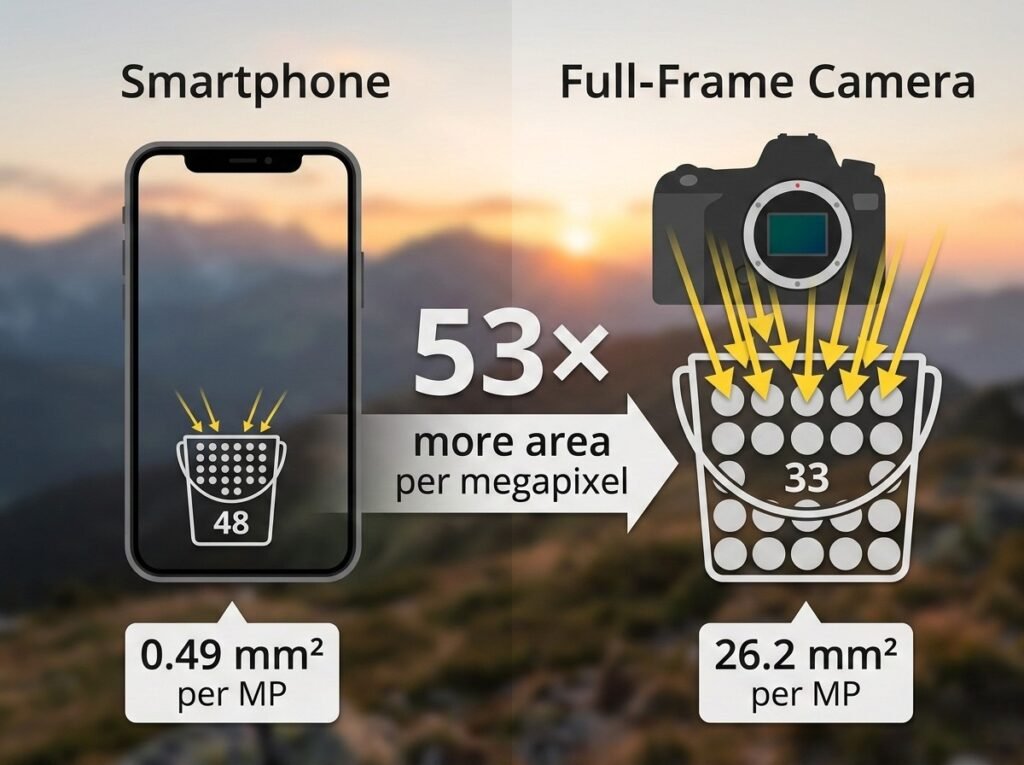
iPhone 14 Pro: 48MP on 1/2.55-inch sensor = 0.49 mm² per megapixel
Sony A7 IV full-frame: 33MP on full-frame sensor = 26.2 mm² per megapixel
The full-frame camera has 53× more sensor area per megapixel despite having fewer total megapixels. Each pixel gathers 53× more light, producing dramatically better low-light performance and dynamic range.
How Sensor Size Affects Image Quality
Sensor size impacts multiple image quality dimensions independently of megapixel count.
Light-Gathering Ability
Larger sensor = more total light collected
A full-frame sensor (864 mm²) collects 30× more total light than a 1/2.55-inch smartphone sensor (23.5 mm²) in the same exposure time. This additional light provides:
Lower noise: More photons per pixel means better signal-to-noise ratio. Images are cleaner, especially in low light.
Greater dynamic range: Ability to capture detail in both bright highlights and dark shadows simultaneously. Full-frame sensors typically achieve 14-15 stops of dynamic range; smartphone sensors achieve 10-11 stops.
Better color accuracy: More photons per color channel (red, green, blue) means more accurate color reproduction.
Pixel Quality vs Quantity
Individual pixel size matters more than pixel count for image quality.
Large pixels (2-4 μm on smartphones, 4-8 μm on full-frame): Collect more photons, have better signal-to-noise ratio, produce cleaner images
Small pixels (0.7-1.5 μm on high-MP smartphones): Collect fewer photons, are more susceptible to noise, require aggressive computational processing to produce acceptable images
Modern smartphones compensate for small pixels through computational photography (pixel binning, multi-frame HDR, AI noise reduction), but physics limits what software can achieve. A 1μm pixel cannot gather as much light as a 4μm pixel regardless of processing algorithms.
Native ISO Performance
Larger sensors have higher native ISO sensitivity
Full-frame cameras: Native ISO 100-6400, usable to ISO 25,600+
APS-C cameras: Native ISO 100-3200, usable to ISO 12,800
Micro Four Thirds: Native ISO 100-1600, usable to ISO 6400
Smartphones: Native ISO 50-400, usable to ISO 1600 (heavily processed beyond this)
Native ISO is the sensitivity range where the sensor operates without significant noise amplification. Larger sensors maintain image quality at higher ISO because larger pixels generate stronger electrical signals, requiring less amplification (which also amplifies noise).
Common Sensor Size Standards
Understanding sensor size categories helps interpret specifications across different camera types.
Full-Frame (35mm Equivalent)
Dimensions: 36mm × 24mm
Diagonal: 43.3mm
Area: 864 mm²
Used in: Professional DSLR/mirrorless cameras, high-end cinema cameras
Advantages: Maximum light gathering, best low-light performance, shallowest depth-of-field control
Disadvantages: Expensive, requires large lenses, produces large/heavy camera systems
APS-C (Advanced Photo System type-C)
Dimensions: ~24mm × 16mm (varies by manufacturer)
Diagonal: 28.8mm
Area: ~384 mm² (1.5-1.6× smaller than full-frame)
Used in: Entry-level to enthusiast DSLR/mirrorless cameras
Advantages: Good balance of image quality and system size/cost, wide lens selection
Disadvantages: Less low-light capability than full-frame, less background blur at equivalent apertures
Micro Four Thirds
Dimensions: 17.3mm × 13mm
Diagonal: 21.6mm
Area: 225 mm² (2× smaller than full-frame)
Used in: Olympus and Panasonic mirrorless cameras
Advantages: Compact camera/lens size, excellent for video (2× crop factor aids stabilization)
Disadvantages: More limited low-light performance, less background blur control
1-Inch Sensor
Dimensions: 13.2mm × 8.8mm
Diagonal: 15.9mm
Area: 116 mm² (2.7× larger than typical smartphone)
Used in: Premium compact cameras, some action cameras, high-end drones
Advantages: Significantly better than smartphones, still compact enough for pocketable cameras
Disadvantages: Not as good as APS-C or larger, limited lens options on fixed-lens compacts
1/2.3-Inch Sensor
Dimensions: 6.17mm × 4.55mm
Diagonal: 7.7mm
Area: 28 mm²
Used in: Most compact cameras, action cameras like GoPro, entry-level drones
Advantages: Very compact, low power consumption, wide depth-of-field (everything in focus)
Disadvantages: Poor low-light performance, limited dynamic range, minimal background blur capability
For action camera specifics, see our guide to budget action cameras for beginners.
Smartphone Sensors (1/2.55-inch to 1/1.3-inch)
Typical main camera: 1/2.55-inch (5.6mm × 4.2mm, ~23.5 mm²)
Large smartphone sensors: 1/1.3-inch (10mm × 7.5mm, ~75 mm²) on premium flagships
Used in: Smartphones, tablets
Advantages: Computational photography compensates for small size, extremely portable
Disadvantages: Physics limits — cannot match larger sensors in low light or dynamic range despite software tricks
Webcam Sensors (1/3-inch to 1/2.9-inch)
Dimensions: 4.8mm × 3.6mm to 5mm × 3.8mm
Area: 17-19 mm²
Used in: Webcams, laptop built-in cameras
Advantages: Sufficient for video calls, low cost, low power
Disadvantages: Poor low-light performance (struggles in typical indoor lighting)
Modern professional webcams use 1/2.9-inch or larger sensors with better optics to overcome typical webcam limitations.
Pixel Size and Pixel Density Explained
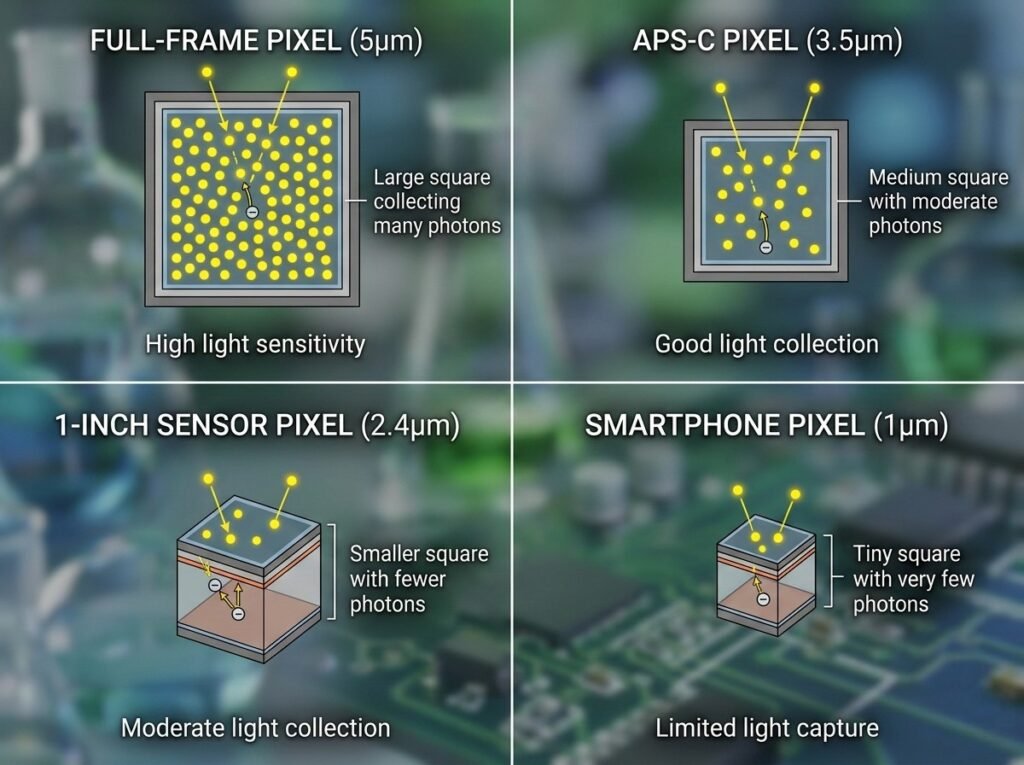
Pixel size (measured in micrometers, μm) determines how much light each individual pixel can collect. Larger pixels gather more photons, producing better image quality.
Calculating Pixel Size
Pixel pitch = √(Sensor Area / Megapixels)
Example 1: iPhone 14 Pro
- Sensor: 1/2.55-inch (23.5 mm²)
- Megapixels: 48MP
- Pixel size: √(23.5 / 48) = 0.7 μm
Example 2: Sony A7 IV
- Sensor: Full-frame (864 mm²)
- Megapixels: 33MP
- Pixel size: √(864 / 33) = 5.1 μm
The full-frame camera has 7.3× larger pixels, collecting far more light per pixel despite lower total megapixel count.
Pixel Size Categories
Large pixels (4-8 μm): Professional full-frame cameras. Exceptional low-light performance, wide dynamic range, minimal noise.
Medium pixels (2-4 μm): APS-C cameras, premium compact cameras with 1-inch sensors. Good low-light performance, moderate dynamic range.
Small pixels (1-2 μm): Smartphones, action cameras, webcams. Require good lighting, significant noise reduction processing in low light.
Very small pixels (< 1 μm): High-megapixel smartphones (64MP, 108MP). Heavy computational processing required, often bin 4 pixels into 1 for actual image capture.
Pixel Binning
Many high-megapixel smartphones use pixel binning — combining multiple physical pixels into one “super pixel” for actual image capture.
Example: 48MP smartphone sensor with 0.7μm pixels bins 4 pixels (2×2 grid) into one 12MP image with effective 1.4μm pixels. This improves low-light performance at the cost of resolution.
Binning is a software workaround for the physics limitation of small pixels. A native 1.4μm pixel would perform slightly better than 4 binned 0.7μm pixels due to less inter-pixel interference.
Low-Light Performance and Sensor Size
Low-light image quality correlates directly with sensor size and pixel size, not megapixel count.
Why Larger Sensors Excel in Low Light
More total light collection: Larger physical area captures more photons in the same exposure time.
Larger individual pixels: More light per pixel means stronger electrical signal with better signal-to-noise ratio.
Less amplification required: Stronger signal requires less ISO gain (amplification), which also amplifies noise.
Quantifying Low-Light Performance
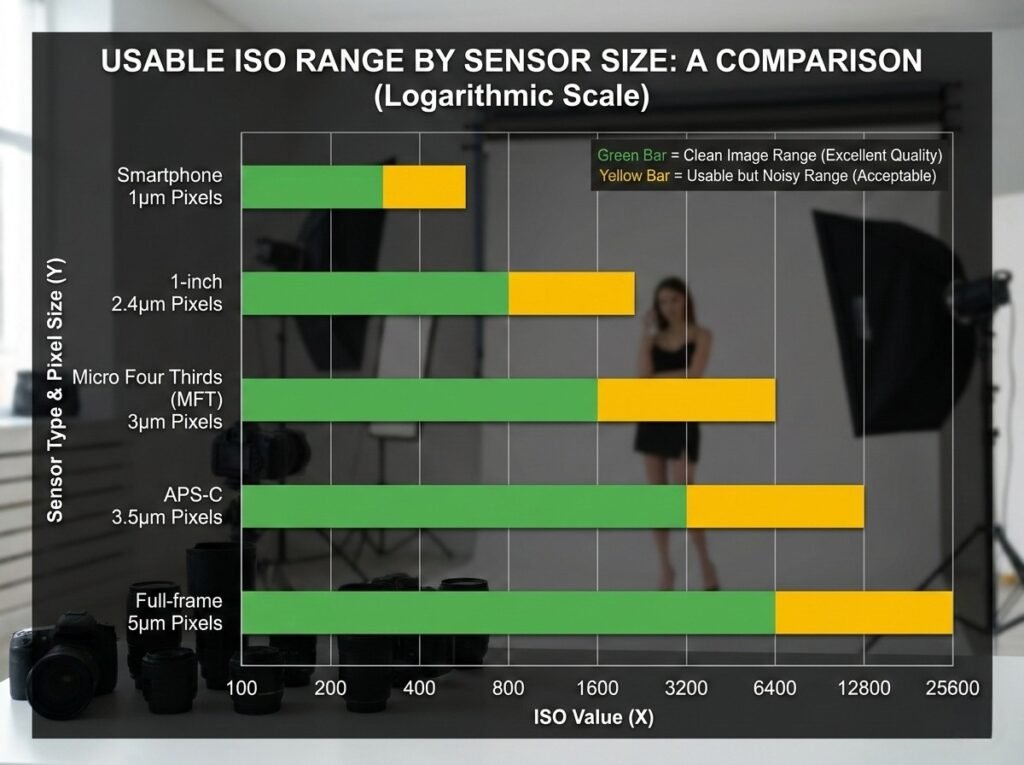
Full-frame camera (5μm pixels): Produces clean images at ISO 6400, usable images at ISO 25,600
APS-C camera (3.5μm pixels): Produces clean images at ISO 3200, usable images at ISO 12,800
Micro Four Thirds (3μm pixels): Produces clean images at ISO 1600, usable images at ISO 6400
1-inch sensor (2.4μm pixels): Produces clean images at ISO 800, usable images at ISO 3200
Smartphone (1μm pixels): Produces clean images at ISO 400, heavily processed images at ISO 1600
These are approximate thresholds where noise becomes noticeable. Each step down in sensor size represents roughly 1-2 stops less light-gathering capability.
Computational Photography Compensation
Smartphones compensate for small sensors through:
Multi-frame capture: Taking 3-9 images rapidly and merging them to reduce noise
Night mode: Extended exposures (1-3 seconds) combined with gyroscope-based stabilization and frame alignment
AI noise reduction: Machine learning trained to distinguish detail from noise
These techniques work remarkably well but cannot overcome physics. A full-frame camera’s single exposure outperforms a smartphone’s computational multi-frame merge in extreme low light.
Depth of Field and Background Blur
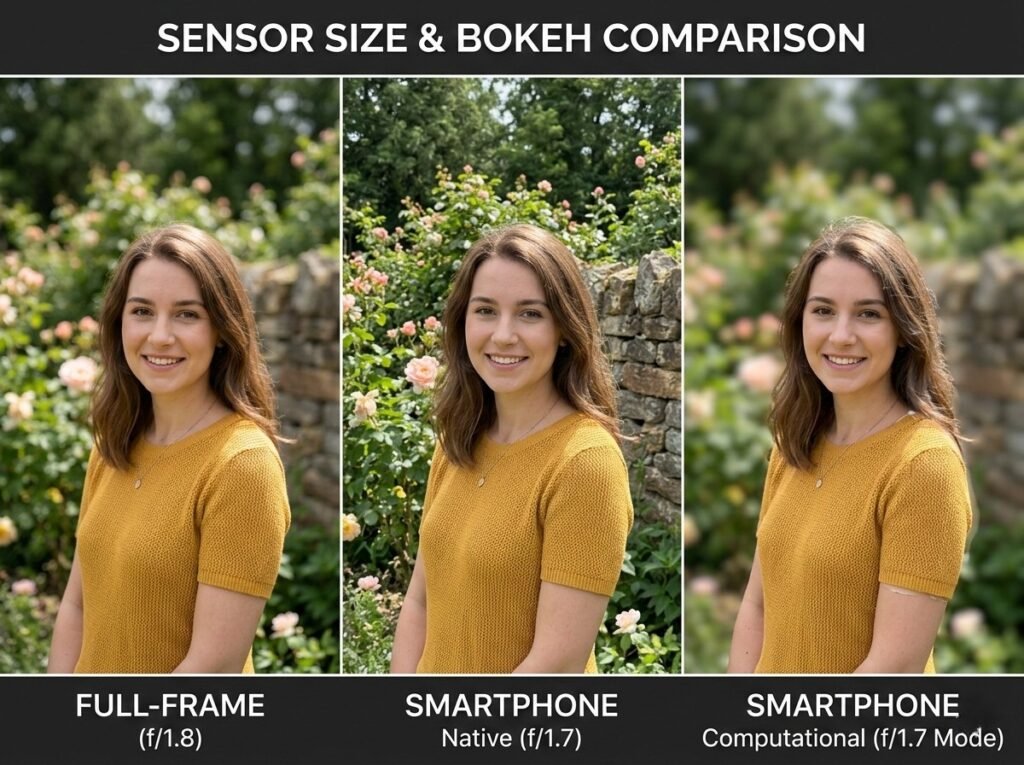
Sensor size directly affects depth-of-field — how much of the image is in sharp focus. Larger sensors enable shallower depth-of-field (blurred backgrounds) at equivalent framing.
The Physics of Depth-of-Field
Depth-of-field depends on:
- Aperture (f-number)
- Focal length
- Subject distance
- Sensor size (via focal length relationship)
To achieve the same field-of-view (framing) on different sensor sizes, you must use different focal lengths. Smaller sensors require shorter focal lengths. Shorter focal lengths increase depth-of-field.
Real-World Example
Goal: Portrait with subject filling frame, background blurred
Full-frame camera:
- Focal length: 85mm
- Aperture: f/2.8
- Result: Shallow depth-of-field, beautifully blurred background
Smartphone:
- Focal length: 6.5mm (equivalent field-of-view to 85mm on full-frame)
- Aperture: f/1.8 (wider than full-frame, yet…)
- Result: Everything in focus — background remains sharp despite wide aperture
The smartphone’s 6.5mm focal length creates deep depth-of-field that even f/1.8 cannot overcome. The full-frame’s 85mm focal length at f/2.8 produces far shallower depth-of-field.
Simulated Bokeh vs Optical Bokeh
Smartphones use computational bokeh (portrait mode) — software that detects subject edges and artificially blurs background. This works well in ideal conditions but often creates:
- Edge artifacts (hair strands incorrectly blurred or kept sharp)
- Unnatural blur quality (doesn’t match optical lens bokeh characteristics)
- Errors with complex scenes (multiple subjects at different distances)
Optical bokeh from large sensors is physically accurate and handles all scenes correctly without edge detection errors.
Crop Factor and Focal Length Equivalence
Crop factor describes the relationship between a sensor size and full-frame (35mm) reference. It affects focal length equivalence and depth-of-field.
Calculating Crop Factor
Crop factor = Full-frame diagonal / Sensor diagonal
Examples:
- APS-C: 43.3mm / 28.8mm = 1.5× crop factor
- Micro Four Thirds: 43.3mm / 21.6mm = 2× crop factor
- 1-inch: 43.3mm / 15.9mm = 2.7× crop factor
- Smartphone (1/2.55″): 43.3mm / 6.8mm = 6.4× crop factor
Focal Length Equivalence
To achieve the same field-of-view as a full-frame lens, multiply the actual focal length by crop factor.
Example: 50mm lens on different sensors
- Full-frame: 50mm actual = 50mm equivalent
- APS-C (1.5× crop): 33mm actual = 50mm equivalent
- Micro Four Thirds (2× crop): 25mm actual = 50mm equivalent
- Smartphone (6.4× crop): 7.8mm actual = 50mm equivalent
This is why smartphone lenses are physically tiny (4-8mm) yet provide “normal” to “telephoto” fields-of-view.
Depth-of-Field Equivalence
Crop factor also affects depth-of-field equivalence. To match both field-of-view AND depth-of-field from full-frame, you must:
- Divide focal length by crop factor
- Divide aperture by crop factor
Example: Matching full-frame 50mm f/2 on Micro Four Thirds (2× crop)
- Focal length: 50mm / 2 = 25mm ✓
- Aperture: f/2 / 2 = f/1.0 (impossible on most lenses)
This physical limitation is why smaller sensors cannot match full-frame background blur — the equivalent apertures would be f/0.7, f/0.5, or wider (impossible to manufacture).
Sensor Sizes Across Device Categories
Professional Cameras
DSLR/Mirrorless: Full-frame or APS-C
Cinema cameras: Full-frame, Super 35mm (APS-C equivalent), or medium format (larger than full-frame)
Megapixels: 12-60MP typically
Pixel size: 3-8 μm
Priority: Image quality, dynamic range, low-light performance, lens selection
Compact Cameras
Premium compacts: 1-inch sensor
Budget compacts: 1/2.3-inch sensor
Megapixels: 12-20MP
Pixel size: 1.5-2.4 μm
Priority: Portability balanced with acceptable image quality
Action Cameras
Standard: 1/2.3-inch sensor
Premium: 1-inch sensor (rare)
Megapixels: 12-20MP
Pixel size: 1.4-1.6 μm
Priority: Wide field-of-view, stabilization, durability over ultimate image quality
Smartphones
Main camera: 1/2.55-inch to 1/1.3-inch
Ultrawide: 1/3-inch to 1/2.55-inch
Telephoto: 1/3-inch to 1/2-inch
Megapixels: 12-200MP (binned to 12-50MP typically)
Pixel size: 0.7-2.4 μm (1.4-4.8μm after binning)
Priority: Computational photography, multiple focal lengths, extreme portability
Webcams
Standard: 1/3-inch to 1/4-inch
Premium: 1/2.9-inch to 1/2.5-inch
Megapixels: 2-8MP (1080p requires 2MP, 4K requires 8MP)
Pixel size: 1.5-3 μm
Priority: Cost, size, adequate quality for video calls
Smart Glasses
Camera sensors: 1/3-inch to 1/2.9-inch
Megapixels: 5-13MP
Pixel size: 1.0-1.4 μm
Priority: Size/weight constraints, power efficiency
For smart glasses camera capabilities, see our smart glasses current options and future prospects guide.
When Megapixels Actually Matter
Megapixels are not irrelevant — they matter for specific use cases where resolution is the limiting factor.
Megapixels Matter When:
Large prints: Printing poster-size (24″× 36″ or larger) requires 20-40MP for optimal sharpness at close viewing distance.
Cropping flexibility: If you shoot wide and crop heavily in post-processing, higher megapixels preserve detail after crop. A 45MP image cropped to 50% still provides 11MP.
Commercial photography: Stock photography, advertising, magazine covers require high resolution for flexibility in layout and cropping.
Archival purposes: Preserving maximum possible detail for future use when display technology improves.
Megapixels Don’t Matter When:
Web/social media use: Instagram compresses to ~1MP. Facebook compresses to ~2MP. Extra megapixels are discarded.
1080p/4K video: 1080p video is 2MP. 4K video is 8MP. Higher megapixels provide cropping/stabilization headroom but don’t improve output resolution.
Low-light photography: Fewer, larger pixels outperform more, smaller pixels. A 12MP full-frame sensor produces better low-light images than a 48MP smartphone.
Standard printing: 8″×10″ prints look excellent at 8-12MP. 16″×20″ prints look good at 12-18MP. Megapixels beyond this are wasted for typical print sizes.
Sensor size limited: Adding megapixels to a small sensor creates smaller pixels with worse noise performance. A 108MP smartphone sensor doesn’t outperform a 12MP full-frame camera.
Frequently Asked Questions
Why does my 48MP smartphone take 12MP photos by default?
Pixel binning. The 48MP sensor has 0.7-0.8μm pixels — too small for good low-light performance. Default mode bins 4 pixels into 1, creating 12MP images with effective 1.4-1.6μm pixels that gather 4× more light. This produces better overall image quality than using all 48MP with tiny pixels.
Can a smartphone camera match a DSLR?
In good lighting with computational processing, modern flagship smartphones approach entry-level DSLR quality for web/social media use. In low light, with background blur, or for large prints, physics limits prevent smartphones from matching even entry-level DSLR/mirrorless cameras with APS-C sensors. Full-frame cameras remain in a completely different performance tier.
What sensor size should a webcam have for good video calls?
Minimum 1/3-inch for acceptable quality. 1/2.9-inch or larger for noticeably better low-light performance in typical indoor lighting. 1/2.5-inch sensors (found in premium webcams) provide excellent video call quality with minimal noise in varied lighting.
Why do action cameras have small sensors?
Physical constraints. Wide-angle lenses required for action cameras (120-170° field-of-view) are easier to design for small sensors. Larger sensors require larger, heavier lenses that increase camera size and weight — problematic for helmet/body mounting. The trade-off favors compact size over ultimate image quality.
Does more megapixels mean better video quality?
Not directly. 4K video requires 8MP. 1080p requires 2MP. Megapixels beyond this provide cropping/stabilization headroom and allow oversampling (downscaling from higher resolution for better quality) but don’t increase output resolution. Sensor size, pixel quality, and processing matter more than megapixel count for video quality.
Why do professional cameras often have lower megapixels than smartphones?
Larger pixels prioritized over pixel count. A 12MP full-frame camera has 5μm pixels collecting massive amounts of light. A 108MP smartphone has 0.7μm pixels collecting minimal light each. The full-frame camera produces superior dynamic range, color accuracy, and low-light performance despite 9× fewer pixels. Professional photographers choose image quality over resolution.
Key Takeaways
Sensor size determines light-gathering ability and is far more important than megapixel count for image quality. A full-frame sensor (36mm × 24mm) collects 30× more light than a typical smartphone sensor (5.6mm × 4.2mm) despite often having fewer megapixels. This translates to dramatically better low-light performance, dynamic range, and color accuracy.
Pixel size matters more than pixel count. Large pixels (4-8 μm on professional cameras) collect more photons and produce cleaner images than small pixels (0.7-1.5 μm on smartphones) regardless of total megapixel count. A 12MP camera with 5μm pixels outperforms a 48MP camera with 1μm pixels in virtually all scenarios except ultimate resolution for large prints.
Depth-of-field and background blur are physically limited by sensor size. Smaller sensors require shorter focal lengths to achieve equivalent field-of-view, which increases depth-of-field and keeps everything in focus. Smartphones cannot match the background blur from APS-C or full-frame cameras — computational bokeh simulates the effect but creates artifacts. This is physics, not fixable through software.
Megapixels matter for large prints, heavy cropping, and commercial use where resolution is the limiting factor. For web use, social media, standard prints, and video, megapixels beyond 12-20MP provide minimal benefit. Higher megapixels on small sensors often hurt image quality by creating smaller pixels with worse noise performance. Match megapixel count to use case and sensor size.
Related guides: