
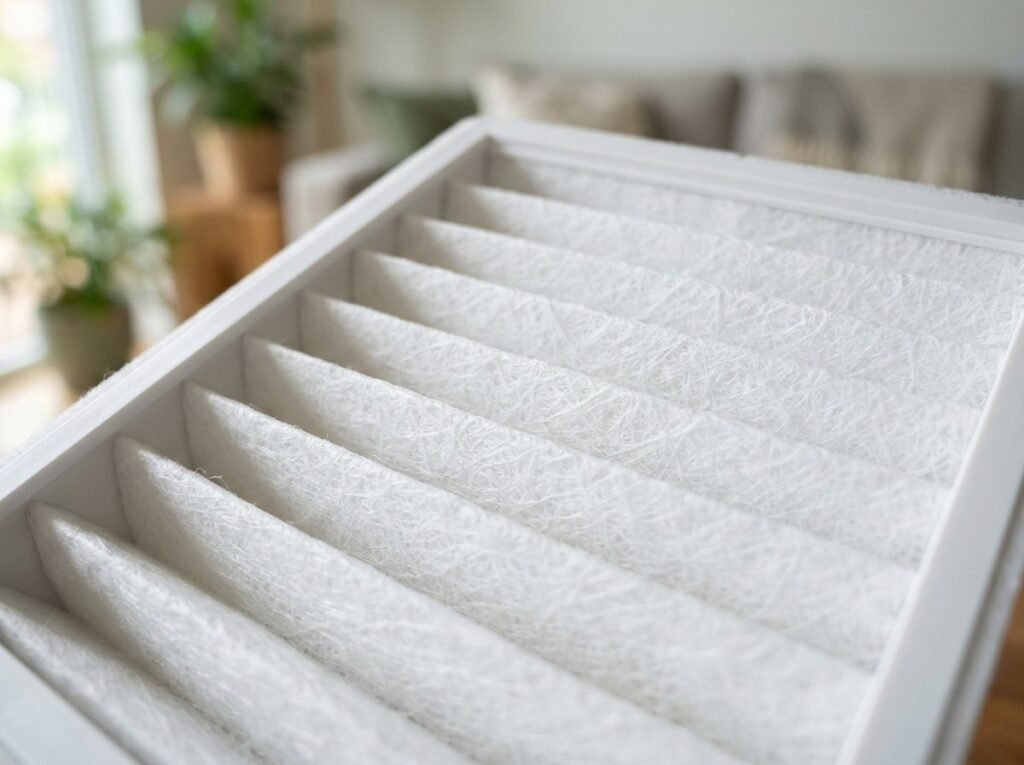
Air purifier marketing uses terms like “True HEPA,” “HEPA-type,” “Medical-grade HEPA,” and “H13” interchangeably — yet these represent dramatically different filtration standards with 10-100× differences in actual particle capture efficiency.
This guide explains the engineering standards behind HEPA classifications, what each rating actually filters and what it doesn’t, how manufacturers exploit loose terminology, and which filter grade matters for your specific air quality concerns.
Quick Navigation
- What HEPA Actually Means
- How HEPA Filters Work
- HEPA Rating Standards
- True HEPA vs HEPA-Type
- European HEPA Classes
- Medical-Grade HEPA (H13/H14)
- ULPA Filters
- What Different Ratings Actually Filter
- HEPA for Specific Air Quality Needs
- Filter Lifespan and Replacement
- Common HEPA Marketing Deception
- FAQ
What HEPA Actually Means
HEPA is an acronym for High-Efficiency Particulate Air filter — a specific filtration standard, not a general term for “good filter.” To be called True HEPA, a filter must capture at least 99.97% of particles that are 0.3 micrometers (μm) in diameter.
Why 0.3 Micrometers?
0.3 μm is the Most Penetrating Particle Size (MPPS) — the hardest size for HEPA filters to capture. Particles larger and smaller than 0.3 μm are actually captured more efficiently than particles at exactly 0.3 μm.
Larger particles (> 0.5 μm): Captured by impaction and interception — they’re too big to follow air flow around fibers and crash into them.
Smaller particles (< 0.1 μm): Captured by diffusion — random Brownian motion causes them to wander off air flow paths and stick to fibers.
0.3 μm particles: Too large for efficient diffusion, too small for efficient impaction. This is the sweet spot where filters perform worst, making it the standard test size.
HEPA Origins
HEPA filters were developed during the Manhattan Project in the 1940s to capture radioactive particles. The technology was declassified after WWII and adopted for industrial clean rooms, hospitals, and eventually consumer air purifiers.
The original military specification became the basis for modern HEPA standards, though “HEPA” itself is not a trademark and has no legal enforcement in consumer products — creating the terminology confusion that exists today.
How HEPA Filters Physically Work
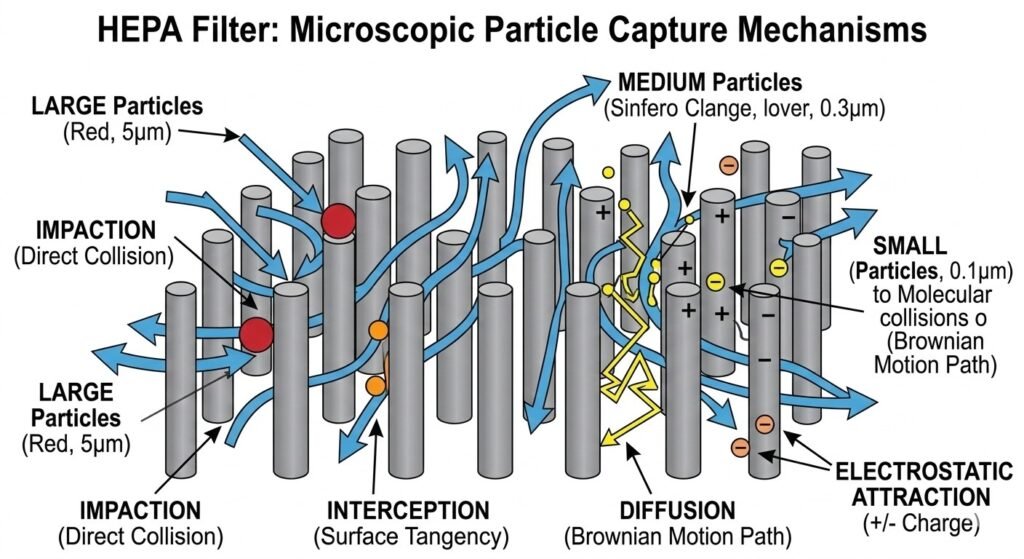
HEPA filters are not sieves with microscopic holes. They’re dense mats of randomly oriented fibers that capture particles through four physical mechanisms.
The Four Capture Mechanisms
1. Interception: Particle follows air flow streamline that passes within one particle radius of a fiber. Particle touches fiber and sticks due to van der Waals forces.
2. Impaction: Particle has enough inertia that it cannot follow rapid air flow changes around fibers. Particle crashes into fiber and adheres.
3. Diffusion: Particles < 0.1 μm exhibit Brownian motion (random movement from collisions with air molecules). This random walk causes particles to contact fibers even when following an air streamline that should miss them.
4. Electrostatic attraction: Some HEPA filters are electrostatically charged. Particles are attracted to fibers electrostatically, increasing capture efficiency beyond mechanical mechanisms alone.
Filter Construction
Material: Borosilicate glass fibers or synthetic polymer fibers (polypropylene, polyester) arranged in random web formation.
Fiber diameter: 0.5-2 micrometers — smaller than the particles being captured.
Packing density: Fibers packed densely enough to force air through tortuous paths that maximize particle-fiber interactions.
Pleating: Filter media folded in accordion pattern to maximize surface area in compact space. More surface area = more air flow at lower pressure drop.
Frame: Rigid frame prevents air bypass around filter edges. Even small gaps bypass a significant portion of air, destroying filtration efficiency.
Air Flow and Pressure Drop
HEPA filters create significant air resistance. Forcing air through dense fiber mats requires energy. The denser the packing (higher filtration efficiency), the higher the pressure drop (harder to push air through).
Typical residential HEPA pressure drop: 200-500 Pascals (0.8-2 inches water column) at rated flow
Result: Air purifier fan must be powerful enough to move target air volume (CFM) against HEPA resistance. Cheap fans cannot maintain adequate flow, reducing effective filtration even with True HEPA filter.
HEPA Rating Standards Explained
Multiple organizations define HEPA standards with different test methods and minimum efficiency requirements, creating confusion about what “HEPA” actually means.
U.S. Department of Energy (DOE) Standard
Rating: HEPA (no subclasses)
Requirement: ≥99.97% efficiency at 0.3 μm MPPS
Test method: DOP (Dioctyl Phthalate) aerosol challenge at specified flow rate
Usage: U.S. military, nuclear facilities, some industrial applications
Consumer relevance: “True HEPA” typically refers to filters meeting this standard, though manufacturers self-certify with no independent verification required.
European Standard (EN 1822)
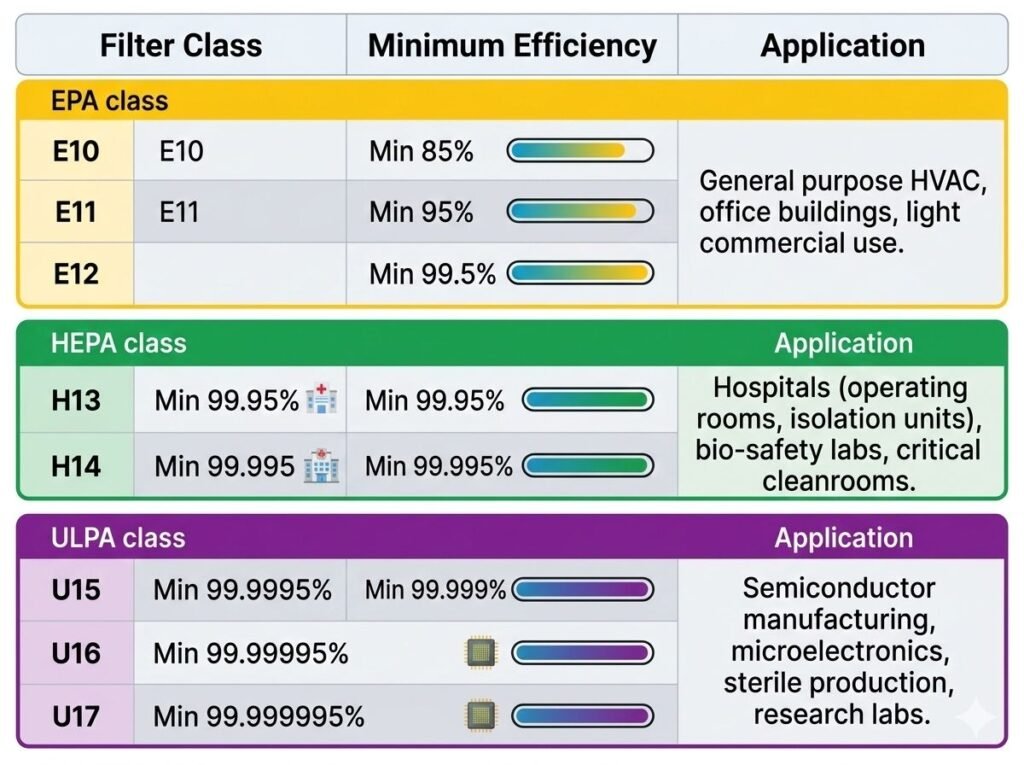
Ratings: E10, E11, E12, H13, H14, U15, U16, U17
Requirements: Graduated efficiency levels from 85% (E10) to 99.999995% (U17)
Test method: MPPS testing with sodium chloride or paraffin oil aerosol
Usage: European industrial, medical, consumer products
Consumer relevance: H13 (99.95% at MPPS) and H14 (99.995% at MPPS) marketed as “medical-grade HEPA” in consumer air purifiers. More stringent than U.S. True HEPA.
ISO 29463 Standard
Ratings: ISO 15 E through ISO 45 U
Requirements: Similar to EN 1822 but with additional test procedures
Usage: International standard harmonizing various regional specifications
Consumer relevance: Rarely used in consumer product marketing. Primarily industrial.
True HEPA vs HEPA-Type: The Critical Difference
“HEPA-type,” “HEPA-like,” “HEPA-style,” and similar terms are marketing language for filters that don’t meet True HEPA standards. The efficiency difference is massive.
True HEPA
Minimum efficiency: 99.97% at 0.3 μm
Real-world performance: Captures essentially all pollen, mold spores, most bacteria, many viruses when attached to larger particles
Cost: $30-100 replacement filter for residential air purifiers
Construction: Genuine borosilicate glass fiber or high-density synthetic fiber media with proper pleating and sealing
Identification: Product should explicitly state “True HEPA” or “HEPA H13” or “99.97% at 0.3 microns.” If specification is vague (“HEPA-type filtration”), it’s not True HEPA.
HEPA-Type / HEPA-Like / HEPA-Style
Minimum efficiency: No standard — typically 85-95% at 0.3 μm (manufacturers choose)
Real-world performance: Captures most large particles (pollen, dust), many medium particles (mold spores), but significant escape of small particles (some bacteria, most virus-containing aerosols)
Cost: $10-25 replacement filter
Construction: Lower-density fiber media, less precise manufacturing, may allow edge leakage
Identification: Uses qualified terms: “HEPA-type,” “HEPA-like,” “HEPA-style,” “99% efficient” (without specifying particle size)
The 99.97% vs 95% Difference
Example: Air purifier processes 1,000,000 particles
- True HEPA (99.97%): 300 particles escape
- HEPA-type (95%): 50,000 particles escape
HEPA-type allows 167× more particles to pass through than True HEPA. For allergy sufferers or immune-compromised individuals, this difference is clinically significant.
European HEPA Classes: H10 Through H14
The European EN 1822 standard defines HEPA filters more precisely than U.S. standards, with graduated classes from E10 (barely HEPA) to U17 (ultra-low penetration).
EPA (Efficient Particulate Air) Classes
E10: ≥85% efficiency at MPPS
Not technically HEPA but sometimes marketed as “HEPA-type”
E11: ≥95% efficiency at MPPS
Better than HEPA-type but not True HEPA equivalent
E12: ≥99.5% efficiency at MPPS
Approaches True HEPA but doesn’t quite meet U.S. 99.97% standard
HEPA Classes
H13: ≥99.95% efficiency at MPPS
First true HEPA grade under European standard. Slightly more stringent than U.S. True HEPA (99.97% vs 99.95% — difference is negligible in practice).
H14: ≥99.995% efficiency at MPPS
Medical-grade HEPA. Used in hospital isolation rooms, pharmaceutical manufacturing. 10× better than H13 at capturing the hardest-to-filter particles.
ULPA (Ultra-Low Penetration Air) Classes
U15: ≥99.9995% efficiency at MPPS
U16: ≥99.99995% efficiency at MPPS
U17: ≥99.999995% efficiency at MPPS
ULPA filters are used in semiconductor manufacturing and BSL-4 biological laboratories. Overkill for residential use and require extremely powerful fans to overcome pressure drop.
For residential air quality improvement, see our guide to air purifiers for large rooms.
Medical-Grade HEPA: H13 and H14
“Medical-grade” is marketing terminology, not an official designation. However, H13 and H14 filters are the grades typically used in medical facilities.
H13 HEPA (99.95% at MPPS)
Used in: Hospital general wards, some operating rooms, pharmaceutical clean rooms (Class D)
Captures: Essentially all pollen, mold, bacteria, many virus particles (when attached to larger respiratory droplets)
Residential use: Beneficial for severe allergy sufferers, asthma patients, immune-compromised individuals
Cost premium: 20-40% more than standard True HEPA. Worth it for those with medical need, overkill for general air quality improvement.
H14 HEPA (99.995% at MPPS)
Used in: Hospital isolation rooms (tuberculosis, COVID-19), surgical suites, pharmaceutical clean rooms (Class C)
Captures: Effectively 100% of particles relevant to residential air quality. The 99.995% vs 99.95% difference (10× better) matters for infectious disease control, less so for allergies.
Residential use: Unnecessary for most applications. The bottleneck in residential air purification is typically room air circulation rate, not filter efficiency. H13 already captures >99.9% of relevant particles.
Cost premium: 50-100% more than standard True HEPA
When Medical-Grade Matters
Immune-compromised: Chemotherapy patients, organ transplant recipients, severe immunodeficiency
Severe asthma: Hospitalizations from environmental triggers
Infectious disease isolation: Caring for family member with airborne-transmissible illness (TB, measles, COVID-19)
For everyone else: Standard True HEPA (U.S. 99.97% or European H13 99.95%) provides sufficient protection. The improvement from H13 to H14 is measurable in labs but imperceptible in real-world health outcomes for healthy individuals.
ULPA Filters: Beyond HEPA
ULPA (Ultra-Low Penetration Air) filters exceed HEPA standards, capturing ≥99.999% of particles at 0.1-0.2 μm (even smaller than HEPA test size).
ULPA Specifications
U15 (99.9995%): Entry-level ULPA. Still 100× better than True HEPA at the hardest-to-filter size.
U16 (99.99995%): 1,000× better than True HEPA
U17 (99.999995%): 10,000× better than True HEPA
ULPA Applications
- Semiconductor fabrication (any particle contaminates chips)
- Pharmaceutical aseptic processing
- BSL-4 biohazard laboratories (Ebola, Marburg virus)
- Research cleanrooms requiring ISO Class 1-3
Why ULPA Isn’t Used Residentially
Pressure drop: ULPA filters are so dense that residential air purifier fans cannot move adequate air volume. A residential fan rated for 200 CFM with HEPA might only achieve 30-50 CFM with ULPA — reducing effective room air changes per hour to inadequate levels.
Unnecessary: No residential air quality concern requires ULPA. H13 HEPA already captures >99.9% of everything relevant. The 0.001% that escapes H13 but would be captured by ULPA is clinically irrelevant.
Cost: ULPA filters cost 2-5× more than HEPA with no practical residential benefit.
What Each Rating Actually Filters
Understanding particle sizes helps match filter grade to specific air quality concerns.
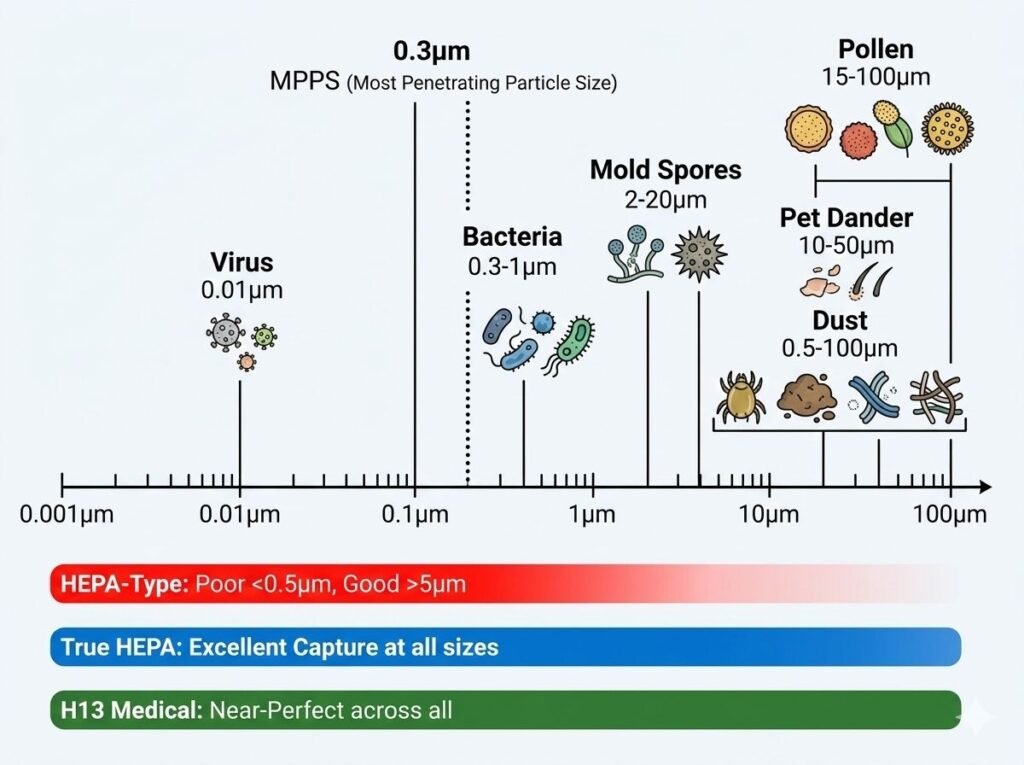
Particle Size Reference
0.001-0.01 μm: Individual virus particles (not relevant — viruses travel on larger droplets)
0.01-0.1 μm: Combustion particles, smoke, smog
0.3-1 μm: Bacteria, small mold spores, virus-containing respiratory aerosols
1-10 μm: Large mold spores, pollen fragments, fine dust
10-100 μm: Coarse dust, pollen grains, pet dander
HEPA-Type (85-95% at 0.3 μm)
Effectively filters: Pollen (15-100 μm), pet dander (10-50 μm), coarse dust
Partially filters: Mold spores (2-20 μm), fine dust (0.5-10 μm)
Poorly filters: Bacteria (0.3-10 μm), smoke particles (0.01-1 μm), combustion aerosols
Best for: Basic dust and large allergen reduction. Not suitable for smoke, bacteria, or viral respiratory aerosol concerns.
True HEPA (99.97% at 0.3 μm)
Effectively filters: Everything HEPA-type filters PLUS bacteria, most mold spores, combustion particles, most smoke
Partially filters: Very small smoke particles (< 0.1 μm), though still >90% capture
Best for: Allergies (pollen, dust mites, mold), asthma, general air quality, wildfire smoke
H13 Medical HEPA (99.95% at 0.3 μm)
Effectively filters: Everything True HEPA filters with marginally higher efficiency
Difference from True HEPA: Negligible in practice. Both capture >99.9% of residential air quality concerns.
Best for: Medical need (immunocompromised, severe asthma), peace of mind for those wanting highest available residential standard
H14 Medical HEPA (99.995% at 0.3 μm)
Effectively filters: Essentially 100% of particles down to 0.1 μm
Difference from H13: 10× better at MPPS but still >99.9% overlap in real-world capture
Best for: Hospital-grade filtration needs, infectious disease isolation
Matching HEPA Grade to Air Quality Needs
Allergies (Pollen, Dust Mites, Pet Dander)
Minimum recommended: True HEPA (99.97%)
Upgrade benefit: H13 provides marginal improvement (captures slightly more small mold spores and pollen fragments)
Not necessary: H14 provides no additional allergy benefit — the particles causing allergies are already >99.97% captured by True HEPA
Asthma
Minimum recommended: True HEPA
Upgrade benefit: H13 captures more smoke particles and fine dust that can trigger asthma
Worth considering: If asthma is severe or easily triggered, H13 provides measurable improvement in ultrafine particle capture
Mold Concerns
Minimum recommended: True HEPA
Upgrade benefit: H13 captures more small mold spores (1-3 μm range)
Note: HEPA filters don’t kill mold, they capture spores. You need UV-C or activated carbon in addition to HEPA to address mold toxins (VOCs).
Smoke (Wildfire, Cooking, Tobacco)
Minimum recommended: True HEPA
Upgrade benefit: H13 captures more ultrafine smoke particles (< 0.3 μm). Noticeable improvement in heavy smoke conditions.
Important: HEPA captures particulates but not gases. You need activated carbon for VOCs and odors.
Bacteria and Viral Respiratory Aerosols
Minimum recommended: H13 medical HEPA
Upgrade benefit: H14 provides 10× better capture of the most penetrating particle sizes (0.1-0.3 μm range where viral aerosols concentrate)
Best use case: Caring for immunocompromised individuals or isolating infectious disease patients
General Air Quality Improvement
Recommended: True HEPA (99.97%)
Upgrade benefit: None for general use. True HEPA already captures >99% of common indoor air pollutants.
Filter Lifespan and Replacement Timing
HEPA filter lifespan depends on air quality, usage hours, and particle loading. No universal replacement schedule exists despite manufacturer claims.
Factors Affecting Lifespan
Air pollution level: Heavily polluted environments (urban areas, wildfire regions, construction zones) load filters faster
Usage hours: Filters last longer with 8 hours/day use vs 24/7 continuous operation
Pre-filter quality: Good pre-filters (capturing large particles) extend HEPA life by preventing large particle loading
Filter quality: True HEPA with higher total surface area (more pleats) holds more particles before airflow drops
Signs Filters Need Replacement
Reduced airflow: Most obvious sign. Fan runs at normal speed but less air exits purifier.
Odors: Loaded HEPA can develop musty odor from trapped organic material (pollen, mold, bacteria) decomposing. Note: HEPA doesn’t filter odors — this is trapped particles decomposing, not filter saturation.
Visible darkening: HEPA turns gray/black as particles accumulate. Heavy darkening indicates replacement time.
Air quality not improving: If you’ve eliminated other pollution sources and air quality remains poor, filter may be saturated.
Manufacturer Replacement Intervals
Typical claim: 6-12 months
Reality: Marketing-driven and conservative. Many filters last 12-24 months in normal residential use.
Best practice: Replace when airflow noticeably decreases OR after 12-18 months even if airflow seems adequate (captured particles decompose and can become secondary pollutant source).
Don’t extend beyond: 24 months even if airflow seems fine — biological material trapped in filter degrades and can release particles.
Common HEPA Marketing Deception
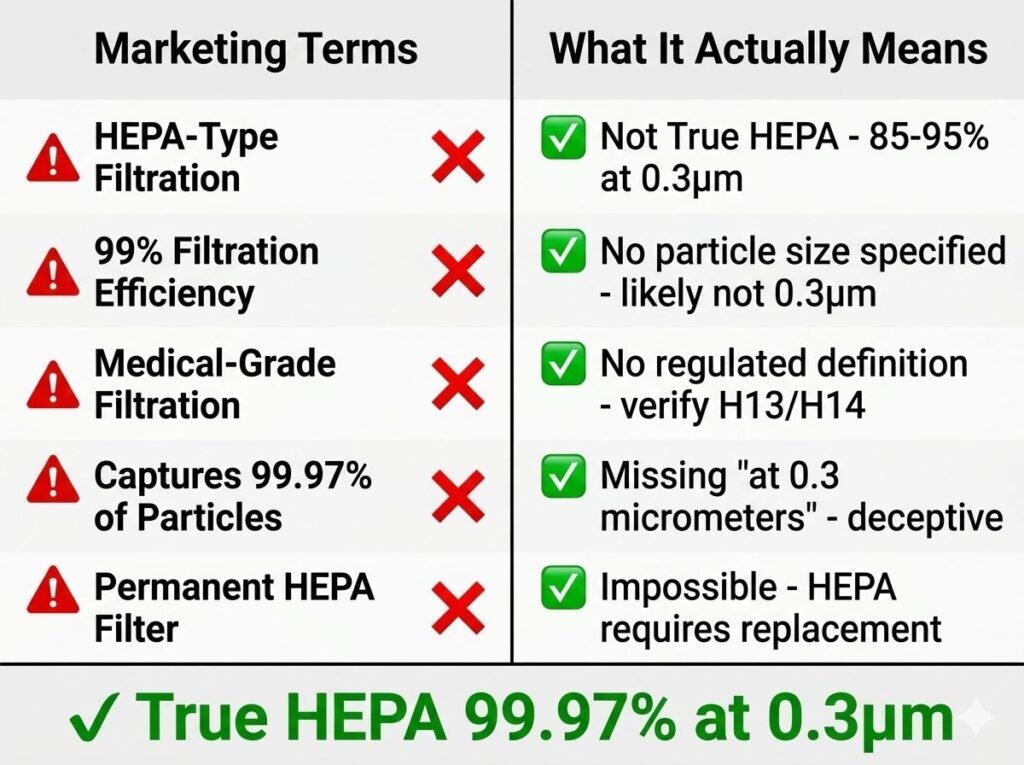
“99% Filtration Efficiency”
What it sounds like: Nearly as good as True HEPA’s 99.97%
Reality: Unspecified particle size. Could be 99% at 10 μm (easy to filter, meaningless for allergies) and only 50% at 0.3 μm.
Red flag: No particle size specified = not True HEPA
“HEPA-Type Filtration”
What it sounds like: HEPA technology
Reality: Doesn’t meet HEPA standards. Typically 85-95% at 0.3 μm — allowing 10-50× more particles through than True HEPA.
Red flag: Any qualifier before HEPA (“HEPA-type,” “HEPA-like,” “HEPA-style”) = not real HEPA
“Medical-Grade Filtration”
What it sounds like: Hospital-quality HEPA (H13/H14)
Reality: No regulated definition of “medical-grade.” Could be True HEPA or even HEPA-type with marketing spin.
How to verify: Look for explicit “H13” or “H14” rating. If not specified, assume standard True HEPA or worse.
“Captures 99.97% of Particles”
What it sounds like: True HEPA
Reality: Missing critical specification — “at 0.3 micrometers.” Could be 99.97% at 10 μm (trivial) and much lower at 0.3 μm.
Red flag: Percentage without particle size = likely deceptive marketing
“Permanent HEPA Filter — Never Replace”
What it sounds like: Cost savings
Reality: Impossible. HEPA filters load with particles and lose efficiency over time. “Washable HEPA” loses structure when washed, degrading performance. These are HEPA-type at best.
Fact: True HEPA cannot be washed without destroying fiber structure. All HEPA requires eventual replacement.
Frequently Asked Questions
Can HEPA filters be washed and reused?
No. True HEPA fiber structure is delicate. Water damages fiber bonds and collapses the random fiber matrix that enables filtration. “Washable HEPA” filters are HEPA-type (lower efficiency) made with more robust fibers that tolerate washing but don’t meet True HEPA standards even when new. Vacuum pre-filters to extend HEPA life, but replace HEPA when efficiency drops.
Do all air purifiers with HEPA filters work equally well?
No. Filter grade is only one factor. Air purifier effectiveness depends on: (1) Filter grade, (2) Fan power (CFM delivery), (3) Room air circulation, (4) Seal quality (preventing bypass). A cheap air purifier with True HEPA but weak fan may clean air slower than a quality unit with HEPA-type but powerful fan. Check CADR (Clean Air Delivery Rate) ratings, not just filter type.
Is H13 worth the extra cost over standard True HEPA?
For severe allergies, asthma, or immune compromise: yes, the 10× improvement in capturing 0.1-0.3 μm particles provides measurable health benefit. For general air quality and mild allergies: no, True HEPA already captures >99% of relevant particles. The improvement is real but clinically insignificant for healthy individuals.
Can HEPA filters remove odors?
No. HEPA captures particles, not gases or odors. Odors are volatile organic compounds (VOCs) — molecules in gas phase. You need activated carbon filters for odor removal. Many air purifiers combine HEPA (particles) + carbon (odors/VOCs) for comprehensive filtration.
Do HEPA filters kill bacteria and viruses?
HEPA captures and traps them but doesn’t kill them. Trapped microorganisms remain viable on filter media. This is irrelevant for air quality — captured particles don’t re-enter air. UV-C lamps (sometimes included in air purifiers) kill trapped microorganisms, but this is unnecessary for particle removal effectiveness. HEPA trapping is sufficient.
Why do some HEPA filters cost $100+ while others cost $20?
True HEPA costs $30-100 for residential air purifiers depending on size and total surface area. Extremely cheap “HEPA” filters (<$20) are usually HEPA-type (not True HEPA). High-end HEPA ($80-150) may be H13 medical grade, have activated carbon layers, or use premium materials for longer lifespan. Check specifications — ensure it’s True HEPA before judging cost.
Key Takeaways
True HEPA requires minimum 99.97% capture efficiency at 0.3 micrometers — the most penetrating particle size. Terms like “HEPA-type,” “HEPA-like,” and “HEPA-style” are marketing language for filters that don’t meet this standard and typically capture only 85-95% at 0.3 μm — allowing 10-167× more particles to pass than True HEPA. The difference is clinically significant for allergy and asthma sufferers.
European H13 (99.95% at MPPS) and H14 (99.995%) medical-grade HEPA filters exceed U.S. True HEPA standards. H13 provides measurable improvement in capturing ultrafine particles (0.1-0.3 μm) relevant for severe allergies and asthma. H14 is hospital-grade and unnecessary for residential use unless caring for immunocompromised individuals or isolating infectious diseases.
HEPA filter effectiveness depends on entire air purifier system — fan power to overcome pressure drop, seal quality to prevent bypass, and room air circulation rate. A True HEPA filter in an underpowered purifier may clean air slower than HEPA-type in a powerful unit. Check Clean Air Delivery Rate (CADR) alongside filter grade for actual performance.
HEPA filters capture particles but don’t remove odors (requires activated carbon), kill microorganisms (trapping is sufficient — UV-C unnecessary), or last forever (all require eventual replacement when loaded with particles). Typical residential lifespan is 12-24 months depending on air quality and usage. Reduced airflow is the primary replacement indicator.
Related guides: