
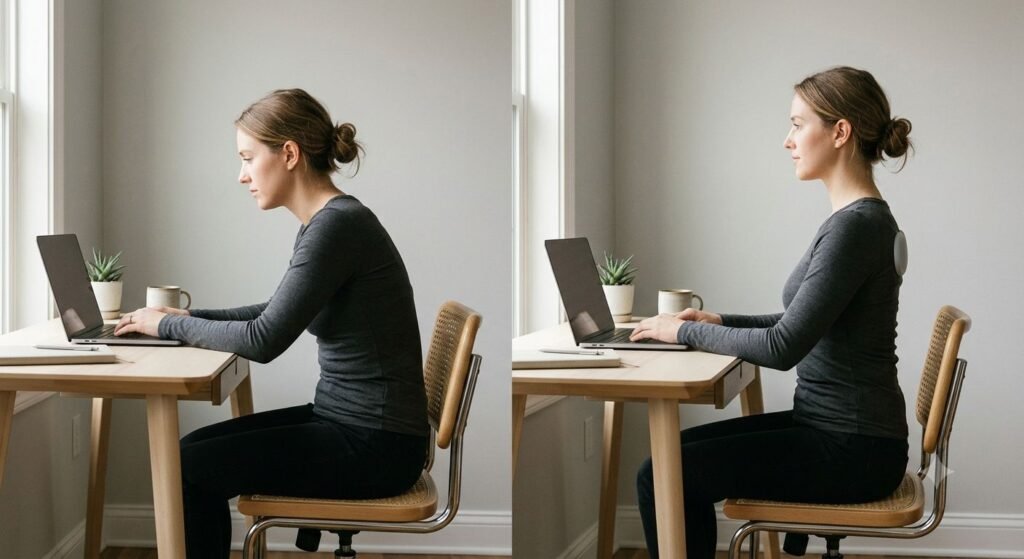
Poor posture has become one of the more medicalised aspects of modern sedentary life. The combination of desk work, smartphone use, and prolonged sitting has produced a generation of people who spend significant portions of their day with rounded shoulders, forward head position, and compressed lumbar spines — and a market of products promising to fix it. Wearable posture correctors occupy a specific and contested corner of that market: devices that either physically hold the body in a corrected position or detect poor posture and alert the wearer to correct it themselves.
The category ranges from simple elastic braces that pull the shoulders back to sensor-equipped smart devices that track spinal curvature, vibrate when you slump, and log your posture data to an app over time. The marketing across the category is confident. The scientific evidence is considerably more nuanced.
This article works through what posture actually is and why it matters, what the research says about wearable posture correctors specifically, who is most likely to benefit, and which devices are worth considering in 2026. It is written with the same commitment to honesty about evidence as the rest of this series — including being clear when the research doesn’t support the claims being made.
What Posture Actually Is and Why It Matters
Posture is the position in which the body holds itself against gravity — both statically, when still, and dynamically, during movement. Good posture is not a rigid military-straight position with shoulders pinned back and spine ramrod vertical. It is the configuration in which the musculoskeletal system is under minimal strain to maintain alignment — where the head is balanced over the shoulders, the shoulders over the hips, and the natural curves of the spine are maintained without excessive deviation.
The three natural curves of the spine — the cervical lordosis at the neck, the thoracic kyphosis at the mid-back, and the lumbar lordosis at the lower back — exist for good mechanical reasons. They distribute the compressive load of gravity and movement across the vertebral column rather than concentrating it at specific points. When these curves are exaggerated or reduced by habitual posture patterns, load distribution changes in ways that can contribute to pain, fatigue, and over time, structural adaptation.
Forward head posture — where the head sits in front of rather than directly over the shoulders — is among the most common posture deviations in desk workers and smartphone users. For every inch the head moves forward from its neutral position, the effective load on the cervical spine increases significantly — a head that weighs roughly 10 to 12 pounds in neutral position exerts the mechanical equivalent of 40 to 60 pounds of force on the cervical spine when held 3 to 4 inches forward. This loading pattern is associated with neck pain, upper back tension, and headaches in populations that spend extended time in this position.
Thoracic hyperkyphosis — excessive rounding of the upper back — is associated with shoulder pain, rotator cuff problems, and reduced respiratory capacity in severe cases. Lumbar hypolordosis — loss of the natural inward curve of the lower back during sitting — is associated with lower back pain, disc loading, and hip flexor tightening.
The mechanism by which poor posture causes pain is not simply mechanical loading. Sustained positioning in poor alignment produces adaptive changes: some muscles become chronically shortened and tight, their antagonists become lengthened and weakened. This muscular imbalance perpetuates the postural deviation even when the person is aware of it and trying to correct it — which is why simply being told to “sit up straight” rarely produces lasting change.
The Two Categories: Passive Braces vs Active Smart Devices
Passive posture correctors
Passive posture correctors are physical devices — elastic bands, shoulder straps, braces, and harnesses — that physically pull or hold the body in a more aligned position. They work by creating mechanical resistance to slouching: when the wearer rounds their shoulders or hunches forward, the brace creates tension that provides proprioceptive feedback and physically restricts further deviation. They require no electronics, no batteries, and no app — you put them on and they do their job immediately.
The mechanism of passive braces is straightforward, and they do what they claim in the short term: while wearing one, your shoulders are pulled back and your thoracic posture is improved. The research question is whether this produces lasting change when the device is removed, or whether it simply provides an external crutch that the musculoskeletal system adapts to rather than internalising.
Active smart posture devices
Active smart posture devices use sensors — typically accelerometers, gyroscopes, or strain gauges — to detect the position of the body segment they’re attached to. When the device detects that posture has deviated from a calibrated baseline, it alerts the wearer — usually through vibration — prompting conscious correction. The data is logged to a companion app, which shows posture trends over time, daily scores, and progress metrics.
The mechanism here is biofeedback — using real-time data about body position to increase conscious awareness of posture and prompt voluntary correction. The theory is that frequent, timely feedback eventually trains the wearer to maintain better posture habitually, making the device progressively less necessary as the habit becomes internalised. Whether this theory is borne out in practice is the central research question for this category.
What the Research Actually Says
The evidence for passive braces
Research on passive posture braces has produced mixed results, and the quality of available studies is generally modest — small sample sizes, short durations, and variable outcome measures.
Short-term studies consistently show that wearing a posture brace improves postural alignment while the brace is in use. This is expected — the mechanical effect is immediate and direct. The more important question is whether brace use produces lasting postural improvement after removal, and here the evidence is substantially weaker.
A concern raised in multiple studies and clinical discussions is dependency: when the back muscles and postural stabilisers are partially offloaded by a brace, they may become less active over time — a use-it-or-lose-it effect that potentially worsens the underlying muscular imbalance that contributes to poor posture. This concern is not uniformly supported by evidence but is sufficiently documented to be taken seriously. Most physiotherapy guidance recommends that if braces are used at all, they should be used for limited periods and in conjunction with active exercises that strengthen the postural muscles the brace is temporarily supporting.
For acute pain management — specifically upper back and neck pain associated with poor posture during a symptomatic flare — short-term brace use may provide relief by reducing muscular load. As a rehabilitation or habit-change tool, the evidence is less convincing.
The evidence for active smart devices
The biofeedback approach has a more theoretically compelling mechanism than the passive brace, and there is emerging evidence that real-time postural feedback can improve awareness and reduce time spent in poor posture during the period of use. Studies on specific devices — including the Upright Go and Lumo Lift — have found that users spend meaningfully more time in good posture during periods of device use compared to control conditions without feedback.
The more important question — whether the posture improvements persist after the device is stopped or whether users relapse to baseline — has fewer high-quality studies addressing it. A 2017 study on wearable posture biofeedback found significant improvement in postural awareness and neck pain during device use, with some persistence of improvement at two-week follow-up. Longer-term follow-up data is limited.
A systematic review published in the Journal of Physical Therapy Science found that wearable posture feedback devices produced short-term improvements in posture and related pain measures but noted that the evidence for sustained change beyond the period of active device use was insufficient to draw firm conclusions. This pattern — clear benefit during use, uncertain durability after use — is consistent across the available literature.
The honest summary of the research is this: active smart posture devices produce real short-to-medium-term improvements in postural awareness and time spent in good posture during use. Whether they produce lasting change that persists after device use ends is not yet well-established. For anyone using a posture device to manage pain or build habit, treating it as a tool alongside strength training and movement rather than a standalone solution is supported by the evidence; treating it as a permanent requirement for maintaining good posture may indicate that the underlying muscular and movement habits haven’t been adequately addressed.
The comparison with exercise-based interventions
The most robust evidence in the postural correction literature supports exercise-based interventions — specifically, strengthening of the thoracic extensors, deep cervical flexors, rotator cuff, and scapular stabilisers alongside stretching of pectorals, hip flexors, and cervical extensors. Multiple randomised controlled trials have demonstrated that targeted exercise programmes produce lasting improvements in posture and associated pain that persist beyond the exercise period.
This does not mean wearable devices are without value — the compliance problem with exercise programmes is real, and a device that keeps posture improvement consistently in the user’s awareness during a period of habit change may facilitate the broader behaviour changes that include exercise. But it does mean that a device used as a substitute for addressing the muscular imbalances underlying poor posture is unlikely to produce the sustained results that exercise-based approaches can.
Who Is Most Likely to Benefit
Desk workers with recently developed postural habits
People who have recently transitioned to long hours of desk work and are developing awareness of posture problems — but haven’t yet had years of muscular adaptation to a poor pattern — are among the most likely to benefit from a biofeedback device. The earlier in the development of a postural habit an intervention occurs, the less muscular and structural adaptation there is to reverse. A smart posture device used during the first few years of desk-intensive work, alongside a deliberate programme of postural strengthening exercises, represents a reasonable evidence-informed approach.
People who have awareness but not habit
Some people have good knowledge of what correct posture looks like and can achieve it voluntarily when they think about it — the problem is that they stop thinking about it within minutes of returning to a task. For this group, the primary barrier is not knowledge or physical capability but attentional consistency. Biofeedback devices address exactly this barrier: they provide the reminder that the person already knows they need. This is a genuinely useful application.
Post-physiotherapy maintenance
Following a course of physiotherapy that includes postural correction as a component, a wearable device can serve as a maintenance tool — reinforcing the postural habits and proprioceptive awareness developed during supervised treatment. In this context the device is supplementing and extending professional intervention rather than replacing it, which is a more defensible use case than standalone device use without professional assessment.
People with sedentary jobs seeking to manage upper back and neck discomfort
For individuals experiencing mild to moderate upper back and neck discomfort associated with desk work, a smart posture device used as part of a broader approach — including ergonomic assessment, movement breaks, and targeted exercises — may contribute meaningfully to symptom management. The expectation should be improved awareness and reduced time in provocative positions rather than resolution of the underlying pain, which typically requires addressing muscular imbalances more directly.
The Limitations That Marketing Doesn’t Mention
Vibration fatigue and alert dismissal
One of the most consistently reported issues with vibration-based posture feedback devices is that users adapt to the alerts. Initially, a vibration prompts immediate correction. Over weeks, as the novelty decreases, vibrations are increasingly ignored, unconsciously dismissed, or turned off. This is the same habituation phenomenon that affects alarm-based systems generally — the alert becomes background noise rather than a behavioural prompt. Studies have found that engagement with posture biofeedback devices tends to peak in the first weeks and decline significantly over months of use.
Device manufacturers address this in various ways — variable vibration patterns, gamification of posture scores, social sharing features — but the fundamental challenge of maintaining long-term engagement with a reminder system is not fully solved by any current consumer product. The devices are most effective when used intentionally for defined periods rather than indefinitely as a passive background system.
Calibration and individual variation
Smart posture devices calibrate their baseline against the position the user adopts during setup — the position taken at calibration becomes the device’s definition of “good posture.” If the user calibrates in a suboptimal position, the device will reinforce that suboptimal position. Individual anatomical variation — the natural degree of thoracic kyphosis varies significantly between healthy individuals — means that a standardised definition of “good posture” encoded in a device algorithm may not reflect what is optimal for a specific person’s anatomy.
For users without a professional posture assessment, the calibration baseline is essentially self-selected. Devices that allow calibration guidance from a physiotherapist or use AI-driven adaptive baselines address this partially — but most consumer devices rely on user-initiated calibration without professional input.
The monitoring vs fixing distinction
A persistent confusion in marketing for smart posture devices is the elision between monitoring posture and improving posture. A device can accurately detect and report that the user spends 40% of their workday in poor posture. This is useful data. Whether this data translates into lasting postural improvement depends entirely on what the user does with it — specifically whether it motivates the exercise, movement breaks, and ergonomic changes that actually address the underlying problem. The device monitors; the user acts. Many users track their posture score without making the behavioural changes that would improve it.
Not suitable for all causes of pain
Poor posture is one contributor to neck and back pain but is far from the only one. Disc pathology, facet joint dysfunction, nerve entrapment, myofascial trigger points, and psychosocial factors all contribute to spinal pain in ways that postural correction does not address. Using a posture device to self-manage pain without professional assessment risks missing diagnoses that require different treatment. Anyone with significant, persistent, or worsening pain should seek clinical evaluation rather than assuming it has a postural cause.
The Best Posture Correctors in 2026
Upright Go 2
Best Smart Posture Device: Proven Biofeedback, Mature App
| Specification | Detail |
|---|---|
| Type | Active smart device — skin-adhesive sensor |
| Placement | Upper back (adheres between shoulder blades) |
| Sensors | Accelerometer, gyroscope |
| Feedback | Vibration |
| Connectivity | Bluetooth |
| App | Upright app (iOS and Android) |
| Battery life | Up to 7 days |
| Water resistance | Splash resistant |
| Training programmes | Yes — progressive daily sessions |
| Warranty | 1 year |
The Upright Go 2 is the most established and most studied consumer posture biofeedback device available. It adheres to the upper back between the shoulder blades using a medical-grade adhesive, calibrates to the user’s upright sitting position, and vibrates when the torso deviates from that baseline. The compact, discreet form factor — about the size of a large USB stick — sits invisibly under clothing and is light enough that most users stop noticing it after initial wear.
The Upright app is the most mature in the posture device category, with progressive training programmes that start with shorter posture sessions and build gradually — an approach that reduces the habituation problem by treating the device use as a structured training protocol rather than passive monitoring. The training mode runs for defined daily sessions rather than continuously, which is consistent with the evidence suggesting that intensive short sessions are more effective than continuous low-intensity feedback for habit formation.
The seven-day battery life is the best in this roundup and means the device can be worn for a full working week before recharging. The adhesive reuse policy allows the same device to be repositioned and reattached multiple times — replacement adhesive strips are available as consumables.
The placement between the shoulder blades targets thoracic posture specifically — it is most responsive to upper back rounding and less sensitive to forward head position or lumbar posture. Users whose primary concern is lower back posture or head position rather than upper back will find the Upright Go 2 less directly relevant.
Pros:
- Most established consumer posture biofeedback device with the largest independent research base
- Progressive training programmes address habituation better than continuous monitoring
- Seven-day battery life — full working week without recharging
- Discreet under-clothing placement — invisible during wear
- Mature app with clear data visualisation and trend tracking
Cons:
- Adhesive placement on skin may cause irritation with extended use
- Targets upper back primarily — less effective for neck or lower back posture
- Adhesive strips are consumables that require ongoing purchase
- Single-sensor design cannot fully characterise whole-spine posture
- One-year warranty
Who Should Buy This:
Desk workers whose primary postural concern is upper back rounding and forward shoulder position. Anyone who wants a structured, progressive training approach rather than passive continuous monitoring. Users who have tried passive braces without lasting benefit and want the biofeedback approach.
Who Should Skip This:
Users whose primary concern is lower back posture or forward head position. Those with skin sensitivity who may react to prolonged adhesive contact. Anyone looking for a device that doubles as a physical posture aid rather than a feedback-only tool.
Upright Pro
Best for Whole-Spine Tracking: Dual Sensor, More Complete Data
| Specification | Detail |
|---|---|
| Type | Active smart device — dual sensor |
| Placement | Upper back and lower back simultaneously |
| Sensors | Dual accelerometers and gyroscopes |
| Feedback | Vibration |
| Connectivity | Bluetooth |
| App | Upright app (iOS and Android) |
| Battery life | Up to 7 days |
| Water resistance | Splash resistant |
| Training programmes | Yes — progressive daily sessions |
| Warranty | 1 year |
The Upright Pro addresses one of the core limitations of single-sensor posture devices: a sensor placed on the upper back cannot characterise lumbar posture, and a complete picture of spinal alignment requires information from multiple points along the spine. The Pro uses two sensors — one on the upper back and one on the lower back — to produce a more complete characterisation of sitting posture, including whether the user is maintaining lumbar lordosis or flattening their lower back during sitting.
This dual-sensor approach is relevant for users who suspect their postural issues involve both upper and lower back — a common pattern in desk workers who simultaneously lose lumbar lordosis and round the thoracic spine when fatiguing in a seated position. The lower back sensor placement can be initially more noticeable under clothing than the upper back sensor alone.
The app experience is the same Upright platform as the Go 2 — the same training programmes, trend data, and session structure. The Pro generates richer data by virtue of the dual sensors, with separate upper and lower back posture scores that allow users to identify which region is the primary source of their postural deviation.
The price premium over the Go 2 is modest and is justified for users with lower back concerns or those who want the most complete posture data available from a consumer wearable.
Pros:
- Dual-sensor design provides upper and lower back posture data simultaneously
- More complete spinal posture picture than any single-sensor device
- Same mature Upright app platform as Go 2 — progressive training programmes
- Seven-day battery life
- Relevant for both upper and lower back postural concerns
Cons:
- Two adhesive placements mean two potential sites of skin irritation
- Lower back sensor placement more noticeable under clothing than upper back alone
- More complex calibration required for dual-sensor accuracy
- Higher consumable adhesive cost than single-sensor devices
- One-year warranty
Who Should Buy This:
Users with both upper and lower back postural concerns who want comprehensive spinal monitoring. Anyone who has used a single-sensor device and found it insufficient for characterising their full postural pattern. Physiotherapy patients who want to monitor whole-spine posture during a rehabilitation programme.
Who Should Skip This:
Users whose postural concern is exclusively upper back — the Go 2 is sufficient and more affordable. Those particularly sensitive to skin adhesives. Anyone who wants a simpler, less data-intensive monitoring approach.
Evoke Smart Posture Trainer
Best Clip-On Option: No Adhesive, Versatile Placement
| Specification | Detail |
|---|---|
| Type | Active smart device — clip attachment |
| Placement | Collar, neckline, or upper back of clothing |
| Sensors | Accelerometer, gyroscope |
| Feedback | Vibration |
| Connectivity | Bluetooth |
| App | Evoke app (iOS and Android) |
| Battery life | Up to 5 days |
| Water resistance | Splash resistant |
| Training programmes | Yes — goal-based daily targets |
| Warranty | 1 year |
The Evoke Smart Posture Trainer addresses the adhesive sensitivity issue that affects some users of skin-mounted posture devices by using a clip attachment — it fastens to the collar, neckline, or upper back of clothing rather than adhering directly to skin. This makes it more accessible for users with skin sensitivities, more repositionable for different clothing types, and eliminates the consumable adhesive cost of skin-mounted alternatives.
The clip attachment introduces its own variable: sensor readings are affected by clothing movement, fabric elasticity, and how consistently the clip maintains its position throughout the day. For tightly fitted clothing in professional settings, performance is consistent. For looser clothing or casual wear where the clip may shift, readings are less reliable. This is an important practical consideration — the device performs best in the clothing contexts where it is most likely to be used in office environments.
The Evoke app uses a goal-based daily target system rather than Upright’s progressive training sessions — users set a daily posture goal (percentage of time in good posture) and receive feedback on progress throughout the day. The approach is less structured than Upright’s training protocol but more flexible for users who want to monitor across a full day rather than structured sessions.
Pros:
- No skin adhesive — suitable for users with skin sensitivities
- No consumable adhesive costs — the device is reusable indefinitely
- Versatile clip placement across different clothing types
- Goal-based monitoring suitable for full-day rather than session-based use
- Competitive price point relative to adhesive-based alternatives
Cons:
- Clip placement on clothing introduces variability that skin adhesion does not
- Performance less consistent with loose or casual clothing
- Five-day battery life shorter than Upright Go 2
- Less established research base than Upright devices
- App less mature than Upright’s platform
Who Should Buy This:
Users who have skin sensitivities that make adhesive placement impractical. Anyone who wants a posture device without ongoing consumable costs. Users who wear consistent clothing types (professional office dress) where clip placement is stable.
Who Should Skip This:
Users who wear varied clothing types including loose-fitting casual wear where clip stability is reduced. Anyone who wants the most research-backed device in the category — Upright has a larger clinical validation literature. Those who prefer a structured training programme over goal-based monitoring.
BackEmbrace Posture Corrector
Best Passive Brace: Comfortable, Discreet Under Clothing
| Specification | Detail |
|---|---|
| Type | Passive posture brace |
| Design | Figure-of-eight elastic shoulder straps with back panel |
| Target | Thoracic posture — shoulder retraction |
| Wearing duration | Recommended 15–30 minutes initially, building to 1–2 hours |
| Sizing | XS through XL |
| Material | Breathable elastic and neoprene blend |
| Electronics | None |
| Washable | Yes |
| Warranty | 30-day return policy |
The BackEmbrace is the most comfortable and discreet passive posture brace in this roundup. The figure-of-eight elastic strap design pulls the shoulders back and down without the bulky rigid panels that make many posture braces uncomfortable under clothing. The breathable material blend reduces heat buildup compared to solid neoprene competitors. It can be worn under a shirt without visible lines — a practical requirement for office use.
Passive braces should be approached with clear expectations: the BackEmbrace provides postural correction while worn, offers proprioceptive feedback at the limit of forward shoulder movement, and does not independently produce lasting postural change without accompanying exercise. The manufacturer’s recommendation to limit initial wear to 15 to 30 minutes and build gradually reflects awareness of the dependency concern — a brace worn all day provides more passive support than the postural muscles are exercising against, potentially reducing their activation rather than developing it.
For occasional use — during long drives, extended screen time, or as a reminder tool during specific activities — a passive brace is a reasonable, inexpensive, and low-tech option. For continuous daily wear as a posture solution, the evidence does not support it as a standalone intervention.
Pros:
- Comfortable, breathable design suitable for hours of wear
- Discreet under office clothing — no visible bulk
- Simple, low-maintenance — no battery, no app, no calibration
- Inexpensive compared to smart devices
- Machine washable — hygienic for regular use
Cons:
- Does not produce lasting postural change as a standalone intervention
- Risk of postural muscle deactivation with extended daily wear
- No feedback data — no awareness of how much time is spent in poor posture
- Targets shoulder retraction specifically — does not address head position or lumbar posture
- Effectiveness entirely limited to periods of wear
Who Should Buy This:
Anyone who wants the simplest, lowest-cost posture awareness tool for occasional use. Users who want a short-term aid during acute upper back discomfort. Those who have already established good postural habits through exercise and want occasional mechanical support during specific high-risk activities.
Who Should Skip This:
Anyone expecting lasting postural change from brace use alone — the evidence does not support this. Users who want data on their posture patterns over time. Those with lower back or neck-specific postural concerns.
Lumo Lift
Best for Neck and Shoulder Focus: Magnetic Clip, Lightweight
| Specification | Detail |
|---|---|
| Type | Active smart device — magnetic clip |
| Placement | Upper chest / clavicle region (clips to clothing) |
| Sensors | Accelerometer |
| Feedback | Vibration |
| Connectivity | Bluetooth |
| App | Lumo Body Tech app (iOS and Android) |
| Battery life | Up to 5 days |
| Water resistance | Splash resistant |
| Training programmes | Basic — step and posture goals |
| Warranty | 1 year |
The Lumo Lift clips magnetically to clothing near the upper chest and clavicle — a placement position that senses forward head and shoulder position differently from upper-back-mounted devices. This positioning makes it more responsive to the forward rounding of the upper chest and shoulder that accompanies the head-forward posture pattern common in smartphone users and people who look down at keyboards or documents, rather than primarily thoracic rounding.
The magnetic clip mechanism is one of the most convenient attachment systems in this roundup — clipping on and off clothing takes seconds and works reliably without adhesive. The device is small and lightweight, often described by users as the most forgettable posture device in terms of physical presence during wear.
The Lumo app is functional but less developed than the Upright platform — step counting and basic posture goals are the primary features, with trend data presented without the structured training progressions that Upright offers. For users who want a simple, low-complexity monitoring experience rather than a guided training protocol, this is a fit. For users who want the most structured, evidence-informed training approach, Upright remains the stronger choice.
Pros:
- Magnetic clip placement near the upper chest — responds to forward head and shoulder pattern
- Most convenient attachment mechanism in this roundup — clips on and off instantly
- Lightweight and physically forgettable during wear
- No adhesive — suitable for users with skin sensitivities
- Competitive price point
Cons:
- Less mature app and training programme than Upright
- Single accelerometer — less complete posture data than dual-sensor alternatives
- Clip position on upper chest can be more visible under thin or fitted clothing than back-mounted alternatives
- Less published clinical validation than Upright Go 2
- Step counting feature adds little value for a posture-focused purchase
Who Should Buy This:
Users whose primary postural concern is forward head position and upper chest collapse rather than thoracic rounding. Anyone who wants the most convenient, adhesive-free attachment mechanism. Users who want a simple monitoring experience without a structured training protocol.
Who Should Skip This:
Users who want a structured, progressive training programme — the Upright Go 2 is better suited. Those whose primary concern is mid-to-lower thoracic or lumbar posture. Anyone who wants the most clinical validation behind their device choice.
Side-by-Side Comparison Table
| Product | Type | Placement | Sensors | Feedback | Battery | App Quality | Best For |
|---|---|---|---|---|---|---|---|
| Upright Go 2 | Smart — adhesive | Upper back | Single | Vibration | 7 days | Best in category | Upper back biofeedback, training |
| Upright Pro | Smart — adhesive | Upper + lower back | Dual | Vibration | 7 days | Best in category | Whole-spine monitoring |
| Evoke Posture Trainer | Smart — clip | Clothing collar/back | Single | Vibration | 5 days | Good | No-adhesive smart monitoring |
| BackEmbrace | Passive brace | Shoulders | None | Mechanical | N/A | None | Simple, low-cost occasional use |
| Lumo Lift | Smart — magnetic clip | Upper chest | Single | Vibration | 5 days | Basic | Forward head and chest focus |
What to Look For When Buying
Active feedback vs passive correction
The choice between a biofeedback device and a passive brace is the most consequential purchase decision in this category and should be made based on what you are trying to achieve. If you want data, habit training, and progressive improvement over weeks, a smart device is appropriate. If you want immediate mechanical support during specific activities with no technology involved, a passive brace is appropriate. Buying a passive brace expecting long-term postural change, or buying a smart device expecting it to physically correct your posture, leads to disappointment in both cases.
Placement and target posture region
Different devices target different parts of the spine based on where the sensor or brace sits. Upper-back-mounted devices target thoracic rounding. Chest-mounted devices target forward head and shoulder collapse. Dual-sensor devices capture both. Identify which postural deviation is your primary concern before choosing a device — if you’re unsure, a brief consultation with a physiotherapist will give you a more accurate assessment than self-diagnosis from a mirror.
Adhesive vs clip attachment
Adhesive-based devices maintain consistent sensor contact with the body and provide more stable readings — they work well for users without skin sensitivities who are comfortable with daily adhesive application. Clip-based devices are more convenient, reusable without consumables, and suitable for users with sensitive skin, but introduce variability from clothing movement. Both types have legitimate use cases — match to your practical preferences and skin tolerance.
App quality and training structure
For smart devices, the app is a significant part of the product. A device with poor app design, unreliable data, or no structured training programme is less likely to produce meaningful behaviour change than one with a thoughtfully designed progressive training protocol. Review app screenshots, current user reviews for app reliability, and whether the training approach matches your preferred engagement style before purchasing.
Realistic expectations
No posture device — passive or smart — eliminates the need to address the muscular imbalances that underlie chronic poor posture. Set realistic expectations: a smart device can increase awareness and reduce time in poor posture during use. A passive brace can provide support and proprioceptive feedback during wear. Neither replaces strengthening exercises, movement breaks, and ergonomic improvements. The best posture device is one used alongside these interventions rather than instead of them.
Frequently Asked Questions
Do posture correctors actually work long-term?
The evidence supports short-to-medium-term improvements in postural awareness and time spent in good posture during device use. Long-term change that persists after device use ends has less robust evidence behind it. Smart biofeedback devices used as part of a broader approach — including targeted strengthening exercises and ergonomic improvements — are most likely to produce lasting change. Passive braces used alone as a long-term posture solution are not well-supported by current evidence and carry the risk of reducing postural muscle activation.
How long should I wear a posture corrector each day?
For smart biofeedback devices, the Upright training approach of starting with 15 to 30-minute daily sessions and building gradually is more evidence-consistent than wearing the device all day from the start. For passive braces, most physiotherapy guidance recommends starting with short periods — 15 to 30 minutes — and not exceeding one to two hours of daily wear, particularly in early use. All-day wear of a passive brace is not recommended and potentially counterproductive due to postural muscle offloading.
Can a posture corrector fix forward head posture?
Forward head posture has both habitual and structural components. The habitual component — the learned pattern of holding the head forward — can be addressed through biofeedback, exercise, and ergonomic correction over time. The structural component — adaptive shortening of posterior cervical muscles and lengthening of deep flexors — requires targeted exercise (specifically deep cervical flexor strengthening) that a wearable device cannot provide directly. A device that places the sensor near the upper chest and responds to head-forward position is more relevant for this pattern than a device mounted on the upper back.
Should I see a physiotherapist before buying a posture corrector?
For mild posture awareness improvement in the context of desk work, a consumer posture device is a reasonable self-directed starting point. For significant or persistent pain, recurring episodes of neck or back symptoms, or uncertainty about what is causing your postural issues, professional assessment before purchasing is advisable. A physiotherapist can identify the specific muscles that are weak or tight, assess whether a postural device is appropriate for your presentation, assist with calibration, and design an exercise programme that addresses the underlying causes rather than just the surface symptom.
Are posture correctors safe?
For most users, posture devices are safe for the recommended periods of use. Skin adhesive devices may cause irritation or allergic reactions in users with sensitive skin — patch testing before extended use is advisable. Passive braces worn for extended periods may reduce postural muscle activation — following manufacturer recommendations for limited daily wear is important. Anyone with existing spinal pathology — disc disease, spinal stenosis, scoliosis, or recent spine surgery — should consult a clinician before using any posture correction device, as the appropriate postural targets may differ from healthy population norms.
What exercises work best alongside a posture corrector?
The exercises with the strongest evidence for improving thoracic posture and associated pain are thoracic extension exercises (chin tucks, thoracic extensions over a foam roller), scapular retraction and depression exercises (rows, face pulls), deep cervical flexor strengthening (chin tucks with resistance), and pectoral and hip flexor stretching. These address the primary muscular imbalances — weak scapular stabilisers and thoracic extensors, tight pectorals and anterior cervical muscles — that contribute to the posture patterns most posture devices target. A physiotherapist can prescribe the specific exercises most relevant to your individual pattern.
Our Verdict
Wearable posture correctors occupy a legitimate space in the toolkit for people who want to improve their posture — but with important qualifications about what they can and cannot do, and how they are most effectively used.
The evidence supports smart biofeedback devices for increasing postural awareness and reducing time in poor posture during device use. The Upright Go 2 is the device with the most research behind it, the most mature app, and the most structured training approach in the consumer category — it is the default recommendation for desk workers who want a biofeedback-based posture intervention. The Upright Pro is the appropriate upgrade for users who want whole-spine monitoring across both upper and lower back. The Evoke is the practical choice for users with skin sensitivities who want smart monitoring without adhesive. The Lumo Lift is worth considering for users whose primary concern is forward head and upper chest posture rather than mid-back rounding.
Passive braces like the BackEmbrace have a role as a low-cost, low-tech tool for occasional proprioceptive support during specific activities — long drives, extended screen sessions, or acute discomfort flares. They are not supported by evidence as a long-term posture correction solution when used alone, and the risk of postural muscle deactivation with extended daily wear is a genuine concern.
The most important conclusion from the evidence is consistent: no wearable device substitutes for addressing the muscular imbalances that cause and perpetuate poor posture. Strengthening the thoracic extensors and scapular stabilisers, stretching the pectorals and hip flexors, taking regular movement breaks, and optimising workstation ergonomics are the interventions with the most durable evidence for lasting postural improvement. A well-chosen posture device, used as a training tool alongside these interventions and with realistic expectations, is a sensible addition to that programme — not a replacement for it.